31 August 2006

And on a lighter note...

Many bloggers shw the results of Blogthings quizzes. Ah well why not try a few of these tests myself and see how they come out.

Your IQ Is 140

Your Logical Intelligence is Below Average

Your Verbal Intelligence is Genius

Your Mathematical Intelligence is Genius

Your General Knowledge is Genius

Hah! Music to my ears, Pander to that ego of mine!!!! MORE, MORE, MORE!!!


You Are a Liberal for Life


You've got a bleeding heart - and you're proud of it.

For you, liberal means being compassionate, pro-government, and anti-business.

You believe in equality for every person, and you consider yourself universally empathetic.

Helping others is not just political for you ... it's very personal too.


Again, fair enough... I probably wouldn't use liberal, but pretty accurate..


You Are 68% Evil

You are very evil. And you're too evil to care.
Those who love you probably also fear you. A lot.
How Evil Are You?

68% evil??? If I am that evil then Ned Flanders is Beelzebub made flesh.. Ah well I suppose I had better change my name to Auric Pullmyfinger and get on with my plan for domination of the Blogospere.... No Mister Bond I expect you to die, Mwuahahahaha


You're 35% Irish

You're probably less Irish than you think you are...
But you're still more Irish than most.

So that Harp on my passport is an illusion then.. Listen America, sticking washing up liquid in your beer to turn it green does not make you Irish, or Oirish for that matter, it makes you ILL!!

Ah these tests are not serious..........

WHAT IF?

I am a bit of a sucker for “what if” alternate histories Perhaps this is why I love Harry Turtledove’s World War/Colonisation (lizard race sends a probe to mediaeval earth but leave it a few centuries before invasion, landing bang in the middle of WWII!) and Great War/Settling Accounts (Confederates win the civil war so two there is the USA and CSA which fight on opposing sides in WWI and WWII) , series and the Changing the Times website. I must get hold of the current issue of Focus, a popular science magazine, which sets out a fascinating series of counterfactual scenarios. Today’s Independent sets out a few of these scenarios, including these:

1348: The Black Death is averted

In the 14th century, the Black Death came out of the heart of Asia. It affected all of Europe within a few years. In cities such as London, half the population died. It was monstrous, but the plague had first appeared in Europe in Roman times, so populations had some resistance. In all, just (just!) a third of Europeans were killed by the Black Death. Compare that to 95 per cent of native North Americans killed during the European conquests by measles, smallpox and plague - diseases to which they had no prior exposure. But could the Black Death have been averted? Arabic doctors had an understanding of hygiene, for example, far in advance of western European medicine. What if the Death had been stopped or diluted?

In the emptied world after the Death, the feudal systems came under strain. Suddenly there were too few folk to do the work; a bad lord could not keep employees. Prices changed as the population drop meant there was more than enough food. There were revolts as the rulers tried to regain control. The relationship of rulers to ruled was transformed, and the slow opening-up of the medieval world began. Our modern freedoms came out of the vast charnel house that was the Black Death.

1962: The Cuban missile crisis blows up

In October 1962, the Cold War almost got very hot indeed. The Soviet Union was losing the arms race. The Russians had an overwhelming number of troops in central Europe but only 300 unreliable long-range missiles. The US had 5,000 nuclear weapons it could have deployed against Soviet targets. Premier Khrushchev saw that if he could plant bases for short-range missiles on the island of Cuba, where there was a friendly Communist government, he could even up the playing field at a stroke. Saturday 27 October, 'Black Saturday', was the most dangerous time of all. An American spy plane was shot down by the Cubans and the US Navy forced a Russian submarine to the surface. Communications were poor and there was a danger of soldiers on the ground opening fire on their own initiative. World war was a gunshot away.

What if that fateful trigger had been pulled? The bombs would have fallen on Sunday 28 October 1962, at 8am in Britain - 3am in Washington - the most difficult time to respond. The first targets would have been military. Civilian, economic and industrial targets - the cities - would have been next. By mid-November Britain would be dark and cold. Epidemics of cholera, typhoid and dysentery would hit.

Reconstruction, rescue and corpse disposal would be attempted, with the workers paid in food. Looters would be shot. December would have seen the peak of deaths from radiation sickness. In all, between 17 and 38 million in Britain would die from the blast, the fallout or the cold. By 1967, between four and eight million people would have been scraping for survival.


Missing the Real Target?

This story , which is widely reported in the press, is not intended to open debate about the rights or wrong of abortion. It simply occurred to me that the Vatican official quoted below had chosen not to heap opprobrium on one of the key players in this story

Cardinal Alfonso Lopez Trujillo, the president of the Vatican's Pontifical Council for the Family, has said the Catholic church will excommunicate a medical team who performed Colombia's first legal abortion on an 11-year-old girl, who was eight weeks pregnant after being raped by her stepfather. In addition, the measure could apply to "relatives, politicians and lawmakers" whom the Cardinal described as "protagonists in this abominable crime".

In May Colombia's constitutional court partially lifted the ban on abortion, allowing pregnancies to be terminated in cases of severe deformity of the foetus, when the pregnancy is the result of rape or incest, or when the mother's life is in danger. The first test of the ruling came when the girl sought to terminate her pregnancy, which followed her being raped by her stepfather. The man admitted to the abuse, which began when the child was seven.

Carlos Lemus, the director of the hospital where the abortion was performed, said he respected the church's decision but did not share its view. "We acted within the constitutional framework," Dr Lemus said. "We were faced with the petition of a girl who wanted to go back to playing with her toys." He said Cardinal Trujillo "calls the doctors and nurses 'evildoers'. I think the person who raped her is the evildoer".
The president of Colombia's ecclesiastic tribunal, Monsignor Libardo Ramírez, said according to canonical law excommunication was applied to anyone who participated in the "murder of a child in the womb". But he added that it would be up to Cardinal Rubiano Sáenz, as the leading figure of the Roman Catholic church in Colombia, to decide whether to formally apply the sanctions and to whom.

If the Catholic Church wishes to excommunicate those who participated in this abortion, then that is up to them, it being a case of “our faith, our rules” after all. What does anger me though is the apparent lack of condemnation of the man who set in train the events. Where is the condemnation of the man who, to put it bluntly, fucked his step daughter? Had he not raped her then none of this would have happened.

30 August 2006

Lisa Germano and OP8 - sand


Lisa Germano and How Gelb, Arizona's finest (or is it New Mexico's finest) Also featuring Burns and Covertino of Calexico

Calexico - The Balad of Cable Hogue


Muy favourite song by Calexico. Is this desert rock?

29 August 2006

TV Smith - Only One Flavour


T V Smith was the driving force behind the Adverts in teh 70s (Gary Gilmore's Eyes This proves that he has lost nothing over the years, certainly not his integrity

Farewell to a king of Kitsch


Vladimir Tretchikoff, the artist whose painting of the Green Lady adorned countless homes in the 60s and 70s and became the best-selling commercial print of all time, has died aged 93. Tretchikoff, who earned the title "the king of kitsch", died in a nursing home in Cape Town, South Africa, on Saturday.

The artist's most famous work, properly known as The Chinese Girl, was inspired when, on a trip to San Francisco, he spotted the daughter of a local restaurant owner and asked if he could paint her. The portrait, notable for the blueish hue to the woman's skin and the yellowed collar of her tunic, sold more than half a million copies. "I always called it my father's Mona Lisa," his daughter, Mimi Mercorio, said of the 1950 work. "I never thought at the time it would become so famous, but it seemed to catch the public eye and they loved it."

The portrait appeared everywhere and became evocative of British popular culture. Tretchikoff always insisted he was a serious artist and hated being categorised as kitsch. Ms Mercorio said: "He didn't like it. It was a label that was dumped on him and it stuck. They abused it. If you look at his works, you can't call everything kitsch."


art

28 August 2006

An Act of Contrition

Today’s Guardian carries a story concerning an act of contrition by a former South African cabinet minister. Adrian Vlok, who had been a minister of Law and Order during the apartheid era, washed the feet of Reverend Frank Chikane an anti-apartheid activist he allegedly tried to have murdered.

The ceremony took place in private earlier this month and was disclosed at the weekend by Mr Chikane. Mr Vlok had been accused of responsibility for an attempt to kill Mr Chikane in an incident in which his clothes and baggage were impregnated with poison while traveling in the US in May 1989. Mr Chikane headed the South African Council of Churches (SACC) when it was one of apartheid's fiercest critics.

The former minister of law and order has previously admitted responsibility for blowing up the offices of the South African council of churches and has received an amnesty for the incident. Mr Chikane, who is now director general of President Thabo Mbeki's office, said he was surprised and uncomfortable when Mr Vlok got down on the floor and washed his feet. Mr Vlok had sought a meeting to discuss "a personal matter

According to the South African News 24 website President Thabo Mbeki was reported to be "deeply moved" by Mr Vlok’s gesture "The gesture was from a committed Christian, who said that if Jesus Christ could do it, he could also." He said.

Mr Vlok and Rev Chikane said in a joint statement that it actually had been a private meeting, but decided that the action had been "so deep and important," they couldn't keep it secret. Mr Vlok said: "I want to thank him again for his attitude and the way he approached the situation." Mr Vlok said he had set a bad example throughout his life. "I'm deeply grateful that, through the grace of God, I received the opportunity to follow the example of my saviour, Jesus Christ, to set a better example for others. I give up my pride, my own self, my superiority, my uncharitable attitude, and my selfishness."

Independent Democrats leader Patricia De Lille said Vlok's gesture had been "a very personal extension of the Truth and Reconciliation Commission. As we get older, we do more introspection about the good and bad we've done throughout our lives. As the only apartheid minister who acknowledged his sins before the TRC, he is apparently more honest with himself than others about the immoral nature of his previous deeds," said De Lille.

The Guardian & Mail reports that the South African Council of Churches (SACC) has welcomed an apology by apartheid minister of law and order Adriaan Vlok, but said considers it insufficient. SACC general secretary Eddie Makue commended Vlok, but felt that he and his former government colleagues still owe the South African people a full confession… "Many high-ranking members of the former government failed to participate unreservedly in the Truth and Reconciliation Commission process. As a result, we are left with many unanswered questions concerning responsibility for gross human rights violations during the apartheid years." Makue said.

Shirley Gunn who spent more than two months in prison after former police minister Mr Vlok falsely accused her of bombing the headquarters of the SA Council of Churches, described the event as "provocative and insensitive".

I am sure that Mr Vlok was genuinely inspired by his faith to make this gesture, although through the eyes of this agnostic it seems does seem a curious way to make an apology….. but what do I know? What this incident seems to show (as if it would be a surprise) that, despite the Truth and Reconciliation Commission, the ugly injustices of Apartheid are never far from the surface.


At Long Last a Memorial for Bomber Crews


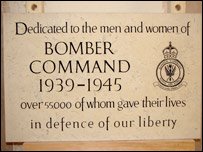
After decades of campaigning by veterans a memorial has at long last been unveiled at Lincoln Cathedral to honour the 55,000 men who died while serving as bomber crew in World War II.

Lincoln is an appropriate place for such a memorial as Lincolnshire was the location of many of the RAF’s bomber stations - the cathedral served as a homecoming beacon for the bombers flying back from raids in Europe.

Douglas Hudson, a former navigator with 100 squadron, helped unveil the memorial:"And now in the hallowed precincts of Lincoln Cathedral for this poignant unveiling ceremony. It is absolutely wonderful."

story


27 August 2006

Irish Irelanders

An edited extract from an address to the Merriman Summer School yesterday by John A Murphy, Emeritus Professor of Irish History at University College, Cork appeared in today’s Sunday Independent . I have set out below an edited extract of this extract if for no other reason but for me to ponder the legacy of the 19th century nationalists in a modern and vibrant society. I am not sure what they would make of today’s Ireland though.

From “the subtle and everyday legacy of Irish-Irelanders”

'IRISH-IRELAND" was the name given to the cultural side of the Irish nationalist revival in the late 19th and early 20th centuries. Essentially it advocated the revived Gaelic nation with its own language, manners and customs and a distinctive literature. The Gaelic League (1893) and the Gaelic Athletic Association (1884) were two prominent manifestations of Irish-Ireland which became the official ideology of the Irish state post independence.

Douglas Hyde

Among its chief exponents was Douglas Hyde; his appointment in 1938 as first President of Ireland was a recognition of his role as founding cultural father. DP Moran popularised the term "Irish-Ireland" and his paper, the Leader, was hugely influential in nationalist circles.
Irish-Ireland propagandists varied in the intensity but all were agreed that the Gaelic tradition was the essential and superior feature. In Moran's words, "the foundation of Ireland is the Gael, and the Gael must be the element that absorbs". And the nation was perceived as primarily a Catholic nation. The Leader played a positive role in stimulating discussion, promoting an Irish industrial revival and fostering radical nationalism.

Irish-Ireland views ranged from the eccentric (a preoccupation with devising distinctive modes of dress) to the censorious (severe disapproval of "vulgar" and "vicious" English popular publications). Irish-Irelanders romanticised and glorified the Gaelic past (where they did not invent it) and were vague about how it could be restored. When Michael Collins asserted the need to restore "Gaelic civilisation" and undo the cultural conquest, he hadn't a clue what he was talking about.

The central anomaly of Irish-Ireland propaganda was its dependence on the English language to advocate the revival of Irish language and culture. Paradoxically, English was the indispensable medium of Irish nationalism. If Irish-Irelanders had used Irish, their readership would have been minuscule. Thus, in the general matter of using Irish, there was a tinge of hypocrisy about Irish-Ireland.

The Irish-Ireland philosophy has had mixed fortunes over the years: the prevailing opinion today is that the revival of Irish as a spoken language is a failure. Two other features have been remarkable successes, however. Gaelic sports remain extremely popular while the traditional music scene is extraordinarily vibrant – more because of its sheer attractiveness, than being an expression of nationalism. The original Irish-Irelanders would probably have welcomed the manifestations of their philosophy in certain features of that state (for all its flaws). These would include such distinctive expressions as foreign policy when practised at its best; the peace-keeping role of our army; and the institution of the presidency, as personified particularly by the two incumbents since 1990.


When Blessing Yourself IS a Crime

Artur Boruc

I rarely comment on sporting matters but this sorry little tale in today’s Observer could not pass me by.

Glasgow Celtic goalkeeper Artur Boruc was given a formal caution by police after being accused of inciting violence. His crime: blessing himself during an “Old Firm” game against Glasgow Rangers, a fixture once described as Time Magazine as “90 minutes of sheer hatred”

The decision has provoked a strong reaction, with politicians and church leaders. Catholic Church spokesman Peter Kearney said “It is extremely regrettable that Scotland seems to have made itself one of the few countries in the world where this simple religious gesture is considered an offence.” Scottish Nationalist leader Alex Salmond said 'The procurator fiscal and the Crown Office are acting in a way that will inflame rather than reduce religious antagonism,' he said.

The Crown Office said a caution was issued as an alternative to prosecution. A spokesman said that as Boruc made the gesture before a crowd in the charged atmosphere of an Old Firm game it constituted a breach of the peace and had 'provoked alarm'.

Neither club has commented on the cautioning, but Eddie Toner, a former general secretary of the Celtic Supporters Association, claimed that the club 'hung Boruc out to dry'. Stephen Smith, spokesman for the Rangers Supporters group, added: 'Professional footballers are meant to set an example. What he did was deliberately provocative and completely done to wind up the fans.'

At times it feels that sectarianism is still alive and spitting in the West of Scotland. Support for Rangers and Celtic is historically on religious lines – Rangers for Protestants, Celtic for Catholics. As a result some gestures others might take for granted assume major significance. While playing for Rangers Paul Gascoigne faced disciplinary action in the late 90s for appearing to play a flute – The flute was a reference to Orange Order fife and drum bands. Edinburgh teams Hearts and Hibernians and Liverpool’s Liverpool FC and Everton were also supported on sectarian lines.

As a Catholic turned agnostic (I am just too lazy to be an atheist!) the idea that making the sign of the cross or appearing to play a flute can be offensive in this day and age is just plain stupid, the hell with the back story.

An anonymous persn left this comment whixh indicates that there was more to this story after all:

Corrections and clarifications

Wednesday September 6, 2006
The Guardian

In two articles in the Sport section we incorrectly asserted that the Celtic goalkeeper Artur Boruc had been cautioned by the Crown Office for "crossing himself" (page 7, August 31), or "blessing himself" (page 5, September 2) during a game against Rangers on February 12. We failed to note that the Crown Office had been at pains to point out that Boruc was cautioned not about "blessing himself" but about other alleged gestures towards the crowd. He was cautioned after the procurator fiscal, having reviewed all the circumstances, decided that criminal proceedings were not necessary. The letter to Boruc from the procurator fiscal made no mention whatsoever of the act of blessing himself.


26 August 2006

Never in the field of human was nothing owed by so many?

RAF Spitfires

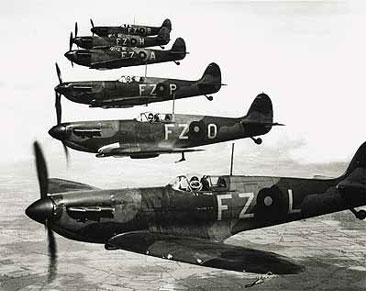
Revisionism and controversy reared their head here in the UK during the week following the publication of an article titled “Pie in the Sky?” in the current edition of History Today. I decided to hold off from talking about this article until I had the opportunity to read it.

So what is this about? Three military historians who lecture at Joint Services Command and Staff College have concluded that the view that Fighter Command was the only thing keeping Britain from invasion in 1940 is an overblown myth. Credit for keeping Hitler at bay should have gone to the navy.

Andrew Gordon, head of maritime history at the college, said: "It really is time to put away this enduring myth. To claim that Germany failed to invade in 1940 because of what was done by phenomenally brave and skilled young men of Fighter Command is hogwash. The Germans stayed away because while the Royal Navy existed they had not a hope in hell of capturing these islands. The navy had ships in sufficient numbers to have overwhelmed any invasion fleet."

Not everybody agrees with this position: Bill Bond, founder of the Battle of Britain Historical Society, said: "There's always somebody trying to rewrite this historical period. Without air cover the Luftwaffe bombers would have smashed all the ports. The dive bombers would have just blasted navy ships out of the water. Unopposed, the Luftwaffe could have done what it liked. To suggest that the Battle of Britain is a myth is nonsense."

The article dos not denigrate the RAF or the role played by the pilots during the Battle of Britain or their bravery. What it tries to do is to put their role into context. – If Operation Sealion was a serious prospect (and that is a big “if”) then the invasion fleet (mainly tugs towing river barges) would have had to contend with Royal Navy and that, as General Jodl said, would have been “to send my troops into a mincing machine”

But what about the Kriegsmarine? minefields ? Surely with air superiority the Luftwaffe would have bombed the Navy to the bottom of the English Channel? All of these would have extracted a toll; this is true but consider this:

1. The Royal Navy had a very large Home Fleet, despite its global commitments. While U boats would have sunk more than a few vessels, the Kriegsmarine’s surface fleet in the latter part of 1940 was pitiful and was incapable of protecting an invasion fleet: all of its capital ships were indisposed while half of its destroyer force was sunk at Narvik a few months earlier.

2. The use of minefields would have slowed up the Navy’s advance but the Kriegsmarine’s minelyaing capability was limited to a handful of vessels. The Luftwaffe would have taken on this function too, but would it have been enough to stem the Navy? Very unlikely in my view.

3. The Luftwaffe was a powerful force and would have done a lot of damage to Naval vessels but without armour piercing ordnance and little experience of anti shipping action the damage would not have been enormous.

The article also rightly points out the role of Bomber Command. Even though it had very limited strike capability at that point in the war, Bomber Command did serious damage to the invasion fleet through its raids on channel ports in occupied France and Belgium.

Perhaps the article does underplay the role of Fighter Command. Its victory in the Battle of Britain ensured the Luftwaffe never obtained air superiority over southern Britain and that gave the German High Command (which had deep reservations over Operation Sealion in the first place) an “exit”. As important in my view is the fact that the Battle of Britain finally brought the people full behind the War. Before the Battle of Britain (and certainly following the fall of France) there were many who would have sought a settlement with Germany. These voices were largely silenced in the Summer of 1940.

25 August 2006

Mimi

A happy little cat with Cerebellar Hypoplasia

Pluto is an ex-planet, it has shuffled off the planetary coil...

A vote at the International Astronomical Union meeting in Prague has expelled Pluto from the planet club. Pluto will now join a a new catgory - the dwarf planets

The move resolves a long standing problem: althoughwhen first discovered it was claimed to be several times larger than Earth, ensuring its prompt labelling, it soon turned out to be smaller than the moon. Astronomers turned a blind eye to Pluto's status until last year when Mike Brown, an astronomer at the California Institute of Technology, discovered 2003 UB313 (Xena) which is bigger than Pluot and claimed it as the 10th planet.

The discovery of Xena brought the definition of the word "planet", to a head as it dawned on scientists that tens of other rocks hurtling around the sun could also qualify for the title. As a result of this vote, the IAU now defines a planet as a body that orbits the sun, is so large its own gravity makes it roughly spherical, and, crucially, also dominates its region of the solar system.

This definition excludesPluto because it is not big enough to clear smaller bodies close to it. Pluto, along with Xena and Ceres, an asteroid that lies between Mars and Jupiter, are now officially dwarf planets. The IAU's decision represents a U-turn on a proposal which would have seen the solar system expand to 12 planets, with four, including Pluto, being classed as new objects called plutons. The proposalwas voted down because it was still too vague.

In addition to the categories of "planet" and "dwarf planet", the definition creates a third category to encompass all other objects, except satellites, to be known as small solar system bodies.

The astronomer Patrick Moore said: "They've made it far too complex. What is a dwarf planet? I agree that Pluto is not a planet, but why not just call it a Kuiper belt object or a large planetoid? In the end, I don't suppose it matters too much. It's just a name."

Guardian


The Camera Sort of Lies and Sort of Doesn't

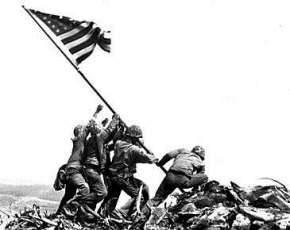
Not too long I put up a post titled No Surprise that the Camera Lies which was based on an excellent Observer article by Geoff Dyer. Following the recent death of renowned photographer Joe Rosenthal. Peter Caddick Adams wrote an interesting article on the BBC website. It is argued that Rosenthal’s (among others) most famous photograph was staged. Carrick-Adams poses the question “Does it matter?”. In the case of the Iwo Jima photo, I say emphatically “NO”. Rosenthal may not have captured the erection of the first flag but he did not intend to deceive anyone. It is a magnificent image that deserves its place as an “icon”
This is an extract from his article.

Images of Victory


One of the most enduring images of WWII was the raising of the US flag on Iwo Jima - a photograph taken by Joe Rosenthal on 23 February 1945. Rosenthal had followed a US Marine group up to the summit of Mount Suribachi, a volcano on the southern tip of the island, and whilst the fighting was ongoing he snapped six men raising the Stars and Stripes.

It now appears this was the second flag raised on the spot, a smaller flag having been erected three hours earlier. Rosenthal's picture won him instant fame and many awards, but a strained relationship with the US Marines who had raised their flag earlier. Enormous controversy arose as to whether the image was staged or depicted a genuine snapshot, a "freeze-frame" during the battle.


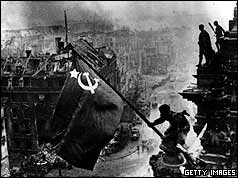
Another iconic images of waris is the raising of a flag over the Reichstag . Representing Victory in Europe, it was shot by Soviet photographer Yevgeni Khaldei on 2 May 1945, as the last Nazi forces resisted in Berlin. It, too, is surrounded by controversy. The German parliament building was stormed and taken on 30 April, when a flag - specifically set aside for planting on the symbol of Nazi power - was held aloft that evening. Khaldei's image, was staged a couple of days later in daylight. Even that had to be retouched as at least one of the Red Army soldiers had been on a looting spree and was wearing several wristwatches.

There is no suggestion here that the pictures themselves were doctored - apart from the removal of a looted wristwatch or two - just that they "don't do what it says on the packet". The question we have to ask is, does it matter? Consider who the images are for. There are many "stakeholders" in a war. The soldiers, their loved ones, war workers, the enemy and so on. The images of Rosenthal and Khaldei communicated a different message to all these important groups in a way print or the human voice could never do. To the enemy, the message was loud and clear - throw down your weapons, you've lost. If the message is "assisted" in its composition, should we be surprised or offended?

Many of the famous war photographers of the 20th Century, including Robert Capa, who caught the agony of the assault troops on D-Day, and Larry Burrows, who worked in Vietnam, died in combat, camera in hand. This is not a suggestion that professionals compromise their integrity by doctoring images, that would be lying in celluloid, but as we are the consumers, we need to applaud the bravery of the Joe Rosenthals of this world for being there in the first place.


24 August 2006

Save the Conker


Britain's horse chestnut trees, providers of conkers for generations of children are dying in their thousands according to today’s Independent. THe trees are being hit by drought, pest attack and disease. On many, the leaves have already withered and shrunk, and conkers, the fruits of the tree, are not being produced at all.

Trees are being severely hit in many parts of Britain and according to the Forestry Commission about 10% of all horse chestnuts may already be affected - about 10 per cent of all the horse chestnuts in Britain. As branches tend to drop off the weakened trees, thousands of them on the fringes of urban streets may have to be cut down for safety reasons"I think you could compare this to Dutch elm disease," said Tony Kirkham, the head of the arboretum at the Royal Botanic Gardens. "The last thing we would want is another epidemic that wiped out a common British tree species."

The trees have already been stressed by three winters of drought. But now in their weakened state they are suffering from simultaneous attack by a pest, the leaf miner moth, whose larvae eats the leaves, and a disease known as bleeding canker. This causes a dark liquid to ooze from spots on the trunk of a tree, which can quickly develop into large damaged patches, spreading all the way around the branch or trunk until limbs fall off, or the tree falls over.

Chris Howkins, botanist and author said "At the weekend, here in Runnymede we couldn't find a horse chestnut that wasn't infected, and there are thousands of them. People don't realise the scale of it yet. They see these trees turning brown and they just think autumn is coming early. A lot of people won't have realised that this is actually death."

23 August 2006

Fischer-Z - So Long

22 August 2006

This poor cat is called a Kitler apparently


I found this picture on Dumka's Why Now? blog. it originates form the hilarious Cats That Look Like Hitler website - not a Chairman Miaow in sight! This pic is one of the very best.


Our Man in Washington, (New York, Chicago……………)

I often post about historical events that are well known to me but are not well known to many. This post, however concerns a tale that stopped me in my tracks. I had no idea at all it happened. This is an edited version of an article written by William Boyd and appeared in Saturday’s Guardian. If you have an interest in WWII I can highly recommend the full article.

"British Security Coordination" (BSC). The phrase is bland, depicting perhaps some sub-committee of a minor department in a lowly Whitehall ministry. In fact it represented one of the largest covert operations in British spying history. It was not run in Occupied Europe, or across the Iron Curtain but in the US during 1940 and 1941.

When Winston Churchill became prime minister he realised that he had to achieve one thing in order to ensure that Britain was not defeated: he had to enlist the US as Britain's ally. With the US alongside Britain, Hitler would be defeated eventually. At the time, however, 80% of Americans were against joining the war in Europe. Anglophobia was widespread and the US Congress was violently opposed to any form of intervention. After the fall of France it was assumed that British capitulation was simply a matter of time so why join the side of a doomed loser, ran the argument in the US.

Churchill felt his task was clear: somehow to persuade Americans that it was in their interests to join the war in Europe. BSC was set up by a Canadian entrepreneur called William Stephenson, working on behalf of the British Secret Intelligence Services (SIS). An office was opened in the Rockefeller Centre in Manhattan with the discreet compliance of Roosevelt and J Edgar Hoover. That said, they did not realize the British agenda and never anticipated the sheer scale of its operations.

BSC became a huge secret agency of nationwide news manipulation and black propaganda. Pro-British and anti-German stories were planted in American newspapers and broadcast on American radio stations. At the same time there was a campaign of harassment and denigration against organisations perceived to be pro-Nazi or virulently isolationist (e.g. the America First Committee).

BSC's media reach was extensive: it included such eminent American columnists as Walter Winchell, and influenced coverage in newspapers such as the Herald Tribune, the New York Post and the Baltimore Sun. BSC effectively ran its own radio station, WRUL, and a press agency, the Overseas News Agency (ONA), feeding stories to the media as they required from foreign datelines to disguise their provenance. WRUL would broadcast a story from ONA and it thus became a US "source" suitable for further dissemination, even though it had arrived there via BSC agents. It would then be picked up by other radio stations and newspapers, and relayed to listeners and readers as fact. Nobody suspected this was all emanating from three floors of the Rockefeller Centre. BSC took enormous pains to ensure its propaganda was circulated and consumed as bona fide news reporting: they were never rumbled.

Some of BSC's schemes verged on the absurd; some were highly sophisticated media manipulation. BSC invented a game called "Vik", described as "a fascinating new pastime for lovers of democracy". Printed booklets described up to 500 ways of harassing and annoying Nazi sympathisers. Players of Vik were encouraged to ring up their targets at all hours of the night and hang up. Dead rats could be put in water tanks, air could be let out of the subject's car tyres, anonymous deliveries could be made to his house and so on.
In the summer of 1941, BSC sent a sham Hungarian astrologer to the US called Louis de Wohl. At a press conference De Wohl said he had been studying Hitler's astrological chart and could see nothing but disaster ahead for the German dictator. De Wohl became a minor celebrity and went on tour through the US, issuing dire prognostications about Hitler and his allies. De Wohl's wholly bogus predictions were widely published.

One of BSC's most successful operations originated in South America. The aim was to suggest that Hitler's ambitions extended across the Atlantic. In October 1941 a map appeared that purported to show a South America divided into five new states - Gaus, each with their own Gauleiter - one of which, Neuspanien, included Panama and "America's lifeline" the Panama Canal. In addition, the map detailed Lufthansa routes from Europe to and across South America, extending into Panama and Mexico. The inference was obvious: watch out, America, Hitler will be at your southern border soon. The map was taken as entirely credible and Roosevelt even cited it in a powerful pro-war, anti-Nazi speech on October 27 1941: "This map makes clear the Nazi design," Roosevelt declaimed, "not only against South America but against the United States as well." The news of the map caused a tremendous stir: as a piece of anti-Nazi propaganda it could not be bettered. But was the South America map genuine? Probably not -BSC had a superb document forging facility across the border in Canada.

The story of BSC seemed to be one of those wartime secrets that was never to be wholly revealed unlike Station X and the Enigma story which is now well known. Perhaps the reason for this is because the story was simply too embarrassing. We will of course never know whether BSC's activities would have been ultimately successful. Although US public opinion was on the turn by the end of 1941 it was overtaken by the events of December 7 1941 and Hitler’s subsequent declaration of war on the USA.


21 August 2006

Fischer Z - Marliese


An utterly forgotten 80s band who seemed to have gone down well in Germany I understand. This got to number one in Portugal. It did not chart here

Let's All Make A Bomb


I still have a soft spot for Heaven 17

New Model Army 225 live


This is a slower version of a great NMA song. It originlly appeared on Thunder and Consolation

20 August 2006

More Pathfinder Photos

"If I spread out my wings toward the morning, your hand shall lead me"

This is the Pathfinder Memorial window at St George's Chapel, RAF Wyton. The image on the right is of St Michael the Archangel. the spots on the left represent bomb drops (pink) and marker flares for HE or incenduary bombs (the red and the green ones).


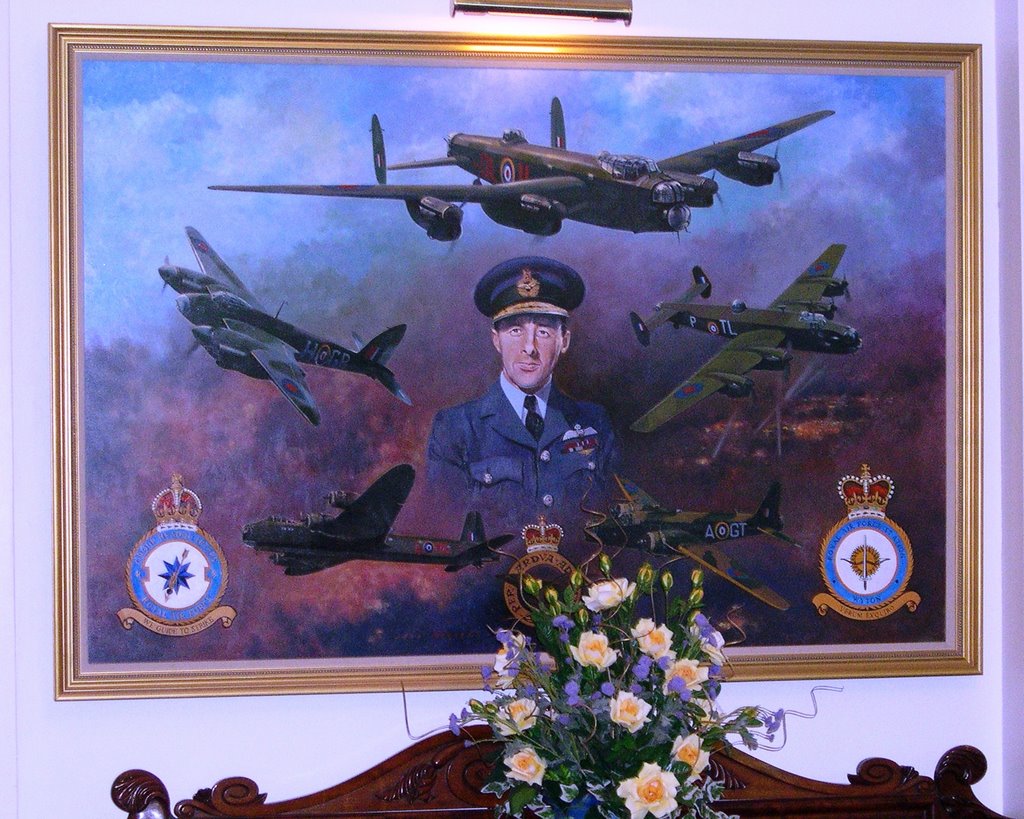
This is a portrait of Don Bennett, the founder of the Pathfinder Force. The Aircraft oare those used by the Pathfinders (Clockwise from the top, Lancaster, Halifax, Wellington, Stirling, Mosquito). The photo is sakew to prevent unwanted reflection from surrounding lights.


A model of the Mosquito, the type of aircraft my father flew. While some are preserved in museums, the only remaing airworthy example is in Canada. the last British one sadly crashed a several years ago

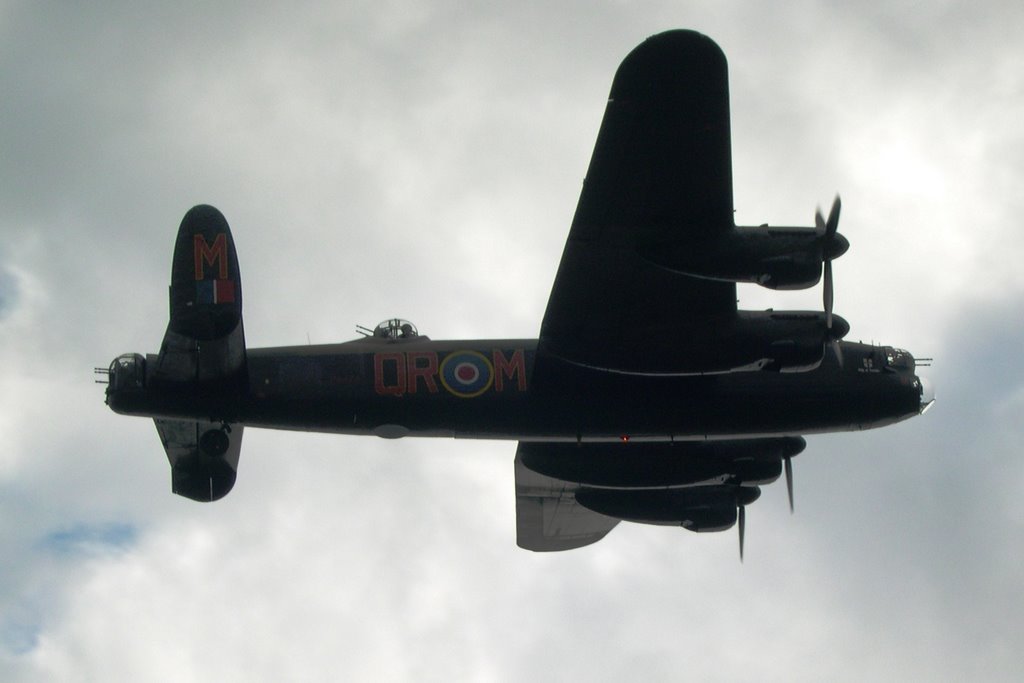
A Lancaster in fly by


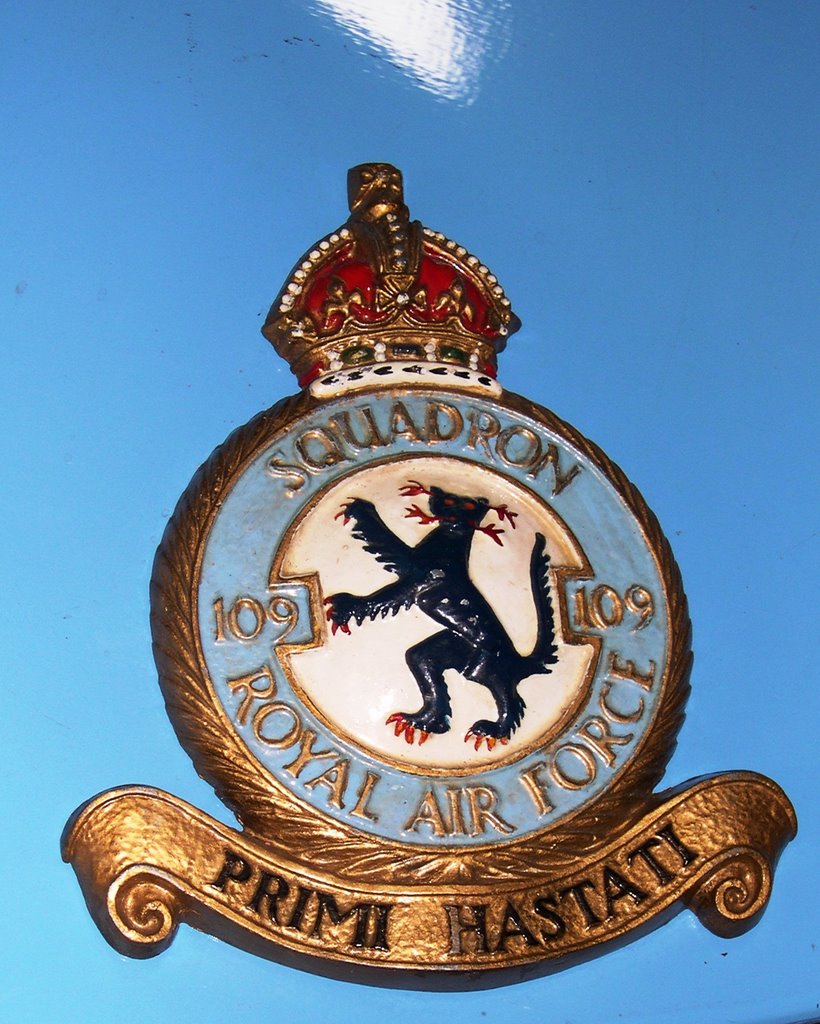
The First of the Legion - This is the badge of 109 sqn, my father's unit. I have never worked out why a panther would have flames coming out of its ears but neither has dad!

Meet the "War Criminals"

The Observer article that was the subject of my previous entry was published on the day I accompanied my father to RAF Wyton for the annual Pathfinder Force reunion. The Pathfinders were an elite force within Bomber Command and Wyton was their main base. Its history will be the subject of future posts. For the moment I will be content with displaying some photos I took today.

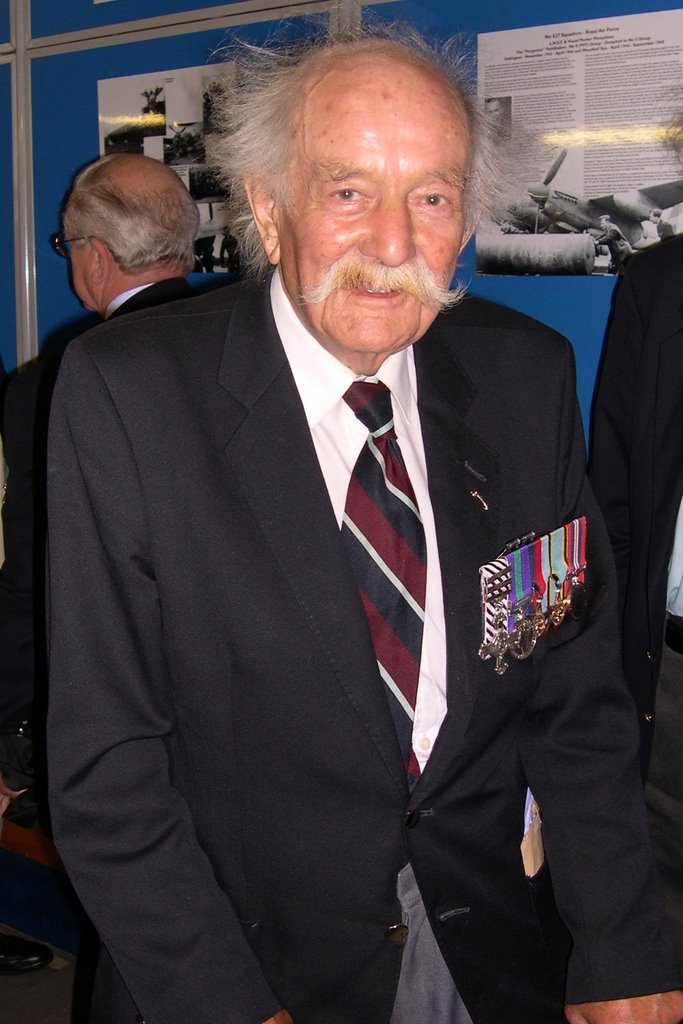
Ex Sqn Ldr Tommy Broom, a man who age has not dimmed (note Squadron Leader is equivalent to a Major)

A pride of lions


My father is on the right


"Chappy" Chapman and his charming wife

My Father, the "War Criminal"

Today’s Observer carries a story concerning objections to a new war memorial that will be unveiled in Lincoln Cathedral next week. The memorial is to honour the 56,000 RAF bomber crewmen who died in WWII. To put this figure into a total of 120,000 men served in EAF bomber crews. I am here because my father is one of the 64,000 that survived the war. Let me just say that my sympathies are not with the Peace Pledge Union on this one. I do have a lot to say on this and the wider issue of BOTH allied AND axis bomber campaigns. I will return to this subject later.


RAF tribute stirs up 'war crime' storm

Some battles never end. For more than 60 years veterans of RAF Bomber Command have sought to escape the shadow of Britain's most controversial action in the Second World War: the firebombing of cities such as Dresden. Next week the 'heroes Britain chose to forget' will finally be recognised when a memorial is unveiled at Lincoln Cathedral, honouring the 55,888 aircrew that died. But far from healing the acrimonious debate, the tribute carved in Lincoln limestone has reopened old wounds.

The Peace Pledge Union, a pacifist organisation which demonstrated against the bombings at the time, regards the attack on Dresden as a crime against humanity and is dismissive of the memorial. 'This is part of the sentimental, nostalgic, crazy age we live in,' said its co-ordinator, Jan Melichar. 'Bombing civilians from the air was against a number of conventions, but the victors don't like to refer to their own actions as war crimes'.

The inscription in the cathedral will read: 'Dedicated to the men and women of Bomber Command 1939-45, over 55,000 of whom gave their lives in defence of our liberty.'
Douglas Hudson, now 90, a navigator on Lancasters, will unveil the memorial next Sunday along with Sylvia Watts, a member of Bomber Command clerical staff. Hudson said: 'The members of Bomber Command have had a very raw deal since the war. They have been accused by historians and writers of being murderers, destroying German culture. The critics don't think that 55,888 men gave their lives for this country.'

'Scotty' Scott, 70, who ran the campaign for a memorial, agreed: 'They are wonderful men and it's shameful they have not been recognised. They flew seven nights a week over Germany and were knocked out of the sky like ninepins at the start. They shortened the war by six months and saved hundreds of thousands from the gas chambers by bringing it to a halt. Politicians have treated Bomber Command disgracefully.'

There was strong support for the memorial from the Dresden Trust, a UK charity which helped to raise funds for the reconstruction of Dresden's Frauenkirche cathedral. Its chairman, Alan Russell, said: 'I do not think the Dresden raid was justified in the way it was conducted, but this is not to be taken as a criticism of Bomber Command.'

19 August 2006

Even Drivel Has Value!


My blog is worth $11,290.80.
How much is your blog worth?


I have visited a couple of blogs and seen a thingy that showed their blog was worth this amount of dollars or that . Out of curiosity I followed the link and got the above result. Presumably this blog is worth more than some but a lot less than most - it has only been around for a bit over 4 months.

Why the hell am I posting this? It is not out of vanity. I am genuinely puzzled how my posts can be taken and assigned a monetary value. Or does it represent the money I could have earned had I got off my arse and worked instead?... Perhaps there are people out there who would pay well for my brand of drivel. If so, I am available for weddings, funerals and bar mitzvahs!

John Irving - in Defence of Gunter Grass

Writer John Irving has written an interesting piece on the Grass affair in today’s

Guardian. Irving is a close friend of Grass and, as you can see, feels strongly about the furore. Here is an edited extract.

Günter Grass is my hero, as a writer and a moral compass

How do I feel about what Kurt Vonnegut would describe as a "shit storm" in the wake of my friend Günter Grass's revelation that he was drafted into the Waffen SS at the age of 17? From what I have read of the editorials, and the lofty remarks of my fellow writers, critics, and journalists of various political persuasions, there has been a predictably sanctimonious dismantling of Grass's life and work from the oh so cowardly standpoint of hindsight, from which so many so-called intellectuals safely take aim at their targets.

Grass remains a hero to me - a courage heightened, not lessened, by his most recent revelation. I do not judge what 17-year-olds volunteer for - short of premeditated rape and murder.
I'm a slow processor; many writers are. I like getting some distance from those things I write about that have seriously affected me. I wrote about my childhood and adolescence not in my first or second novel, but in my 11th and most recent novel, Until I Find You. Only then did I reveal to the media that the central experiences in that novel were autobiographical - namely, the missing and unmentioned father and the sexual abuse (in my case, at the age of 11 with a woman in her 20s; in the novel, the character is 10, the woman in her 40s).

Now there is all this bitching in Germany about when Grass chose to reveal his Waffen SS enlistment as a teenager! The man (and the writer) is a model of soul-searching and national conscience. People are saying he deliberately withheld this information until after he won the Nobel prize for literature, because he would never have won the prize if it were known he'd been in the SS. And some people are saying that Grass chose to time his revelation to sell copies of his new autobiography. I heard that when I talked openly about my sexual experience as an 11-year-old with an older woman - that I was just selling books.

The fulminating in the German media has been obnoxious. Grass is a daring writer, and he has always been a daring man. I wish Günter Grass all the best.


18 August 2006

Local Schools with American Connections

Romford is part of the London Borough of Havering and has been since the 1960s when it was removed from the County of Essex to form part of Greater London. Most of the local schools have names relevant to their locality (Wykeham, Royal Liberty and so on and so forth) or, if catholic, after saints (my own school was named after Edmund Campion a Jesuit priest executed in Elizabethan England).

Two schools, however, have names with distinct American connections. A primary (elementary) school in Crahnham is named after James Oglethorpe, the founder of the state of Georgia. He lived in Cranham and is buried in the local church.

In the 1970s the Secondary school (ages 11-18) Suttons was renamed Sanders Draper. Who on earth was Sanders Draper and why change the name? Raimund Sanders Draper was born in 1914 to a wealthy American family. While the USA was still neutral he came to the UK to join the Royal Air Force and was commissioned as an Officer in September 1941. After serving in various locations as a fighter pilot his squadron moved to RAF Hornchurch in March 1943. RAF Hornchurch was an important fighter station. Its squadrons had fought with distinction during the Battle of Britain. Suttons School was located next to the station’s perimeter

On 26 March Sanders Draper took off from RAF Hornchurch. Whilst approaching the school, his engine failed. He had the decision of baling out and to let the aircraft hit the school or to save the school by staying with the stricken aircraft . He chose the latter and fortunately missed the school. However in the following crash and explosion, Sanders Draper was tragically killed.. The School is thus named in honour of a man who in the circumstances did the right thing although the choice was fatal

Sadners Draper’s commander, MG Donnet, when interviewed some years ago said “I remember Sanders Draper (known by us in the RAF as Elmer) who was a fine officer and a very cheerful friend. He was a USA citizen who had joined the RAF early, and who remained with us after the USAAF squadrons arrived in England. We felt greatly the loss of our friend amongst the pilots of the squadron. He had an aunt who was a famous actress, she attended the funeral and remained in touch with the pilots. [His aunt was British actress Joyce Grenfell] The fatal accident was due to engine trouble shortly after take-off. He remained at the controls of his aircraft trying to avoid the school known to be on the trajectory of the aircraft."

A play called “the Good Intent”(the name of a local pub frequented by the pilots). It was performed at the Queen’s Theatre, Hornchurch in 2003. The following link contains recollections from people who were children at the school on the fateful day.


17 August 2006

Hawkwind on Myspace

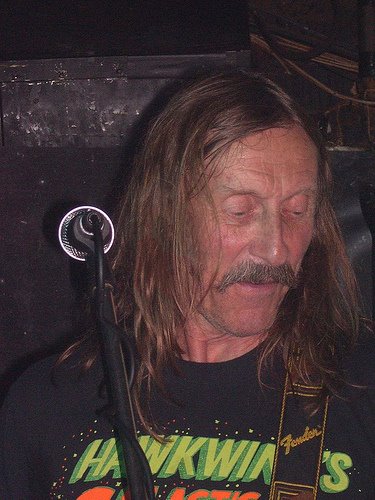
Jason Stuart - Keyboards

Alan Davey - bass

Dave Brock- Guitar
(all photos taken by myself at the Spirit of the Age single release party at the Borderline in September 2005)


At long last Hawkwind has set up a Myspace spot. If you have never heard anything by the Hawks and are curious to hear what they sound like there are four songs available for your delectation. Three songs were recorded live in Holland at the Roadburn Festival earlier this year. The fourth song is a taster of a project that Dave Brock and Robert Calvert may have done in the late 80s had Robert not died.

The four songs are:

Lord of Light – this is an old song originally from 1972 and a real highlight of the 1973 live album the Space Ritual. Personally it is one of my favourite Hawkwind songs

Out Here We Are – an instrumental from their last album Take Me to Your Leader. Not bad but far from essential Hawkwind

Love in Space – this is from the mid 90s and is a glorious spacey song. This is classic stuff in my view.

Siren Song – this is part of the posthumous Brock/Calvert collaboration and is new to me. Dave Brock has put music to some Calvert songs. I will have to listen to this a couple of times before I form my opinion on this.

I could not resist posting this


I found this on Paul Burgin's Mars Hill blog who found this on Sned's blog, who found this.... and so on.

An Ever Worsening Situation in Darfur

Today’s Independent reports that up to half of Darfur's population has been trapped by renewed violence. The humanitarian crisis has become so alarming that Kofi Annan has alerted the Security Council to the deepening conflict which has been overshadowed by the war in Lebanon.

"As a result of the fighting and direct targeting of humanitarians, only 50 per cent of civilians affected by the conflict can be reached by humanitarian organisations. The rest, some 1.6 million people, are either inaccessible, or can only be reached by putting the lives of aid workers directly at risk." states Mr Annan. Villagers are fleeing to camps reporting "indiscriminate killings, rape and abduction. Several hundred militiamen attacked a group of women collecting shelter materials outside Kalma camp, south of Nyala, raping 17 of them".

Three months ago Sudanese rebels struck a peace deal with Khartoum that was to end a bloody conflict that killed an estimated 200,000 people and displaced 1.8 million in Darfur. Since then rebel factions have turned on each other, the killing of black African civilians by Arab militias has resumed and aid convoys have come under attack. The Sudanese government has, meanwhile, stepped up its resistance to a fully fledged UN force taking over from an African observer mission.

The Security Council will discuss Mr Annan's assessment. He also laments the fact that the African Union (AU) peacekeeping mission faces bankruptcy, despite a "relatively positive" outcome from a pledging conference last month (note: the AU force is a few thousand soldiers with no real powers who patrol an area about the size of France. I also think we in the West can afford a few million to support these soldiers too) . The AU mission's mandate expires on 30 September after which it had been hoped that the Khartoum government would agree to a 24,000-strong UN force being dispatched to the region with a more robust mandate than the AU observers. The UN now hopes to deploy an international force in January, but the Sudanese government has steadfastly disrupted preparations for it.

On Tuesday Omar al-Bashir, the Sudanese President, declared: "We are determined to defeat any forces entering the country just as Hizbollah has defeated the Israeli forces. We are opposed to the deployment of American, British or other forces imposed by the Security Council."

According to Mr Annan, a plan to restrict the government-armed Janjaweed militia to designated areas has gone unheeded. Jan Egeland, the chief UN humanitarian officer, has said the situation is "going from real bad to catastrophic". About 14,000 aid workers have remained in Darfur despite the safety risk - 11 have been killed since the peace deal was signed. Some Darfur aid workers have been beaten to death by angry mobs, according to the UNHCR. The World Food Programme warned yesterday that a decline in donations might force it to scale back food rations for six million people in Sudan.

The situation in Sudan is appalling and getting worse. That it remains pretty well ignored by the world at last is an utter disgrace. Do we want another Rwanda? George W you did say "Not on my watch". As far as I am concerned, the rebels, the Janjaweed and the Khartoum government are scum. They have no regard for their people. The sooner they are all smashed, the better it will be for the people of Sudan it would seem.

Bye, bye Stroessner


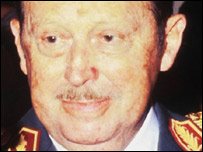
Today’s Independent reports the death of former Praguayan dictator Alfredo Stroessner, Stroesner ruled Paraguay for 35 years,. He died in exile yesterday aged 93. Stroessner died of a stroke in Brazil's capital, where he lived in near isolation for the 17 years after he was deposed.

Stroessner siezed power in a 1954 coup and governed Paraguay through fraud and repression. He was finally driven from power by his own generals in 1989. The son of a Bavarian immigrant and a Paraguayan mother, he epitomised a generation of authoritarian leaders in Latin America, putting his name on public buildings and describing opponents as Marxist subversives.

Under his rule, Paraguay became haven for Nazi war criminals , including Josef Mengele, who lived openly in Paraguay's German community before moving to Brazil. He also sheltered other right-wing dictators, such as Nicaragua's Anastasio Somoza. Many Paraguayans still revile Mr Stroessner. Current President Nicanor Duarte has stated that there are no plans to honour him.

In my view, South America is the richer for the passing of this old bastard. Like Pinochet, Galtieri, Videla et al Stroessner was an old style South American Caudillo – the sort of dictator who I hope has been consigned to the dustbin of history. Love or hate the likes of Chavez (I do have some big reservations about Chavez myself) or Morales they were democratically elected and will be democratically deposed if their electorate sees fit.

Wikipedia provides a good biography of Stroessner.


16 August 2006

It Gets Worse for Gunter Grass

There have been a wave of criticism of novelist Gunter Grass following his recent admission that he served in the Waffen SS during WWII. Charlotte Knobloch, president of the Central Council of Jews has added her voice to these criticisms. "His long years of silence over his own SS past reduce his earlier statements to absurdities."

Grass was long seen as the moral conscience of Germany "My silence through all these years is one of the reasons why I wrote this book," Grass announced. "It had to come out finally." Grass said he volunteered at age 15 for the submarine service and was refused, only to be called up for military service two years later. When he reported for duty in Dresden, he found it was with the 10th SS Panzer Division Frundsberg. He said that under the sway of Nazi indoctrination he did not view the Waffen SS as something repulsive but as an elite force. Grass had claimed he had been forced to work on anti-aircraft batteries. Nobody is suggesting that Grass's service in the Waffen SS means he was involved in Nazi war crimes. Although the SS was in charge of administering the Holocaust, the Waffen SS was a military arm.

"It is a disappointment, in a way he has betrayed the whole generation," said his biographer, Michael Jürgs "We adored him not only as a moral icon, but as a figure who was telling the truth even when the truth hurts." Former Polish Solidarity leader and president, Lech Walesa, was quoted as saying Grass should hand back the honorary citizenship he was awarded for the Polish city of Gdansk, where he was born. "If it had been known he was in the SS, he never would have been given the honour," Mr Walesa told the German tabloid Bild.

Story

I have been thinking about this issue quite a bit since the story broke. The world rightly looks on the SS as a criminal organisation., The Waffen SS itself was a fighting force. It consisted of around 1 million soldiers ranging from elite troops to out and out butshers (eg the Dirlwanger brigade). While the Waffen SS did not run the death camps it was responsible for numerous atrocities (there was also a lot of movement of men between fighting units and death camps). Only one unit, the Wiking Division, was never officially implicated in war crimes. The Wehrmacht on the other hand has been portraued as honourable but its own record on the Eastern Front is no less vicious as that of the Waffen SS. Once could thus argue that a teenager’s membership of the SS, given that he did not participate in any war crime, is no worse than being in the Wehrmacht especially if facing the Red Army.

The real issue here I think is that the “conscience of Germany” has admitted he was a flawed human being but there is not one of us alive that does not at least have a toe made of clay!


Therapy? - Screamager


A bit of heavy rock from another great band from Northern Ireland

Stiff Little Fingers-Barbed Wire Love


I loved Stiff Little Fingers. I was glad to see them in my teens. It's a pity there are no vids on youtube of two of their later songs Beirut Moon and Each Dollar a Bullet.. We can't ask for everything though!

Blyth Power - Ixion


There'ss plenty to write about but I am too knackered so here's a bit more favourite music instead. This is folk punk band Blyth Power at a recent gig. The sound and vision are both ropey but there is very little Blyth Power on youtube.. Hiho!

More Planets Rather Than Less?

Following on from Monday's Judgement Day for Pluto the International Astronomical Union (IAU) may have come up with a solution which downgrades Pluto but still recognises it as a planet. The following is based on a report on the BBC website.

The IAU proposal recognises eight classical planets, three planets belonging to a new category called "plutons" (Pluto, its satellite Charon and UB313, aka Xena) and the largest asteroid Ceres. Pluto thus remains a planet, but becomes the basis for a new category. Astronomers gathered at the IAU General Assembly in Prague will vote on the plan next Thursday.

Dr Andrew Coates of the Mullard Space Science Laboratory in Dorking said he thought the plan was "a good compromise". He explained: "It keeps the idea of eight classical planets, while Pluto is allowed to retain its status. But other objects are allowed in, which I suppose makes life more interesting. Something had to be done about the definition.... It does change the textbooks somewhat, but it also demonstrates that this is a vibrant area of research..... The surprise is Ceres, because most people thought of it as an asteroid". (Ceres is the largest object in the asteroid belt between Mars and Jupiter, and like a planet is spherical in shape)

The basis for this re-evaluation is a new scientific definition of a planet which uses gravity as the determining factor. According to this definition, two conditions must be satisfied for an object to qualify as a planet: The object must be in orbit around a star, but must not itself be a star; It must have enough mass for the body's own gravity to pull it into a nearly spherical shape

More objects are likely to be announced as planets in the future. The IAU has a "watchlist" of at least a dozen other potential candidates that could become planets once more is known about their sizes and orbits. These include the distant objects Sedna, Orcus, Quaoar and 2003 EL61 and the asteroids Vesta, Pallas and Hygiea.


15 August 2006

THE REZILLOS - top of the pops


More glorious silliness from Fay Fife and co

silicon teens - memphis tennessee


A silly but fun cover of Memphis Tennessee, ostensibly by a group of 16 year olds. In reality it was Daniel Miller who went on to form Mute Records.

Ted

14 August 2006

Ahmadinejad's Exercise in Hypocrisy


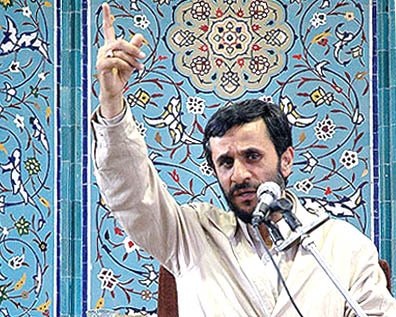
The Guardian, BBC and most other quality papers report the rise of a new star in the Blogoshere – None other that the people’s friend (unless if Jewish or American of course) Mahmoud Ahmadinejad. Imaginatively titled Ahmadinejad.ir his first entry is a fairly lengthy autobiography interspersed with fulsome praise for Ayatollah Khomeni. As an added bonus you also get to vote on whether you think the US and Israel are trying to start a new world war (about 57% against at present).

His entry into the Blogoshere is probably an attempt to communicate directly with ordinary Iranians over the heads of the nation’s elites. Given that is available in Arabic, English and French as well as Farsi he surely has an eye on an international audience.

Ahmadinejad may be wily and intelligent but starting this blog he is showing himself to be a hypocritical bastard. Just take a look at a site like Reporters without Borders and see what happens to other bloggers in Iran.


Judgment day for Pluto


Pluto with its satellite Charon

From today’s Guardian. Nearly 400 years after Galileo first peered at the heavens through a rudimentary telescope, the world's top astronomers have called an urgent meeting to decide once and for all the meaning of the word "planet".

A vote today at the International Astronomical Union meeting in Prague today, will end what has become an embarrassing crisis for scientists. It will also change the nature of the solar system forever: where we now have nine planets endlessly looping around the sun, we may soon have only eight. Or 23, or 39, or more.

At the root of the crisis is a 76-year-old celestial fudge that has until now been papered over: the discovery of Pluto. When scientists at the Lowell Observatory announced they had spotted Pluto in 1930, they claimed it was several times larger than Earth, ensuring its prompt entry into the textbooks as the ninth planet. It later turned out to be a rock substantially smaller than the moon. Until last year, the astronomy community was mostly happy to turn a blind eye to Pluto's apparent crashing of the planetary party. But last year, Mike Brown, an astronomer at California Institute of Technology, discovered a fly in the ointment -another celestial body larger than Pluto, hurtling around with an orbit stretching beyond Neptune.

The Hubble space telescope measured the rocky object at about 1,490 miles in diameter - roughly 70 miles longer than Pluto's. While it is officially known as 2003 UB313, Professor Brown named the rock Xena, after the Warrior Princess TV series, and claimed it as the 10th planet. "The discovery of this object really brought things to a head. It's spherical, it orbits the sun, and it happens to be bigger than Pluto," said Dr Marsden.


Xena with its satellite Gabrielle

The reason the question has become such a headache is that unlike the inner eight planets orbiting the sun, Pluto is a member of a vast band of extremely distant rocks called the Kuiper belt that orbits the sun beyond Neptune. Xena is a Kuiper belt object too, so if Pluto qualifies as a planet, so must Xena. And the headache does not end there. Astronomers know that the Kuiper belt is likely to be full of countless other rocks, so where do they draw the line?

"It's time we have a definition," said Alan Stern, who heads the Colorado-based space science division of the Southwest Research Institute of San Antonio. "It's embarrassing to the public that we as astronomers don't have one."

A popular idea is to count only objects above a certain size. Some scientists want an arbitrary limit - a diameter of around 1,243 miles. Others say the size and rotation of the object should be sufficient to give the rock a strong enough gravitational field to make it spherical.

Whatever the outcome, the IAU's decision could rewrite school textbooks and encyclopaedias and countless science fiction stories. "I don't know about the public, but whatever happens, the astrologers will be upset about it," said Astronomer Patrick Moore.

13 August 2006

The Red Mantis: Lord's Resistance Army

One of my favourite bloggers dave over at The Red Mantis writes regularly about the Lord's Resistance Army and the criminally ignored civil war in Uganda. I wholeheartedly recommend you read this post

No surprise that the camera lies

The recent furore over a manipulated photograph of Beirut was utterly justified but is absolutely nothing new. The only difference between modern photographers and those in years gone by is the easy availability of computer software to do the donkey work.

Geoff Dyer has written an illuminating article in today’s Observer reminding us that photo manipulation has been taking virtually place since cameras were invented

The camera is the eye of history,' declared Matthew Brady, who took some of the best-known photographs of the American Civil War. Actually, there is no direct source for the quotation. Also, because of his poor eyesight, Brady himself didn't take many of the photographs commonly attributed to him. A number of 'his' pictures were actually taken by the team working for him. Still, we see what he meant: the camera shows what really happened, for the benefit of posterity. Philosophers might debate what 'really' really means but most people agree that a photograph, unlike a drawing or painting, 'quotes' directly from reality - hence its power as evidence.

Last week, the reliability of this form of evidence was again called into question when it was revealed that the picture of an Israeli air strike on Beirut had been manipulated by the photographer, Adnan Hajj. Smoke had been added, using Photoshop, to increase the scale and intensity of the destruction, Hajj insisted he'd only been trying to clear dust from his image - by adding more? - But Reuters immediately withdrew the picture and announced that it would no longer accept work from him. While taking advantage of the latest technology, it is part of a tradition almost as old as photography itself.

The Brady Sharpshooter

Some of Brady's Civil War work was actually done by Alexander Gardner who, in 1863, took a picture of a dead rebel sharpshooter at Gettysburg. It's a great photograph, well worth the effort of dragging the corpse 40 yards, propping its head on a knapsack (so that it faced the camera) and leaning a rifle (not the sharpshooter's, but one Gardner carried as a prop) against the barricade for dramatic effect.

Fenton's Charge of the Light Brigade

Eight years earlier, in the Crimea, Roger Fenton photographed the cannonball-strewn aftermath of the Charge of the Light Brigade. The picture was an immediate success, underscoring the heroic sentiments of Tennyson's poem, even though it was not actually this valley that the Light Brigade had charged down. Not only that, but Fenton did two versions of the same scene, one in which the cannonballs lay as they were found; another - the one always reproduced - in which the cannonballs, had been more dramatically and abundantly 'scattered' by the photographer's assistants.

The Capa photograph

In both these early examples, the raw material has been adjusted in such a way as to enhance a more general truth (a poetic one, in Fenton's case). This kind of thing went on throughout the 20th century - Robert Capa's claim to have caught the moment of a republican soldier's death in the Spanish Civil War is still disputed - and continues today as photographers exploit the poignancy of a child's death by nudging cuddly toys closer to a blood-stained hand. What is surprising, Sontag suggests, is not that this happens, but that we are surprised and disappointed to learn that it does.

A different kind of ethical blemish attaches to manipulating the picture after it's been taken. It is, in other words, not the scene itself so much as the record of the scene that is considered sacrosanct. If the communist habit of airbrushing undesirable elements such as Trotsky out of history provokes laughter rather than opprobrium, that is only because it is so ham-fisted. This was the practice that elicited Milan Kundera's famous declaration in The Book of Laughter and Forgetting: 'The only reason people want to be masters of the future is to change the past. They are fighting for access to the laboratories where photographs are retouched and biographies and histories rewritten.'

The difference, now, is that anyone with a computer has access to these laboratories. Photographs can be retouched with the press of a button, almost as soon as they are taken. History can be changed as it happens, before it's even written. While the existence of untouched originals or negatives offered a standard against which any subsequent alterations could be compared, the digital revolution has done away with the primacy of the original.

Does this mean that the idea of truth itself is being undermined? On the contrary. The attendant uncertainties reaffirm a basic human longing for accuracy and verifiability. The fact that pictures can be so easily manipulated greatly enhances the value of those that aren't. Hence the strict rules that news agencies such as Reuters and newspapers such as this one impose on their photographers.

Though long-frustrated, the urge to create an objective visual record made the eventual invention of photography inevitable. The subsequent urge to tamper with that record is no less predictable but consider, by analogy, the premise behind another technological innovation. If human beings weren't programmed to tell the truth as they see it, how could a lie-detector ever be expected to work?

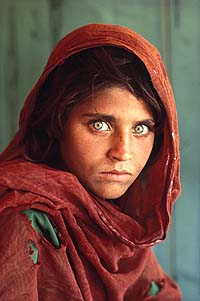
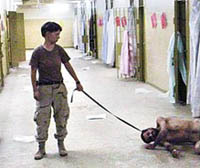
Even though a picture is now so easy to manipulate in my view it does not prevent an image from becoming iconic. I have set out below a few such photographs from the past plus a recent one that will sadly be one of those that sums up the invasion of Iraq. Photoshop aside there will still be great photographs in the future.

St Paul's December 1940

Kim Phuc as a child


Sharbat Gula


Lindy England marking her dubious place in history


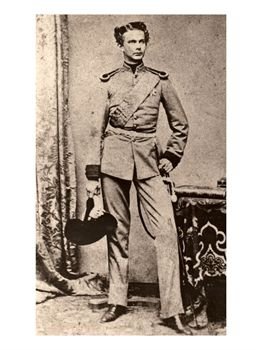
Mad Ludwig Not So Mad After All?


Staying with Germany for a third post Today’s Observer reports that King Ludwig II of Bavaria might not have been quite so loopy as thought: German scientists have shown him to be one of the unsung pioneers of flight.

Ludwig, whose fantastical castle at Neuschwanstein aptly featured in the film Chitty Chitty Bang Bang, drew up plans for a flying car more than two decades before the Wright brothers took to the air, but when he tried to build it he was declared insane and stripped of his crown. German aeronautical experts who have studied Ludwig's designs say they would have worked. Sketches recovered from letters between the ruler and Austrian engineer Gustav Koch show the monarch had planned to create a fleet of flying machines that would take him to his many castles. The craft he designed looked like flying cable cars powered by steam engines. They were decorated like peacocks.

But his dreams of flying over the mountains of Bavaria only convinced his opponents that he was mad, and he was declared insane on 10 June, 1886, and deposed. He died shortly afterwards and his drawings were consigned to an archive. Dalibor Karacic is working on the project to re-draw the machines. He said: "King Ludwig was unbelievably progressive. He understood technology. The flying peacock cars may have looked funny, but technologically they were sound and certainly would have worked".


12 August 2006

Gunter Grass admits to being in the Waffen SS


Remaining on things German, the Guardian reports that Nobel laureate Günter Grass has admitted that he served in the Waffen SS in the second world war.

His declaration that he served in an army unit of Hitler's Nazi elite came in a book about his recollections of war to be published next month. Explaining how the secret weighed on his mind, he told the Frankfurter Allgemeine yesterday: "My silence through all these years is one of the reasons why I wrote this book. It had to come out finally."

Grass, 78, won international acclaim in 1959 with his first novel, The Tin Drum, voicing the thoughts of a generation raised in the Nazi era who had survived the war. This, and later works such as Cat and Mouse, and Dog Years, earned him the role of "conscience of his generation". He has since become part of the artistic movement known in German as Vergangenheitsbewaeltigung or "coming to terms with the past".

As a teenager, he volunteered as a way of breaking away. "For me it was primarily about getting out of home. It was like that for many of my generation. We were doing army service and then suddenly, one year later, the draft order was on the table. And then I realised, probably not until I was in Dresden, that it was the Waffen SS."

Writing on the 1945 surrender in the Guardian last year, Grass told of being wounded: "I was a naive 17-year-old, who had believed in the ultimate victory right to the end ... it was not the hour of liberation; rather, I was beset by the empty feeling of humiliation following total defeat."

I doubt Grass was much different to most other young germans of that age. He would have been steeped in Nazi propaganda for virtually his whole life and it would have been an exceptional sort to see through the lies. Let’s face it there were not many Sophie Scholls or Swing Kids. Still it will be interesting to read his memoirs when they are published here.


Remembering the Berlin Wall


This article from today’s Independent is a dark reminder of the madness and sheer brutality of the East German communist regime.

Siegfried Noffke wanted nothing more than to be reunited with his wife and baby daughter. It was the summer of 1962 and less than a year earlier, the 22-year-old had been separated from his family by an event that took the world by surprise. On the night of 12 August 1961, armed units of Communist police and militiamen began cordoning off the eastern sectors of Berlin with barbed wire, and started reinforcing the divide with hastily erected breezeblock barriers. That was the beginning of Berlin's infamous Wall, the concrete and barbed wire Cold War barrier that divided Germany's biggest city for 28 years until its fall in the winter of 1989.

Noffke had been visiting relatives in West Berlin that evening. Like hundreds of others, he returned to a crossing point into East Berlin on the morning of 13 August but found it barred. His only chance of contact with his wife and daughter, left in the east, was to wave at them across the barbed-wire divide. He decided his only chance was to smuggle his family into the West. He joined a group that had started to dig a tunnel that aimed to break through under the Wall. When Noffke and his team broke through, they were met by East Germany's notorious Stasi secret police.

Noffke, one of the first out, was instantly machine-gunned to death. His colleagues were arrested and put on trial for "anti-state provocation". Unbeknown to the tunnel-diggers, a Stasi mole had joined the group and had kept the East Berlin authorities fully informed of their activities. Noffke's wife was jailed in East Germany for "anti-Communist conspiracy".

Then came scores of similar acts of murder perpetrated by the former East German authorities at the Berlin Wall. They were formally confirmed this week, The findings of extensive research by a German government-backed commission into deaths at the Berlin Wall has established that at least 125 people were killed trying to cross the barrier that divided the city during the Cold War. "These numbers are just the tip of the iceberg," said Hans-Hermann Hertle, a director of the commission organised by the Potsdam Centre for Historical Research. "The numbers are certain to rise, given that an estimated 100,000 people were jailed in East Germany for trying to flee to the West."

Statistics on the number of people killed at the Wall vary. Berlin's privately run Checkpoint Charlie museum puts the toll at 238 and estimates more than 1,000 people were killed at the Wall and in the heavily fortified and mined former East-West German border between 1961 and 1989. But even if the Potsdam commission's tally is conservative, the circumstances of its now officially confirmed Wall deaths make grim reading. In scores of cases, would-be East German escapers were shot dead at point-blank range or left in the no man's land between the Wall's fortifications to bleed to death from wounds inflicted by Kalashnikov assault rifles or machine guns.

The last person to be shot dead at the Wall was Chris Güffroy, a young East Berliner who decided to try his luck at escaping on 5 February 1989, months before the Wall finally fell. He had wrongly assumed the East German regime had suspended its order to shoot would-be escapers on sight. Yet Chris Güffroy was not the Wall's final victim. Four weeks later, 33-year-old Winfried Freudenberg died fleeing East Berlin in a gas-filled balloon. Freudenberg's balloon crashed in the West Berlin suburb of Zehlendorf and killed him instantly.


Bloody Hell 200 Posts Already?

200 posts in a little over 4 months? This is proof positive that I have no life!

Portrait of a saddo!

11 August 2006

Richard Thompson - 1952 Vincent Black Lightning


Again precious little Richard Thompson on youtube but this is one of my favourite of his folkier numbers

Neil Young - Rockin' In The Free World


Neil in rocking mood. One of my favourite Neil Young songs

Warren Zevon - Roland The Headless Thompson Gunner


It's a shame there are not many Warren Zevon videos on youtube. I love this song but I do wish Mister Bad Example was available. Ah well. His passing was a sad loss

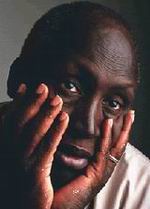
Ngugi wa Thiongo


Today’s Independent carries a long article about the great Kenyan author Ngugi wa Thiongo. His new novel Wizard of the Crow will be something I will be purchasing very soon.

Forces within Kenya have tried to silence Ngugi wa Thiong'o's voice twice. In 1977, the future president Daniel arap Moi threw him into a maximum-security prison without trial for co-authoring a play critical of the government. Ngugi was released one year later, only to discover that his teaching job had disappeared. He eventually left the country because of fear for his own safety in 1982.

For a while, it looked like he would never return. "Moi used to say, 'I can forgive anybody but Ngugi'," says the 68-year-old novelist today at his home in Irvine, where he is a professor of English at the University of California.. When Moi agreed to abide by term limits, and his hand-picked successor lost in the presidential elections, Wa Thiong'o realised that he had a chance to come home. It was good timing. Wa Thiong'o had just completed a six-volume satirical novel called Murogi wa Kagogo, a ribald satire of a fictional African dictator. It was also the longest novel ever written in his native Gikuyu language.

He decided to turn his homecoming into a book tour and lecture circuit. He and his second wife, Njeeri, had never been married in the traditional style, but most importantly they had never been to Kenya together as a family. "At the airport the crowds were there," he recalls, "some weeping, some holding onto books. All the newspapers headlined my talk."
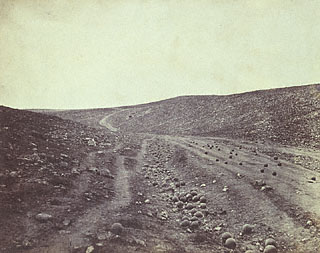
"Some of the books were covered in dirt," his wife says. "Because they had to bury them - to hide them - when his books were banned." And then things went horribly awry. On 11 August 2004, intruders broke into the apartment where they were staying. "We felt that this was no ordinary robbery," Wa Thiong'o recalls. " Quite frankly, I think we were going to be eliminated."

They managed to escape that fate, but not without suffering. Wa Thiong'o's wife was stabbed and raped in front of him. When Wa Thiong'o tried to intervene, he was burned with cigarettes on his forehead and arms. The couple emerged from hospital a day later, and Wa Thiong'o issued a profoundly sad but generous statement. "We have to keep rising up," he said. "The Kenyans who attacked me do not represent the spirit of the new Kenya."

Wa Thiong'o has laboured to bring his magnum opus from Gikuyu into English - no small feat when the book runs to 766 pages. The novel is now published in Britain as Wizard of the Crow (Harvill Secker, £17.99).
Set in the fictional African republic of Aburiria, the novel conjures a ruler who has surrounded himself with comically sycophantic cabinet ministers. One has surgically enlarged his ears to prove he always has an ear to the ground; another has had plastic surgery on his eyes to show that he has his eyes on the public. For the ruler's birthday, this group suggests building a tower up to heaven so that the ruler can speak directly to God. For funding, Aburiria's majestically self-important ruler turns to the Global Bank for cash, but he must constantly fight against the mockery of the public. An underground resistance called Movement for the Voice of the People protests against his ceremonies, while long lines of unemployed workers betray his failure to provide for his people.

"When people talk about Africa," Wa Thiong'o says, "they often only talk about it through one lens - so they blame its lack of progress on its people, or its landscape. In this book I wanted to show everything - the influence of aid, the neocolonialism of capital, and how this affects things for the people."

At the crux of the resistance are a young beggar named Kamiti and a revolutionary he falls in love with, Nyawira. Kamiti discovers he has the capabilities of a seer when he sets up shop as a fictional wizard, dispensing advice to people who want to crush their enemies. Nyawira occasionally sits in for him when he cannot make his engagements.

Although the leader's Westernised suits recall Arap Moi's jackal dapperness, Wa Thiong'o insists that this is not just a novel about Kenya and the failures of aid. "I was drawing from lots of Third World dictatorships: I was thinking of Moi, but also of Mobutu, Idi Amin and Pinochet. They were all on my mind... In 1982, when I was exiled, I was based in London, and I worked on the committee for the release of political prisoners in Kenya. I worked closely with people from Chile, from the Philippines."

One thing Wa Thiong'o shared with them was the colonial experience. He was born in a small village north of Nairobi with the name James Thiong'o Ngugi and raised a Christian. He attended mission schools, where he read Robert Louis Stevenson. Like Wole Soyinka and Chinua Achebe, he left Africa and went to England for further study, earning a degree from Leeds. Returning to Kenya, he successfully petitioned the University of Nairobi to turn its English department into the Department of African Languages and Literature, soon after renouncing his birth name and taking on its version in Gikuyu. As he explained once: "Language is a carrier of a people's culture, culture is a carrier of a people's values; values are the basis of a people's self-definition."

Since 2003, Wa Thiong'o has been distinguished professor of the humanities and director of the International Center for Writing and Translation at Irvine. "What is so devastating in a dictatorship is the taking away of a voice," he says. And the prevalence of English in the world, he argues, has only sharpened that blade against the larynx of indigenous peoples. "It is not a balanced equation if all languages must come to English to mean something."

Wa Thiong'o began writing fiction in Gikuyu while he was in prison 30 years ago, scribbling on toilet paper, and has never turned back. This has made his job a little harder, even as the circumstances of writing Wizard of the Crow were much easier than before. "I began it in Orange, New Jersey, and I finished in Orange County," he says. And yet this book's flavour is anything but sweet.


10 August 2006

Camper Van Beethoven - Take the Skinheads Bowling


A gloriously silly song. I love it!

Atrocity Foiled?

From the BBC

Flights out of the UK are today have been massively disrupted following an apparent disruption of a plot to blow up planes in flight from the UK to the US. It is thought the plan was to detonate explosive devices smuggled in hand luggage on to as many as 10 aircraft operated by United, American and Continental airlines.

Police are searching premises after 21 people were arrested. Home Secretary John Reid said had the attack gone ahead it would have caused a loss of life of "unprecedented scale". He said they were "confident" the main players are in custody, but neither the police nor the government is "in any way complacent".

The plot was thought to have involved a series of "waves" of simultaneous attacks, targeting three planes each time. He also said the plan "revolved around liquids of some kind".

Metropolitan Police Deputy Commissioner Paul Stephenson said the alleged plotters had intended "mass murder on an unimaginable scale. We are confident that we have disrupted a plan by terrorists to cause untold death and destruction and to commit, quite frankly, mass murder," he said. "We believe that the terrorists' aim was to smuggle explosives on to aeroplanes in hand luggage and to detonate these in flight. We also believe that the intended targets were flights from the United Kingdom to the United States of America."

According to BBC sources the "principal characters" suspected of being involved in the plot were British-born. There are also understood to be links to Pakistan. Despite the arrests the threat level had been raised "in case there is some other sub-plot, back-up plot around this that the police aren't aware of".

The Department for Transport set out the details of the security measures at UK airports. Passengers are not allowed to take any hand luggage on to any flights in the UK, the department said. Only the barest essentials - including passports and wallets - will be allowed to be carried on board in transparent plastic bags.

Some may accuse the government of scare tactics or perpetrating a ruse to facilitate a raft of more draconian anti terror laws. Such people would call me naïve or brainwashed but in the same way that I do not believe the government had any hand in 7/7 I do not believe they would pull a stunt like this. That does not mean the authorities do not get things badly wrong – de Menezes and the recent Forest Gate raid spring to mind.


From Big Oaks, Little Acorns Grow, Hopefuiiy

Guardian. David Cameron may still be a relative sapling among party leaders but it appears he is likely to fight the next election under the cover of a sweeping English oak tree. The Conservative party has been hunting for a new logo to replace Margaret Thatcher's flaming torch, which subsequent remakes turned into something resembling a dripping ice-cream on a hot summer's day.

From this

to this

Yesterday a fuzzy image of the likely alternative made its way on to a website for party supporters, with Mr Cameron's office confirming that the tree was the frontrunner among a series of designs being tested on party activists.
.
Labour's rose seems a bit lifeless these days. Perhaps it is time to take a leaf out of the Tory’s book and choose a different symbol. I personally would suggest choosing a more vigorous rose, such as the Kiftsgate rambling rose which can climb up to 80 feet and smother an oak in no time.


From this?


to this?

09 August 2006

Dead Can Dance - The song of the Sibyl

While eyes are on Lebanon, in Darfur….....


The Darfur peace agreement signed in May appears to be on the verge of collapse. Clashes involving government forces, allied militia and guerrilla factions have forced more than 50,000 people from their homes since the deal was signed three months ago, aid workers said. Most have ended up in overcrowded refugee camps, which are becoming increasingly difficult for aid agencies to reach. "There is extreme tension across Darfur," said Suliman Baldo, the Africa programme director for the International Crisis Group, who was in Sudan last week. "The peace deal is on the verge of collapse,"

The agreement, signed on May 5, was meant to end the violence that left more than 180,000 dead and 2 million displaced since the Arab-dominated government began targeting African tribes in February 2003. It now seems clear the deal was deeply, and perhaps fatally, flawed.
Only one of Darfur's rebel groups signed up - a faction of the Sudan Liberation Army (SLA) led by Minnie Minnawi. Minnawi, who is from the minority Zaghawa tribe, had little support on the ground. Most of the displaced in Darfur are Fur, and trust neither Mr Minnawi, who has been appointed as a special adviser to the president, Omar al-Bashir, nor the government.

Reports suggest Mr Minnawi's troops are receiving help from the government and its proxy Janjaweed militia in fighting rival rebel groups The new National Redemption Front now appears the strongest and most active rebel movement. Made up of the Justice and Equality Movement, which also shunned the peace deal, and dissident fighters from both SLA factions, it controls much of north Darfur.

"There is much more violence than everyone expected and the situation has quickly become fluid and complicated again," said Eltayeb Hag Ateya, director of the peace research institute at Khartoum University. "We thought Darfur inter-dialogue may work, but it hasn't and it seems we are in trouble now."

The camps are awash with rumour and suspicion. On July 20, three water and sanitation workers were beaten to death in a camp near Zalingei. With banditry and rebel attacks on the increase, effective aid work is becoming near impossible. Tearfund, Care, Relief International and Oxfam have all had staff killed in recent weeks, and Médecins sans Frontières' vehicles have been repeatedly attacked. The government has become increasingly emboldened. Last week, even as the UN secretary general, Kofi Annan, pushed for 18,600 troops to replace the toothless 7,000-strong African Union mission, the government issued several statements rejecting any intervention.

The status quo suits Khartoum. Mr Baldo said "All along, the government has been very actively promoting ethnic divisions and splintering the rebel groups to try to vindicate its claim that the Darfur crisis was always just a tribal problem,"

Source: Guardian


08 August 2006

In Praise of Essex Part 4 (well sort of) – Essex Man

Like Essex girl, Essex man is another well worn stereotype , Basically he is portrayed as a xenophobic Sun reader who drives a Dagenham dustbin (Ford to you), and is set on material gain (and minimal taxes): In the eighties Essex Man was at the (white)vanguard of Thatcherism.

Loadsamoney

Being an Essex man myself (well Romford was still part of Essex when I was born), I consider it to be an unfair portrayal. Unfortunately there have been “Essex men” for centuries.

Dick Turpin

Dick Turpin (as found on the Highways Agency website of all places!)

Change the Ford to a horse and the material gain to thuggery and highway robbery and you have Dick Turpin. Turpin was born in 1706 in rural Essex, the son of John Turpin, a small farmer and some-time innkeeper. Young Dick probably served an apprenticeship with a butcher in Whitechapel (later the hunting ground of Jack the Ripper). When his apprenticeship was over, he opened a butcher shop, and began to steal sheep, lamb and cattle. Caught in the act of stealing two oxen, he fled to Essex to save himself. He then tried his hand at smuggling, but proved as inept at this as he had at cattle rustling.

At this point Turpin was part of what was known as the Essex or Gregory Gang. The gang started raiding isolated farmhouses, terrorizing and torturing the occupants into giving up their valuables. Robbing remote farmhouses became the Gang's speciality, and it was only towards the end of his criminal career that Turpin was actually involved in highway robbery.

After the capture members of the gang Turpin returned to East Anglia where he began working with 'Captain' Tom King, one of the best-known highwaymen of the day.. One night, while on the road to London, he took a fancy to a particularly fine horse ridden by a man called Major. Mr. Major didn't take the loss lying down and the horse was finally traced to the Red Lion pub in Whitechapel. When Tom King came to collect the horse, he was arrested. Turpin, who had been waiting nearby, rode toward the constables holding King and fired at them. Unfortunately, he was a dreadful shot, and the bullets hit King rather than his captors.

Realising that he would not escape capture if he remained in the London area, Turpin set off for Yorkshire., where he settled under the name of John Palmer, financing his fancy lifestyle with frequent excursions into Lincolnshire for more horse and cattle rustling and the occasional highway robbery. One day, returning from an unsuccessful hunt he shot his landlord's rooster. When the landlord complained he threatened to kill the landlord and he was taken into custody. Things might not have gone badly for Turpin had he not written a letter to his brother, requesting him to 'procure an evidence from London that could give me a character’

Unfortunately for Turpin, his brother was too mean to pay the postage and returned the letter to the Post Office. By a great coincidence Turpin's former schoolmaster saw the letter recognised the handwriting. He took the letter to the local magistrate and, with his permission, opened it. Despite the fact that it was signed John Palmer the author was identified as Turpin. Convicted on two indictments, Turpin was sentenced to death and hanged in York in April 1739.

The legend of Dick Turpin as a dashing highwayman was sealed with the novel Rookwood (1834) by Harrison Ainsworth in which the highwayman 'Dauntless Dick Turpin' with his horse Black Bess is a secondary character. Ainsworth's description of an epic ride from Westminster to York caught the popular imagination and turned a fairly average pot-boiler into a runaway best-seller. History, romance, and legend rapidly blurred and, eventually, the fictional ride of Ainsworth's Turpin totally eclipsed the villain's real exploits. The metamorphosis of Dick Turpin, house-breaker, torturer, murderer, horse-stealer and all-round real nasty piece of work into Dick Turpin, Highwayman and Knight of the Road was complete.

For what it’s worth the great ride to York was actually made by a 17th-century highwayman John Nevison, who early one morning in 1676 robbed a homeward-bound sailor on the road outside Gads Hill, Kent. Deciding he needed to establish an alibi, Nevison set off on a ride that took him more than 190 miles in about 15 hours.

Source: Stand and Deliver


Umm... Errr....Welcome Home Dame Shirley


Today’s Independent reports that Dame Shirley Porter has returned to London after 12 years of self-imposed exile in Israel, Porter has bought a £1.5m flat in Mayfair close to the sumptuous Bayswater flat from which she masterminded a major gerrymandering operation during the 1980s.

The “homes for votes” affair was arguably the most scandalous case of political corruption in recent British history. It saw her convicted of selling council homes in marginal wards to prospective Tory voters. She was also found to have forced 122 homeless families likely to vote Labour out of eight marginal seats, forcing them instead to live in tower blocks that the council knew to be contaminated with asbestos.

At the time, Labour was threatening to take control of Westminster, which was seen as one of Tory flagship councils, following a near-victory in the 1986 elections. Following a district auditor's investigation in 1994, Dame Shirley was found guilty of wilful misconduct and gerrymandering, and ordered to pay surcharges of £31.6m to Westminster Council. This later rose to £42m with interest and legal fees.

She fled to Israel, which has no extradition treaty with the UK, and consistently refused to pay. Two years ago, Westminster, which is still run by the Conservatives, accepted £12.3m in settlement of her outstanding debt, and the case is now considered closed.

There is nothing to stop her returning to the UK but somehow I cannot imagine she will be anything but an unwelcome reminder of past Tory scandal. I doubt Cameron will be rushing to put her on his A list any time soon.


Genocidaires Still in Suburbia

Genocidaires in Suburbia also refers. According to today’s Guardian, Amnesty International is urging the attorney general to prosecute two Rwandan genocide suspects living in Britain. Secretary general, Irene Khan, has written to the attorney general, Lord Goldsmith, expressing "grave concern" that the government has failed to take any action against two men who are among the top 100 Rwandan genocide suspects at large and living in Europe.

Charles Munyaneza, 48, was granted asylum in Britain in 2000 and lives with his family in a semi detached house in Putnoe, Bedford. Celestin Ugirashebuja, 55, lives in Walton on the Naze, Essex. Both were mayors of towns in southern Rwanda during the 1994 genocide, and are accused by the Rwandan prosecutor general of organising and directing the killings in their provinces. They both deny the charges.

Had they been investigated when they first arrived in the UK in 2000, the men could have been sent for trial to the International Criminal Tribunal for Rwanda (ICTR) in Tanzania. However, the tribunal has now been instructed by the UN security council to complete all trials by 2008.

Ms Khan said the British government should put appropriate legislation in place so as to be able to prosecute in this country in line with the UK's international obligations There are precedents for the UK to prosecute such suspects: last year an Afghan warlord, Faryadi Sarwar Zardad, 42, was convicted at the Old Bailey of taking hostages and robbing, beating, and shooting civilians at a checkpoint in Afghanistan 10 years ago.


07 August 2006

Music Update


Although originally scheduled for release on 10 July, the new Hawkwind mini album Take Me to Your Future will now come out on 28 August. It will be a dual disc (CD one side, DVD on the other). The CD side will consist of five songs: the Reality of Poverty, Ode to a Time Flower, Small Boy plus re-workings of Uncle Sam’s on Mars and Silver Machine. The DVD side will contain a selection of concert performances. Full details have not been issued but it will include Utopia and Assassins of Allah.


Last Friday saw the release of Fall of Iron by folk-punk band Blyth Power. Blyth Power are very much an acquired taste, in no small part due to the distinctive voice of singer/drummer Joseph Porter. Sadly the not-wife has never acquired the taste so I am forced to listen to them when she is not around; unless I want the CD inserted into a non playing slot!


Finally Robyn Hitchcock will be releasing his new album Ole Tarantula in October. Recorded with Peter Buck (of REM), Scott McGaughey and Bill Rieflin as the Venus Three it includes Adventure Rocket Ship, Ole! Tarantula and (A Man's Gotta Know His Limitations) Briggs which I have heard him play live and are excellent. Other tracks include NY Doll, the Museum of Sex and Underground Sun which was written for a friend of Hitchcock's who died last year. Hopefully he will be touring the album later in the year.


Secret locations we knew about anyway

Today’s Guardian reports that the The Ordnance Survey has finally stopped falsifying Britain's maps, almost 80 years after the government first ordered cartographers to delete sensitive sites in the hope of thwarting German bombers.

The Landranger map series will, for example, now show the nuclear warhead plant at Burghfield, near Reading, previously shown as a mysteriously empty field while the access road appears for the so-called Corsham Computer Centre in Wiltshire, thought by conspiracy buffs to be Tony Blair's nuclear shelter.


AWE Burghfield ( from its own official site)

Censorship started in 1927 when Prime Minister Stanley Baldwin secretly instructed: "No work of defence shall appear upon any map on sale to the general public” During the cold war, the Ministry of Defence listed 4,800 "key points" to be deleted. Censorship was later slashed to a more manageable list of super-secret targets, such as the Windscale nuclear plant, and GCHQ, the radio espionage agency.

But technology was moving too fast. Firms such as Multimap systematically made aerial surveys available from 1999, and now satellite pictures are available on the web and via software like Google Earth.


GCHQ (from a government better public buildings website)

Intelligence writer Duncan Campbell said the tampering was a "futile farce that creaked on 40 years after it had ceased to have any conceivable value. It didn't even stop Hungarian diplomats taking picnics outside Burghfield in the 1960s."


06 August 2006

Cameron backs down over 'A-list'

The Guardian website is carrying a report that David Cameron is bowing to pressure from local conservative associations and letting them choose local favourites as candidates for by-election battles rather than from the “A-list” of candidates which was intended to increase the representation of women and ethnic minorities among its MPs.

Many Conservative Associations have already defied requests from the party's leadership over the choice of candidates: in the recent Bromley and Chislehurst by-election, activists preferred white, male barrister Bob Neill over a woman and an Asian candidate from the A-list. In future by-elections, Conservative Central Office would work with local associations to draw up a shortlist made up both of local people and A-list members.

Women and ethnic minorities are badly under represented in parliament – less than 20% of MPs are women; for ethnic minorities the figure is less than 4% (for the conservatives this figure is less than 1%). Forcing change is difficult (as we found to our cost in Blaenau Gwent) but parliament needs to reflect more closely the society it represents. While it amuses me to see Cameron in a spot of bother with his party it does highlight a problem that all parties need to address to a greater or lesser degree.


Yet Another Crab Spider Photo!


Shame the fangs are a little blurred but I do like this shot of the spider

From Nagyrev to the Yorkshire Dales

Helen Mirren is set to star in a new film called Angel Makers, a tale based on the murders that took place in the Hungarian village of Nagyrev from the end of the First World War until 1929.

The film was inspired by a documentary by the Dutch film-maker Astrid Bussink who spent four months in the village investigating claims that, after the First World War, an epidemic of poisoning claimed the lives of men who had recently returned to their wives from the trenches. The spouses were the suspected culprits.

'Angel maker' was the name given to the village midwife, Zsuzsanna Fazekas, who supplied the women with arsenic. This was originally a euphemism for her part-time trade of administering abortions but when village women complained about their drunken or violent husbands, Fazekas told them: 'If there's a problem with him, I have a simple solution.'.

Injured soldiers came home to a severe economic depression. It was a hard life. The circumstances were extreme, and feeding another mouth that couldn't contribute anything was too much of a burden on the family.

Over the years, with the village cemetery filling up, police suspicions grew. They started to exhume bodies. Out of 50 bodies examined, 46 contained arsenic. Fingers pointed towards the midwife. Mrs Fazekas cheated retribution by taking some of her own poison but 26 women form the village stood trial. Eight received the death sentence, the rest went to prison, seven of them for life.

Nagyrev women facing trial

The updated, fictionalised version of the story will see the women of a Yorkshire farming community take the place of the Hungarian villagers. They turn murderous when their British husbands return from the trenches to discover their places have been taken by German prisoners of war.

Note I have been advised by a good Hungarian friend that the expression Angel Makers is not appropriate as a description for the murders. It is an expression used in Hungary to describe aborted foetuses.

Story

BBC report on Nagyrev


05 August 2006

European Spider of the Year 2006


The not-wife called me out into the garden at lunchtime to show me another crab spider. The other ones we have seen in the garden were white but this one was yellow with red stripes on its abdomen.

According to the European Society of Arachnology , what we had seen was a female flower crab spider, Misumena vatia, exactly the same specie as the white ones we had seen and photographed earlier. Amazingly it has the ability to change its colour from white to yellow.

Like all crab spiders, Misumena has crab-like legs rotated onto their sides, which give the family its name. The flower crab spider is, a sit-and-wait predator. It mostly lurks among flower petals waiting for insects to fly by. The front legs, which are held outwards, will grab an unsuspecting visitor with amazing speed, while at the same time a poisonous bite is administered. Prey is mostly eaten on the flower and is sucked dry through tiny holes, such that an almost complete exoskeleton is left over.


Typical habitats are open spaces like meadows, moors and fields, but also sunny paths and forest margins, wasteland and gardens. In the UK the species seems to be occurring exclusively in the southern parts. In Europe Misumena occurs from Scandinavia to the Mediterranean.

The European Society of Arachnology has designated the flower crab spider as its spider of the year for 2006.


Tag, you’re it

I have been tagged

1: One book that changed your life:

No book has actually changed my life as such. Some have definitely influenced me. I
will choose 1984 by George Orwell, not because it changed my worldview but because it represented a major change in my reading tastes.

2: One book you have read more than once:
Quite a few have been given a second or third re-reading but I will choose The Poor Mouth by Flann O’Brien (well my blog takes its name from this book; I had better give it a plug!)

3: One book you would want on a desert island:

How to Build a Teleportation Device with Two Coconuts and a Hermit Crab by Alexander Selkirk

4: One book that made you laugh:

The War of Don Emmanuel’s Nether Part by Louis de Bernieres. A mix of the very dark and the riotously funny

5: One book you wish had been written:

Anything by John Kennedy Toole written after a Confederacy of Dunces. His suicide meant that this was his last.

6: One book you wish had never had been written:

The Soft Machine by William Burroughs. Utter shit

7: One book that made you cry:

No book has made me cry but there are a few where I wanted a happy ending. Emile Zola’s Germinal is an example

8: One book you are currently reading:

Talk Talk by TC Boyle

9: One book you have been meaning to read:

Not one book but a book cycle: In search of Lost Time by Marcel Proust.

10: Now tag five people

Redwine

Obokun

Dave

Gert

Elasticwaistbandlady

Size Zero?????

Nicole Ritchie

Today’s Independent reports that the "size 0" look favoured by Hollywood stars(?) such as Nicole Ritchie and Lindsay Lohan is beginning catching on with girls in Britain,.
Size 0 equates to a UK size 4 and is now cropping up on the UK high street. If it caches on it would herald a major shift in beauty ideals from the "perfect 10" that used to represent the ideal female shape in Britain to by the tiny LA look. There is some evidence for this shit: Victoria Beckham, a mother of three, was recently reported to have worn jeans that would fit a seven-year-old.
Victoria Beckham

The former Cosmopolitan editor Marcelle D'Argy Smith said the size 0 craze represented the "death of the grown-up woman". She believes that those who portray size 0 as a "normal" body shape are perpetuating a cult of thinness. "What is so bizarre about all this is that they are being praised for their bodies. Who is defining these bodies? Some gay men in the fashion industry who want to hang their clothes on stick insects," she said.

Karen Fenn, buying director for Topshop, said that its size 4 was intended for girls aged between 12 and 14. Only 2 per cent of sales in the Petite range were size 4. Ms Fenn said: "It's for a small and young customer. It's not something that is by any means for a grown woman."

Women come in all shapes and sizes, some will be waif-like and will be able to fit such a size but most will most certainly not. For me it beggars belief that anyone would consider the figure of a young teenage girl to be the ideal shape for an adult woman. The only people I can think of that have a penchant for the young teen look normally get hounded out of their homes and spend their prison sentences in isolation!

Arthur Lee RIP

Love - Alone Again Or (2003)


Arthur Lee of the 60s psychedelic rock band Love has died of Leukaemia in Memphis at the age of 61. A full obituary can be found here.

03 August 2006

Iranian Woman Awaits Stoning Decision

I have reported previously on Naznin Mahabad Fatehi here and here The Save Nazanin site reports that following her death sentence being overturned she will face a new trial starting early this month. Here’s hoping that the original death sentence will not be upheld.

Meanwhile today's Independent carried a report on Ashraf Kalhori a woman who has sentenced to death by stoning for adultery and conspiring to kill her husband. The chief of Iran's, Ayatollah Mahmoud Hashemi Shahroudi, declared a moratorium on stoning in December 2002, but it remains on the statute books and his decision could be reversed. Last month Mrs Kalhori was told by a special verdicts court that she would be executed within 15 days but after protests from her lawyer and international rights groups, Ayatollah Shahroudi is reviewing her case.

Shadi Sadr, the lawyer representing Mrs Kalhori, says she is optimistic. "We are campaigning to make the moratorium actually enacted in law," Mrs Sadr said. "While the law remains unchanged, cases of stoning can happen anywhere in the country despite Shahroudi's order because the head of the judiciary is not above the law."

Mrs Kalhori's husband, Akbar Estiri, was killed in April 2002 after quarrelling with their neighbour, Mahmoud Mirzaei. She says that the killing was accidental but police say she was having an affair with Mr Mirzaei and encouraged the attack. The sentence of stoning is for adultery, but she was also sentenced to 15 years in prison for her alleged part in the murder. Mrs Sadr says that if the stoning verdict is upheld it should not be implemented until after her prison term.

Mr Mirzaei received 100 lashes instead of stoning for adultery because he was unmarried, but was sentenced to death for the murder. However, this cannot be carried out for another nine years, when the youngest of the Kalhori children turns 18 and can decide to take blood money instead.

Human rights groups also say that issues such as stoning can divert attention from abuses for political crimes. Last week, a student leader, Akbar Mohammedi, died while on hunger strike in prison. A liberal academic, Ramin Jahanbegloo, has been held without trial for several months. Rights groups say incidences of such cases have increased since Mahmoud Ahmadinejad's election because officials do not expect him to interfere. They also point to an apparent strategy for countering political opposition by relaxing social rules while cracking down on political dissent


02 August 2006

Echinops 3 - in full bloom

Small portions but many courses

01 August 2006

Wordless Wednesday Blogroll


Cephalaria

Cephalaria gigantea