Safia Amajan the chief of the Woman’s Affairs department in Kandahar, had devoted the last five years of her life to improving women’s rights and opportunities for education and vocational training. Yesterday she was gunned down outside her home.
Ms Amajan had taken over the post of women's welfare officer soon after the fall of the Taliban. With the return of the Taliban, aid workers were intimidated into leaving the region but Ms Amajan was one of the few who refused to flee. Ms Amajan had asked for, and been refused, a protective vehicle, or bodyguards, despite repeated death threats. She was in a taxi when two gunmen on a motorcycle opened fire. A Taliban commander, Mullah Hayat Khan, declared that Ms Amajan had been "executed". He said: "We have told people again and again that anyone working for the government, and that includes women, will be killed."
Ms Amajan's funeral yesterday was attended by the provincial governor and hundreds of mourners, including tribal elders. In Kabul, President Karzai said: "The enemies of Afghanistan are trying to kill those people who are working for the peace and prosperity of Afghanistan. The enemies of Afghanistan must understand that we have millions of people like Amajan." Fariba Ahmedi, a female member of parliament, who attended the burial, said: "Those enemies who have killed her should know it will not derail women from the path we are on. We will continue on our way.”
Human rights groups point out, that the battle for women's rights is in serious danger of being lost. There are now entire provinces where there is no girls' education; of the 300 schools shut or burnt down, the majority were for girls. The death rate at childbirth is the second highest in the world, and the number of women who have committed suicide, mainly through self-immolation, has risen by 30 per cent in two years.
Safia
Amajan
Kandahar
26 September 2006


25 September 2006
Bringing the Dead (cells) to Life
While there are many false dawns in science, This article reports on a technique that could have real promise for medical research.
Scientists working under Professor Miodrag Stojkovic at Newcastle University have achieved a breakthrough in the field of stem cell research by taking cells from dead embryos and turning them into living tissue.
The technique could soon be used to create treatments for patients suffering from diseases such as Alzheimer's and Parkinson's, the researchers say. The breakthrough has been hailed by many scientists and ethical experts because it could circumvent opposition to stem cell experiments because live embryos will no longer need to be used.
In a paper, published last week online on the website of the journal Stem Cells, Stojkovic reveals he and his colleagues took 13 embryos, created by IVF. All 13 had stopped developing a few days after conception. The team then waited 24 hours to check that the embryos were no longer dividing before beginning their experiments. 'These were all deemed to be arrested embryos,' said Stojkovic. 'In other words, they were dead but they had the capacity to develop any different type of cell you could think of, including kidney cells, liver cells, and skin cells.'
George Daley, of the Harvard Stem Cell Institute, said the paper's approach raised scientific concerns. 'If there was something wrong with the embryo that made it arrest, isn't there something wrong with these cells? We don't know.' Josephine Quintavalle, of Comment on Reproductive Ethics, a Catholic campaign group. 'We do not have objections to the use of donated tissue and organs in other areas of medicine. There is the critical question of how you know when an embryo is dead or not.'
However, Stojkovic's work was given strong backing by Donald Landry, at the Columbia University Medical Center in New York: 'regardless of how you feel about personhood for embryos, if the embryo is dead, then the issue of personhood is resolved, This then reduces the ethics of human embryonic stem cell generation to the ethics of, say, organ donation. So now you're really saying, "Can we take live cells from dead embryos the way we take live organs from dead patients?
stem
cell
research
24 September 2006
Yawn, Rosindell

My poltroon of an MP Andrew Rosindell usually manages to vent his spleen in the local papers every week , quite often on some ludicrous pretext. This week his hobby horse is the new online postal service offered by the Royal Mail. It is now possible to pay for postage online and download a special barcoded stamp which can be printed on to a label or directly on to an envelope.
So why is Rosindell indignant? Is he a luddite who thinks ye internette be ye worke of ye deville? Apparently not: Rosindell’s anger is at the decision not to have the Queen's head on the internet stamps. This decision apparently ends a long tradition of having the monarch’s head on British stamps. The world's first stamp, the Penny Black, was issued on May 6, 1840 and featured the head of a young Queen Victoria.
Mr Rosindell, a staunch royalist and keen stamp collector, opposed the idea when it was first mooted in Parliament 18 months ago claiming the company is trying to shake off its links to Queen and country.
Err so what, Rosindell. I think most people would be far more concerned that the letter, package or what have you gets to where it needs to go quickly than whether the Queen’s head is on the stamp or not. Perhaps Rosindell’s time would be better spent railing at the real issues like compulsory Morris dancing on Wednesday mornings.
Source: Romford Recorder
Rosindell
wanker
23 September 2006
Kaiser Chiefs - I Predict A Riot
Wow a song made this century I really like. Perhaps I am not the dinosaur I thought I was!
The Bitter Price of Bravery
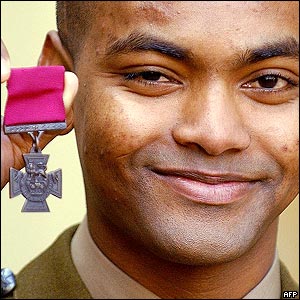
Today’s Telegraph carries an interview with Private Johnson Beharry who last year became the first recipient of the Victoria Cross in 23 years. It goes to show that even bravery comes with a bitter price.
The young soldier from Grenada was awarded Britain's highest award for valour for rescuing fellow soldiers from his burning armoured personnel carrier after it was hit by rocket-propelled grenades in two ambushes in 2004. espite serious injuries and being exposed to enemy fire he led his five-vehicle convoy to safety then clambered on to the red-hot metal to save colleagues, including his commanding officer.
When he went to Buckingham Palace to collect the VC, the Queen told him that the injuries inside would take the longest to heal. The Queen's words were prophetic: Pte Beharry said, he had yet to discover both the down side of fame and the full extent of his physical and mental injuries. Some members of his extended family, both in Britain and the Caribbean, had plagued him with requests for help, he said. "Everyone thinks that because I receive the Victoria Cross, I receive a wall of money," he said. "They expect me to give them whatever they ask for. But the Victoria Cross is just a medal.
Several members of the family have circulated stories that Pte Beharry, puffed up by his honour, deserted his home-loving wife for a striking Grenadian, Tamara Vincent. Pte Beharry says the reality is that the marriage was already over: his wife did not write to him when he was serving overseas and did not spend much time by his bedside when he was recovering from brain surgery. Pte Beharry's skull was shattered by the blasts and he still suffers blinding pain in his head, his back and his shoulder.
His brain injuries have altered his easy-going personality and left him short-tempered and quick to take offence. So he stays at home rather than risk "getting into trouble" in clubs or bars. Two years on, he is still having treatment. He said that doctors could not tell him when — or if — he would get better. Pte Beharry is now in an unusual position: superiors salute him but he has no job; he is on the Army payroll but without a role.
Pte Beharry was one of eight children brought up in a two-room hut in Grenada. He moved to Britain when he was 19 and worked on building sites. By joining the Army, he reversed a slide into drink and soft drugs and subsequently discovered an aptitude for driving the 25-ton Warrior vehicles. Asked whether there was ever a moment when he wished he were an unknown soldier again without his VC, Pte Beharry replied: "I am proud of it, but you don't get something like this for free. You get it and survive with the pain — or you get it and die."
Johinson Beharry is one of 1352 persons to receive the Victoria Cross since its inception in 1856. He is by far the youngest of the 12 living recipients. Eight of the living recipients were awarded the medal in WWII, one during the Korean War, one in the Malaysian-Indonesian Confrontation and one (an Australian) during the Vietnam War.
Beharry, like his predecessors were awarded this medal for extreme courage, (often in situations where given the choice I am sure they would rather have been elsewhere). One need not condone the presence of the British armed forces Iraq or any other war to acknowledge this.
A few other recipients
Lachiman Gurung Nepal
Charles Upham New Zealand one of only three persons to be awarded the medal twice
Edward Fogarty Fegen British of Irish descent

John Cornwell who is commemorated locally
Garden 23 September - A little better
 Same view after a lot of effort cutting away the detached foliage. Luckily none of the other plants seem damaged apart from some morning glories that had grown into the ivy.
Garden 23 September
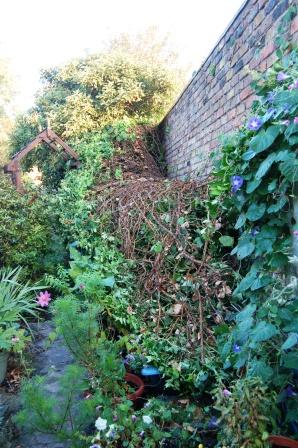
When the not-wife went out into the garden after coming home from work yesterday she was presented with this sight. Most of the ivy that makes this part of the garden look particularly lush had detached from the wall of the neighbour's shed. Although it was raining heavily yesterday, I doubt the it ccame away of it's own accord - the ivy is very healthy and there is no signigicant damage to the shed except for some missing pointing.
We suspect that this was a deliberate act. If the neighbour did rip the ivy away from his wall then he is a fool as well as a vandal: ripping it away could have done a lot more damage. We will have to see what damage has been done to the plants underneath but the ivy will be back.
22 September 2006
Guest Cat - TC
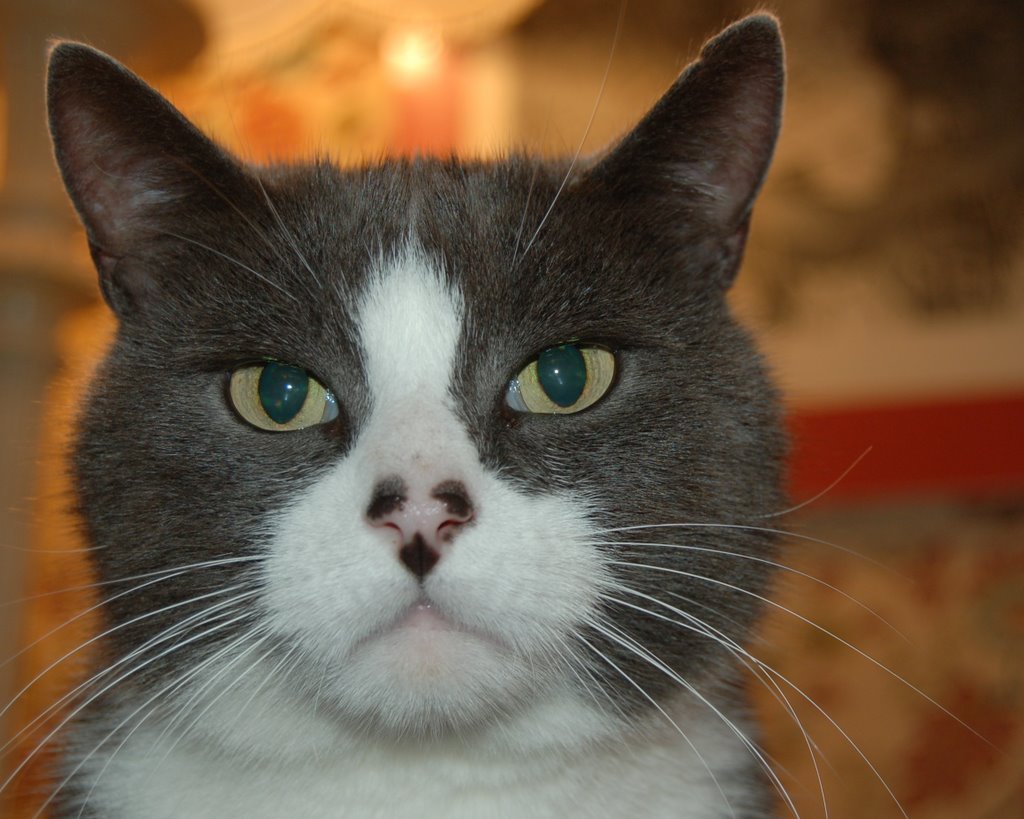 This is my sister's cat TC trying to look stern. Taken while over on a visit to my sister's lastweek. An early post for the Friday Ark and Carnival of the Cats (see sidebar for links)
21 September 2006
New Kindertransport Memorial at Liverpool Street Station
 Hope Square, outside Liverpool Street Station
Some time ago I posted an item about the Kindertransport memorial. Sadly the orignial memorial, which consisted of a statue of a girl and a transparent case containing memorabilia the children brought with them, had to be taken down after the memorabilia started to deteriorate.

It is good to see that a new statue is being constructed. Currently behind hoardings at present it consists of several bronze statues depicting children. It is not easy to get a good photograph througn the one small glass window but it does look like an excellent replacement, I look forward to its unveiling after which I will get better pictures
Kindertransport
Memorial
Sometimes it takes decades for the past to catch up with you.
Many news sources are carrying the story of Elfreide Rinkel who, for over 60 years, hid a a dark secret from friends and family. Although to her friends and family, especially her Jewish husband Fred, Mrs Rinkel was one of many Germans who had come to the US after the second world war to seek a better life.
On Tuesday the US Department Justice announced that Mrs Rinkel had been deported to Germany after US investigators discovered she had worked as a guard at Ravensbrück concentration camp, north of Berlin, from June 1944 to April 1945.
According to US charges filed in April, Elfriede Huth, who was born July 14 1922 in the east German city of Leipzig, had applied for a US immigrant visa in Frankfurt in 1959. The application told her to list all her residences from 1938, but she omitted Ravensbrück. She was admitted to the US in September 1959 at San Francisco.
Her sister-in-law, who was married to Mrs Rinkel's brother, Fred Rinkel had no idea of his wife's dark past. His funeral service was held at a Jewish memorial chapel and he was an active member of the Jewish service organisation B'nai B'rith. "He had to leave Germany during all that terrible stuff that happened there and had to relocate in Shanghai," she said. "A lot of the Jewish Germans went to Shanghai."
Mrs Rinkel had met her husband at a German-American Club in San Francisco. She lived in the US until her deportation. "We did help her to close up her apartment and helped her to buy her airplane ticket and go to the airport and buy her luggage - but never a word about why she was leaving," said her sister in law. "We thought she was going because her situation in her apartment had deteriorated. She said she just wanted to go back to Germany ... we believed her."
Completed in 1939, Ravensbruck was built almost exclusively for female prisoners. More than 130,000 women, mainly came from Poland or the occupied Soviet Union, passed through the camp during its history .. Only 40,000 survived. German historians said Mrs Rinkel had been one of about 3,500 young, unattached and mainly uneducated women from Germany and Austria who were overseers at the camp, some of whom were later executed.
Ephraim Zuroff, the head of the Simon Wiesenthal Centre in Jerusalem, said Mrs Rinkel's story was typical. Many low-ranking Germans who collaborated with the Nazis kept silent about their role to family and friends for decades afterwards, he said. He conceded, however, that what made Mrs Rinkel's case extraordinary was that she had then married a German Jew.
Elfreide
Rinkel
Ravensbruck
Subscribe to:
Posts (Atom)