This episode in Speedy's career is well known to readers of the Aubrey Maturin series. In the first book HMS Sophie takes on the Spanish frigate Cacafuego (shitfire?!!!). This was of course based on Speedy's encounter with El Gamo.
As stated HMS Speedy carried fourteen four pound cannons giving it a "massive" broadside weight of just 28lb. El Game was a 32 gun frigate carrying 22 12 pounder cannons, 10 8 pounders plus two 24 pounder carronades (shorter range guns also known as smashers for their destructive capability). El Gamo, with a broadside weight of 190lb should have been able to turn the sloop into matchwood but things don't always run to form.

Speedy was cruising off Barcelona at dawn on 6 May 1801 when El Gamo was sighted. El Gamo carried 319 men, compared to Speedy's complement of 90 of which 48 were away on prizes. Cochrane was many times outnumbered both in terms of broadside and in
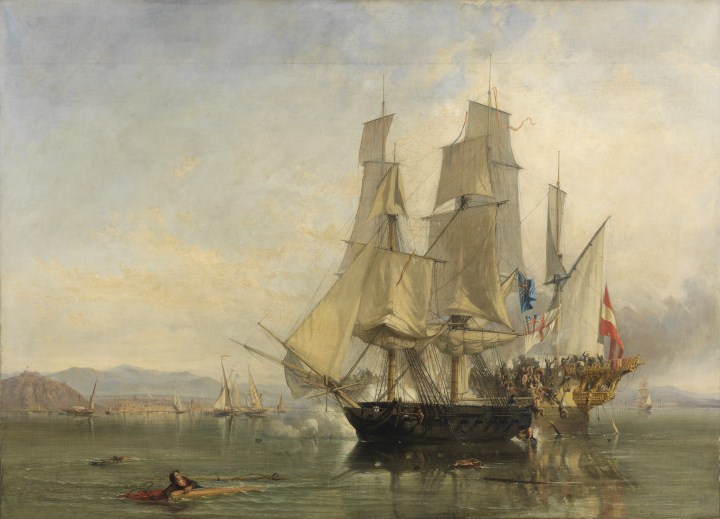
Instead of evading the frigate Cochrane closed on her, under false American colours. after hoisting British colours, Cochrane was able to evade Gamo's fire until he ran alongside her and locked her yards in Gamo's rigging. Gamo's fire was now ineffective as her guns were mounted too high to hit the Speedy. Cochrane then opened fire with his 4-pounders double- and treble-shotted, their shots passing up through the sides and decks, the first broadside killing the Spanish captain.
Seeing their disadvantage the Spanish second-in-command assembled a boarding party, at which Cochrane drew off, pounded their massed ranks with shot and musket fire, before drawing in close again. After having their attempts to board frustrated three times, the Spanish returned to their guns. Cochrane then decided to board the Gamo, and assembled his entire crew into two parties, leaving only the ship's doctor to command and crew Speedy. The British then rushed the Gamo, boarding from bow and waist. There was a hard-fought battle between the two crews, until Cochrane called down to the doctor, at the time the only person on Speedy, ordering him to send the rest of the men over. At the same time he ordered the Spanish colours to be torn down. Thinking that their officers had surrendered the ship, the remaining Spanish seamen stopped fighting.
Cochrane had lost three men killed and nine wounded, while the Spanish had lost 14 killed and 41 wounded with the rest captured. . Finding that he had been beaten by such an inferior foe, the Spanish second-in-command asked Cochrane for a certificate assuring him that he had done all he could to defend his ship. Cochrane obliged, with the equivocal wording that he had 'conducted himself like a true Spaniard'. El Gamo was subsequently sold to the ruler of Algiers as a merchantman.
This was not the end of the Speedy's adventures by any means. Cochrane returned to the coast off Barcelona in June 1801, and joined the 16-gun HMS Kangaroo in attacking a Spanish convoy of 12 merchant ships and 5 armed vessels, capturing thee brigs after a sharp action. Three weeks later he was cruising off Alicante when he encountered several merchant vessels, which ran ashore. Rather than wasting time trying to get them off, he burnt them, but in doing so attracted the attention of a foe vastly more powerful than the Gamo.
A formidable French squadron under the command of Rear-Admiral Linois which was bound for Cadiz to collect reinforcements for Napoleon's army in Egypt, sighted Speedy and gave chase. Cochrane ordered the guns, boats and provisions thrown overboard to lighten the ship but the French caught up. After narrowly avoiding the broadside of the 74-gun Dessaix, Cochrane struck his colours. He was taken aboard the Dessaix, where her captain, Christy-Pallière, recognised Cochrane's accomplishments by refusing to accept his sword. Cochrane was taken along with the fleet and watched the Battle of Algeciras Bay from the Dessaix. He and the crew of the Speedy were later exchanged in the aftermath of the battle. On returning to Gibraltar Cochrane was court-martialled for the loss of his ship, and honourably acquitted.
Speedy was taken to Toulon and renamed Saint Pierre and inscribed with the words "Donné par le premier consul Bonaparte au Pape Pie VII" ("Given by the First Consul Bonaparte to Pope Pius VII") in gilt letters on her poop cabin. She sailed from Toulon on 12 December 1802 bound for Rome as a present to the Pope. She was taken into the Papal Navy in 1804 under the name San Pietro, and remained there until being broken up in 1807.
Cochrane 's career saw astonishing highs and lows, during which he failed to defeat his greatest enemy - Lord Cochrane himself. But that is for a set of posts in their own right.
As stated HMS Speedy carried fourteen four pound cannons giving it a "massive" broadside weight of just 28lb. El Game was a 32 gun frigate carrying 22 12 pounder cannons, 10 8 pounders plus two 24 pounder carronades (shorter range guns also known as smashers for their destructive capability). El Gamo, with a broadside weight of 190lb should have been able to turn the sloop into matchwood but things don't always run to form.
Speedy was cruising off Barcelona at dawn on 6 May 1801 when El Gamo was sighted. El Gamo carried 319 men, compared to Speedy's complement of 90 of which 48 were away on prizes. Cochrane was many times outnumbered both in terms of broadside and in
Instead of evading the frigate Cochrane closed on her, under false American colours. after hoisting British colours, Cochrane was able to evade Gamo's fire until he ran alongside her and locked her yards in Gamo's rigging. Gamo's fire was now ineffective as her guns were mounted too high to hit the Speedy. Cochrane then opened fire with his 4-pounders double- and treble-shotted, their shots passing up through the sides and decks, the first broadside killing the Spanish captain.
Seeing their disadvantage the Spanish second-in-command assembled a boarding party, at which Cochrane drew off, pounded their massed ranks with shot and musket fire, before drawing in close again. After having their attempts to board frustrated three times, the Spanish returned to their guns. Cochrane then decided to board the Gamo, and assembled his entire crew into two parties, leaving only the ship's doctor to command and crew Speedy. The British then rushed the Gamo, boarding from bow and waist. There was a hard-fought battle between the two crews, until Cochrane called down to the doctor, at the time the only person on Speedy, ordering him to send the rest of the men over. At the same time he ordered the Spanish colours to be torn down. Thinking that their officers had surrendered the ship, the remaining Spanish seamen stopped fighting.
Cochrane had lost three men killed and nine wounded, while the Spanish had lost 14 killed and 41 wounded with the rest captured. . Finding that he had been beaten by such an inferior foe, the Spanish second-in-command asked Cochrane for a certificate assuring him that he had done all he could to defend his ship. Cochrane obliged, with the equivocal wording that he had 'conducted himself like a true Spaniard'. El Gamo was subsequently sold to the ruler of Algiers as a merchantman.
This was not the end of the Speedy's adventures by any means. Cochrane returned to the coast off Barcelona in June 1801, and joined the 16-gun HMS Kangaroo in attacking a Spanish convoy of 12 merchant ships and 5 armed vessels, capturing thee brigs after a sharp action. Three weeks later he was cruising off Alicante when he encountered several merchant vessels, which ran ashore. Rather than wasting time trying to get them off, he burnt them, but in doing so attracted the attention of a foe vastly more powerful than the Gamo.
A formidable French squadron under the command of Rear-Admiral Linois which was bound for Cadiz to collect reinforcements for Napoleon's army in Egypt, sighted Speedy and gave chase. Cochrane ordered the guns, boats and provisions thrown overboard to lighten the ship but the French caught up. After narrowly avoiding the broadside of the 74-gun Dessaix, Cochrane struck his colours. He was taken aboard the Dessaix, where her captain, Christy-Pallière, recognised Cochrane's accomplishments by refusing to accept his sword. Cochrane was taken along with the fleet and watched the Battle of Algeciras Bay from the Dessaix. He and the crew of the Speedy were later exchanged in the aftermath of the battle. On returning to Gibraltar Cochrane was court-martialled for the loss of his ship, and honourably acquitted.
Speedy was taken to Toulon and renamed Saint Pierre and inscribed with the words "Donné par le premier consul Bonaparte au Pape Pie VII" ("Given by the First Consul Bonaparte to Pope Pius VII") in gilt letters on her poop cabin. She sailed from Toulon on 12 December 1802 bound for Rome as a present to the Pope. She was taken into the Papal Navy in 1804 under the name San Pietro, and remained there until being broken up in 1807.
Cochrane 's career saw astonishing highs and lows, during which he failed to defeat his greatest enemy - Lord Cochrane himself. But that is for a set of posts in their own right.


