Irish Prime Minister Bertie Ahern has been in trouble recently over a loans scandal. Wags apparently been saying that you can now buy a T Shirt in Dublin saying "Been there, done that, bought the taoiseach."
Macuaid’s blog has a report on Ian Paisley at the Labour Party Conference. When he was at university he saw Ian Paisley at a public meeting. One heckler shouted "Paisley! You're a wanker!" Paisley replied, "Sir, my hands are on the table. Where are yours?"
I’ll get me coat…
01 October 2006


30 September 2006
Decameron v Webcameron
The Decameron hails from the 14th Century and is Giovanni Boccaccio’s wonderful collection of exactly 100 often quite bawdy stories, ostensibly told by a group of lords and ladies who have escaped an outbreak of bubonic plague in Florence and pass the time by telling stories to each other.
The Webcameron on the other hand is David Cameron’s attempt to bring the Tories kicking and screaming into the 13th century by use of cutting edge technology. Cameron’s first video is pretty risible and while I may be biased, I cannot see the IT generation turning Tory in droves as a result of this
The Decameron is available from Amazon at a reasonable price. The Webcameron is free and is worth as much
When the East End said “No Pasaran”
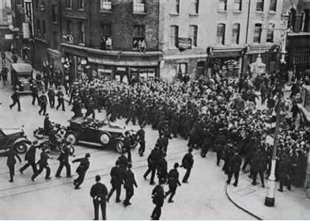
Next wednesday marks the 70th anniversary of the “Battle of Cable Street”, a day when the people of the East end united in defiance of Mosley's British Union of Fascists (BUF) and refused to let them march through their streets.
Shouting the Spanish civil war slogan "No pasaran" thousands (more than 300,000 according to the Daily Worker, the Communist Party newspaper) of East enders turned back a Blackshirt (another name for the BUF - not surprisingly on account of their predilection for wearing black shirts) march that was intended to be a general show of its strength in the area and to intimidate the local Jewish community (The east end at the time was home to s substantial proportion of Britain’s Jews).
The Jewish Board of Deputies had advised Jews to stay away. But they didn’t keep away. Side by side with the other East enders they built barricades, women threw the contents of chamber pots on to the heads of policemen and children hurled marbles under their horses and burst bags of pepper in front of their noses.
Professor Bill Fishman who was 15 on the day: "There was masses of marching people. Young people, old people, all shouting 'No Pasaran' and 'One two three four five - we want Mosley, dead or alive'," he said. “Between 3pm and 3.30 we could see a big army of Blackshirts marching. They were surrounded by an even greater army of police. There was to be this great advance of the police force to get the fascists through. Suddenly, the horses' hooves were flying and the horses were falling down because the young kids were throwing marbles."
Thousands of policemen were sandwiched between the Blackshirts and the anti-fascists. The latter were well organised and through a mole learned that the chief of police had told Mosley that his passage into the East End could be made through Cable Street.
"I heard this loudspeaker say 'They are going to Cable Street'," said Prof Fishman. "Suddenly a barricade was erected there and they put an old lorry in the middle of the road and old mattresses. The people up the top of the flats, mainly Irish Catholic women, were throwing rubbish on to the police. We were all side by side. I was moved to tears to see bearded Jews and Irish Catholic dockers standing up to stop Mosley. I shall never forget that as long as I live, how working-class people could get together to oppose the evil of racism."
Max Levitas, now 91, was a message runner at the time: "I feel proud that I played a major part in stopping Mosley…They did not pass. It was a victory for ordinary people against racism and anti-Semitism. The Battle of Cable Street is a history lesson for us all. People as people must get together and stop racism and anti-Semitism so people can lead an ordinary life and develop their own ideas and religions."
 A mural commemorating the Battle of Cable Street
Some may regard this portrayal of the Battle of Cable Street as romanticising a riot. It also ignores that there was also fair degree of support for the BUF in the East end. Perhaps it is to some extent but I wholeheartedly endorse the sentiments of both Professor Fishman and Mr Levitas. Living as we do in a vibrant and relatively inclusive society, racism and anti Semitism may not be quite so overt as they once were but there is still plenty of it around.
The East end’s Jewish community has declined considerably over the years, having been replaced to a great extent by Muslim Bengalis; they are now main targets for racist abise (and have been since well before 9/11 etc) . The BUF is long gone but in recent years we have seen a rise in support for the British National Party. The targets change somewhat, the names change but it is clear that the fight is far from over.
According to the East End Advertiser , there will be a commemoration day on Sunday October 8 with a procession, street theatre, music, singers and an exhibition of photographs from 1936, as well as stalls and other festivities.
Some Sources
Guardian report
What Next Journal (a Marxist perspective but worth reading)
For what it's worth, the battle of Cable street from a BUF supporting perspective
Blip or Good News?
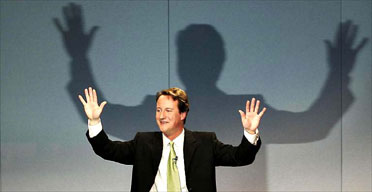 Cameron surrendering the Tory lead?
Following on from a bloodless and well behaved Party conference the Daily Telegraph gives faint hearted Labourites as me a little boost.
It carries a Yougov poll which indicates that the Tory lead that had opened up over the course of this year has been slashed with both parties currently level pegging at 36%. This compares with a similar poll last month where the Tories were showing a seven-point lead over Labour
The poll also suggests that just over half of voters do not know what the Tories currently stand for, while Cameron’s own personal approval rating is down from 46% at the beginning of the year to 35% now.
I know full well that one swallow does not a summer (or a White House intern famous) make but this sort of result indicates that if the Party can avoid fratricide (voters will always punish disunity) during the coming leadership election and get on this the business of government then maybe a fourth term can be ours
Labour
Conservative
opinion
poll
29 September 2006
First review of Ole Tarantula
Robyn’s new album Ole Tarantula finally hits the stores on Monday. Usually he ignored by large sections of the music press so it was good to see this review in yesterday’s Independent
Artist: Robyn Hitchcock & The Venus 3
Title: Olé! Tarantula
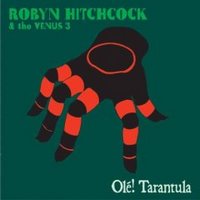
Robyn Hitchcock sounds more than ever like his hero Syd Barrett on this latest album, recorded in Seattle with his chums Peter Buck and the R.E.M. auxiliary of bassist Scott McCaughey and drummer Bill Rieflin. Indeed, the opening psych-rock wig-out "Adventure Rocket Ship" sounds like the Floyd might have if Syd had written the space-rock songs rather than Roger Waters. The rising melodic hook of "Red Locust Frenzy" recalls Tim Buckley; and the warm horns on "Museum Of Sex" have an engaging Memphis soul character - all of which illustrates the problem Hitchcock has in transcending his influences. But there is recompense here in the poppy, epiphanic "'Cause It's Love (Saint Parallelogram)", which may yet furnish him with the hit he deserves.
The reviewer gives if 3 stars (our of five) - to a fan this would translate to at least eight stars! I have heard a couple of the songs played live (Adventure Rocket Ship and a Man’s Gotta Know his Limitations, Briggs and of course Ole Tranatula itself) and if they are representative of the album as a whole then I will be a happy camper!
Artist: Robyn Hitchcock & The Venus 3
Title: Olé! Tarantula

Robyn Hitchcock sounds more than ever like his hero Syd Barrett on this latest album, recorded in Seattle with his chums Peter Buck and the R.E.M. auxiliary of bassist Scott McCaughey and drummer Bill Rieflin. Indeed, the opening psych-rock wig-out "Adventure Rocket Ship" sounds like the Floyd might have if Syd had written the space-rock songs rather than Roger Waters. The rising melodic hook of "Red Locust Frenzy" recalls Tim Buckley; and the warm horns on "Museum Of Sex" have an engaging Memphis soul character - all of which illustrates the problem Hitchcock has in transcending his influences. But there is recompense here in the poppy, epiphanic "'Cause It's Love (Saint Parallelogram)", which may yet furnish him with the hit he deserves.
The reviewer gives if 3 stars (our of five) - to a fan this would translate to at least eight stars! I have heard a couple of the songs played live (Adventure Rocket Ship and a Man’s Gotta Know his Limitations, Briggs and of course Ole Tranatula itself) and if they are representative of the album as a whole then I will be a happy camper!
Mimi puts on her war face
 Robyn looks at her when she pulls such a face and gives her his "ooh I'm scared" look. For the Friday Ark and Carnival of the Cats (see sidebar)
28 September 2006
Iva Toguri - Orphan Ann, not Tokyo Rose
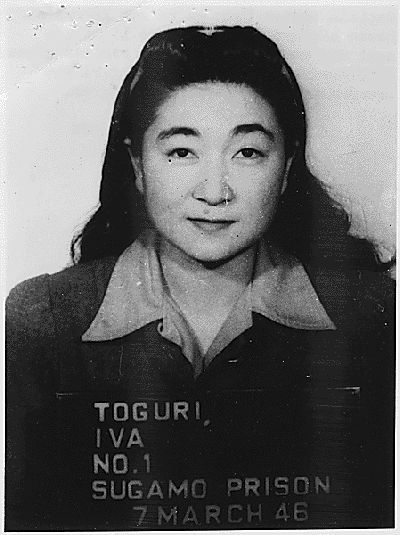
Many sources are carrying news of the death of Iva Toguri who after WWII was tried and convicted for broadcasting as “Tokyo Rose”. Although there is no doubt that Toguri made broadcasts on Japanese radio there never was a Tokyo Rose as such: It simply was a generic name given to describe around a dozen female presenters on Japanese Radio. Her broadcasts were never political and contained none of the venom spewed by Mildred Gillars (aka Axis Sally) a counterpart on German Radio.
This obituary comes from the Chicago Tribune.
Few who stopped in at J. Toguri Mercantile Co. on Belmont Avenue knew the story of the unassuming woman who moved quietly among the cluttered piles of Asian books and toiletries. Iva Toguri certainly didn't look like a war criminal, although the U.S. government convicted her as one following World War II. In the late 1940s, she was branded as being one of the voices of "Tokyo Rose," Japan's infamous radio siren to embattled U.S. troops, and served 6 years in a West Virginia prison.
Toguri lived with that stigma until 1977, when she received a presidential pardon following a flurry of media attention, including a series in the Chicago Tribune in which two of her chief accusers said their testimony had been coerced. A Chicago resident since 1956, Toguri, 90, died Tuesday, Sept. 26,
Toguri seldom spoke of her past and remained intensely private throughout her 50 years in Chicago. Customers at the store who knew who she was quickly learned that questions would go unanswered. "She didn't talk much about it," said Ross Harano, former president of the Chicago Chapter of the Japanese American Citizens League. "She was not a bitter person at all, she just put it aside."
Toguri was born on July 4, 1916, and grew up in California, where she received a degree in zoology from UCLA with designs on becoming a doctor. Those plans were waylaid by her ill-fated trip to Japan. Toguri was visiting a sick aunt in Japan when Pearl Harbor was bombed. He has since died. Stuck in the country, she was tossed out by her family because of her U.S. citizenship and harassed by the Japanese government. In 1943, she took a secretarial job at Radio Tokyo. The Japanese wanted a woman with an American accent for a radio show called "Zero Hour," and Toguri was enlisted
Toguri was one of about a dozen female broadcasters dubbed "Tokyo Rose" by American GIs. Toguri actually broadcast under the moniker "Orphan Ann" (Ann for announcer). While the Japanese were trying to use the broadcasts as propaganda, an Australian prisoner of war who wrote the shows Toguri did said the programs were intended as "straight-out entertainment”. Nonetheless, she was held for a year by U.S. occupying forces after the war, then released. But a public outcry fanned by influential radio broadcaster Walter Winchell led the U.S. to re-arrest her, said Wayne Collins, whose father defended Toguri at her 1949 trial in San Francisco.
Toguri was convicted of treason following a 12-week trial. The single count of which she was found guilty—seven others were thrown out—accused her of referring to U.S. sailors as "Orphans of the Pacific" and asking, "How will you get home now that your ships are sunk?"
Her innocence finally was proven in the 1970s through efforts by the media and her attorney. In 1976, two of her primary accusers told the Tribune's Far East correspondent, Ronald Yates, that FBI officials had forced them to give false testimony. His reports followed a February 1976 Tribune series by Linda Witt that brought Toguri's prosecution into question. TV's "60 Minutes" also did a segment on Toguri, said Collins, who had taken over his father's case and filed for a presidential pardon.
In January 1977, on his last day in office, President Gerald Ford pardoned Toguri. At the time, she said that she hoped to "go back to my simple life and work. The difference now is, however, that I have regained my American citizenship, a right and privilege I have always cherished."
Her father moved to Chicago after the war and started his import and retail business, which was initially on Clark Street. Toguri joined him after being released from prison and rarely talked about her ordeal.
In January, the World War II Veterans Committee presented Toguri with the Edward J. Herlihy citizen award, which is named after the World War II newsreels announcer. The committee had earlier printed Toguri's story in its newsletter, drawing an outpouring of support from veterans, said its president, James Roberts. "Not one said they were demoralized in any way by the broadcasts," Roberts said. "She remained loyal to the U.S., when many others may have turned on it, or given up." She accepted her medal during a quiet luncheon ceremony at Yoshi's, having declined an invitation to a larger gala three months earlier in Washington, D.C. "She was tearful and overcome with emotion," Roberts said. "As I understood it, it was part of a long process of vindication."
Toguri
Orphan
ann
Tokyo
Rose
27 September 2006
Lakes on Titan
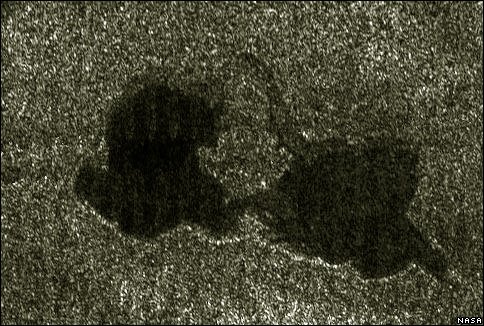
This picture can currently be found in the Science and Nature section of BBC news and plenty of other places too I would imagine. It was taken by the Cassini probe and shows two lakes on Saturn's moon Titan. Both are about 20-25km in size and almost certainly consist of liquid hydrocarbons rather than water.
Being someone who has been fascinated by space missions since the Moon landings this sort of picture makes me go "wow!"
26 September 2006
Blair’s swansong
 Tony Blair admitted "it's hard to let go" as he used his last Labour conference speech as leader to urge the party to unite and win a fourth term. He won a long standing ovation, telling an emotional Labour gathering.
He praised Gordon Brown and laughed off his wife's alleged criticism: "At least I don't have to worry about her running off with the bloke next door." (a reference to alleged comments made about Gordon Brown’s speech yesterday). "The truth is you can't go on forever, that's why it is right that this is my last conference as leader. "Of course it is hard to let go. But it is also right to let go. For the country, and for you, the party. Over the coming months, I will take through the changes I have worked on so hard these past years. And I will help build a unified party with a strong platform for the only legacy that has ever mattered to me - a fourth term election victory that allows us to keep changing Britain for the better.
As Mr Brown did in his speech, Mr Blair admitted there had been difficulties in their relationship. "But I know New Labour would never have happened and three election victories would never have been secured without Gordon Brown," he said. "He is a remarkable man, a remarkable servant to this country - and that is the truth."
With the Conservatives ahead in the opinion polls, Mr Blair urged people to remember there were three years until the next election. "Don't ignore the polls but don't be paralysed by them either," he said. Mr Blair's advice for the next election from his "hot seat" was that Labour had to meet the challenge of global changes - getting the balance right between openness and security and also continuing reforms to public services. "The danger in all this, for us, is not ditching New Labour. The danger is failing to understand that New Labour in 2007 won't be New Labour in 1997," he said.
Blair delivered a rousing speech and deserved the rapturous applause he received. It was a fitting swan song to over 12 years in power. Even if I can be gloomy about Labour’s prospects, I do appreciate what Blair has done for the Party. Despite some missed opportunities and major mistakes (Iraq being one). Once again, here’s hoping we can put aside the infighting (some hope I fear), have an orderly leadership election and then go on to win a fourth term. Hiho.....
Tony
Blair
Labour
Party
conference
Subscribe to:
Posts (Atom)