The title of this blog comes from a Gaelic expression -"putting on the poor mouth"-which means to exaggerate the direness of one's situation in order to gain time or favour from creditors.
25 October 2006
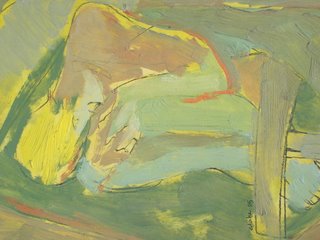
Elahe Heidari - Iranian Artist
Two years ago I knew little about Iranian culture. I still don’t know much but I was pleasantly surprised to discover (well not discover as such but to have it drawn to my attention by Redwine – for which I am extremely grateful) the sheer depth of quality of Iranian art.
One artist who stands out is Elahe Heidari. Elahe lives and works ln Tehran and has exhibited extensivley in Iran and as well as contributing to group exhibitions in India and Portugal
I was particularly taken with the sheer power of her work, particularly her portrayal of women. It is heartening that most who see examples of her work are deeply impressed and more than a few feel as strongly about it as I do.
More examples of her work can be found at Kargah and the Gallery Etemad. I would strongly recommend Kargah is well worth exploring at length.
Rush Limbaugh - what a nice man (hmm)
Perhaps we are fortunate “mild surprise” jocks here in the UK rather than the shock jocks that seem to be common on the American airwaves. While nobody is above criticism, Rush Limbaugh ‘s recent attack on Michael J Fox seems to have come back and bitten him on the arse.
Fox who suffers from Parkinson’s disease made a series of TV advertisements for Democratic candidates who support stem cell research. In the ads he talked to the camera during a violent shaking attack. Fox’s body weaved and writhed while his head jumped out of the frame in violent spasms.
Rush Limbaugh accused Mr Fox of acting to exaggerate the effects of his Parkinson's disease. He told his audience: "He is exaggerating the effects of the disease. He's moving all around and shaking and it's purely an act. This is really shameless of Michael J Fox. Either he didn't take his medication or he's acting." He added: "This is the only time I've ever seen Michael J Fox portray any of the symptoms of the disease he has. He can barely control himself
Neurosurgeon Prof John Boockvar, said: "Mr Limbaugh's allegations are ludicrous. Those with Parkinson's have "on" and "off" spells.” Dr Elaine Richman, a neuroscientist and author: "Mr Limbaugh's attack is insulting. It's appallingly sad, at best. "Anyone who knows the disease well would regard Mr Fox's movements as classic severe Parkinson's disease. Any other interpretation is misinformed."
As anger grew, Mr Limbaugh half-apologised, saying "Now people are telling me they have seen Michael J Fox in interviews and he does appear the same way in the interviews as he does in this commercial. I will bigly, hugely admit that I was wrong, and I will apologise to Michael J Fox, if I am wrong in characterising his behaviour on this commercial as an act." But then he added: "The truth - the whole truth - must be told. Michael J Fox is allowing his illness to be exploited. That Mr Fox is a victim is not a license for him to mislead or manipulate the public."
What a lovely guy. Just the sort of person many would like to grasp warmly by the throat. Limbaugh and his sort are one slice of american culture that can stay firmly on the other side of the Atlantic
24 October 2006
Robyn Hitchcock - Birdshead
Robyn performing one of his lesser (but still better than most things written imho!) songs with Peter Buck out of REM
23 October 2006
Hawkwind - Take me to your future

A little while ago I said that I was looking forward to getting my hands on the new Hawkwind release Take Me to Your Future. I have finally gotten around to buying it and despite some reservations I am certainly not disappointed.
Take Me to Your Future is unusual in that is a dual CD/DVD consisting of a 5 track EP on a one side and 5 Full video track plus extras on the other. .The cover appears to be based on Georgia O Keefe’s 1927 painting Radiator Building.
The five tracks on the CD side are: Uncle Sam’s On Mars, Small Boy, The Reality of Poverty, Ode to a Timeflower and Silver Machine.
Uncle Sam’s On Mars originally appeared on the 1979 album PXR5. The band has a habit of revisiting earlier works with varying degrees of success (Last year’s re workings of Paradox and Spirit of the Age were good but an earlier reworking of Psychedelic Warlords was dreadful). This new version of Uncle Sam is worthy enough: it is an improvement on the original in my view but you are left to question whether it really was necessary.
Small Boy and Ode to a Time Flower will appear on the forthcoming “Calvert Project” – poetry readings by the late, great Robert Calvert will be set to music composed by Dave Brock. According to Starfarer’s site both originally appeared in Centigrade 232, a 1978 collection of Calvert’s poetry and then again on audio cassette in 1988. The accompanying music to Small Boy is soft and atmospheric while Ode to a Time Flower is louder and has a “techno” edge. On the basis of these two tracks I am will certainly be purchasing the Calvert Project when it sees the light of day.
The Reality of Poverty should have appeared on last year’s Take Me to Your Leader (TYTML). I wasn’t too impressed when I first heard it but it is a grower. I am not sure why this was left off TYTML I would have much rather it had been included and the execrable Letter to Robert consigned to the dustbin.
Finally there is another re-recording of the bands biggest hit Silver Machine – My initial feeling was “why bother?” But it works. This is the definitive version of the song and justifies the price alone!
The tracks on the DVD side are Images, Utopia, Assassins of Allah, The Golden Void
Steppenwolf, Don’t be Donkish and Paradox
Images, like most of the other tracks on the DVD side, will appear on future DVD releases; in this case Space Bandits Space Bandits was a patchy affair, featuring Bridget Wishart, the band’s only female vocalist to date (I don’t count Samantha Fox !) Images was one of the highlights of the album. It is a good song and a good video which includes contemporary live video footage.
Utopia will appear on Australia 2000 – a recording of an Australian television broadcast from March 2000. . The band are on good form, the sound and image quality are excellent but perhaps the downside is Harvey Baindbridge’s improvised spoken part. A copy of the video is legally (honest!) available on YouTube courtesy of the bands record label Voiceprint I will let you judge for yourself.
Assassins of Allah (formerly Hassan i Sabha) is taken from the Hawkwind Passport holders only DVD Winter Solstice 2005. Recorded at last year’s Astoria concert, The band were on sparkling form that night and it is good to know that it has been recorded for posterity.
The Golden Void will appear on the re-release of the 1989 Treworgey Fayre concert (again for passport holders only). Great sound but again but the image quality isn’t that good.
Steppenwolf was recorded during rehearsals in 1996 and features the tour dancers practising their choreography. Odd footage but it is really quite enjoyable!
Finally there are photo montages of previous Hawkfests (the band's private festival) and the TYTML launch party A new instrumental, Don’t Be Donkish and a new version of Paradox provide the musical accompaniment
Take me to your Future is basically a sampler album for future releases with a couple of unique tracks/videos thrown in for good measure. Although an essential purchase for an obsessive fan (like me!) it is by no means the best introduction for a new listener. Given that it is available quite cheaply I would imagine that few fans would feel they have been ripped off.
Hawkwind TakeMe ToYour Future
22 October 2006
The end of the peer show at last?
Today’s Sunday Times (as well as plentu of other sources) is carrying a leaked government memo which indicates, perhaps, that movement on Lords reform may at long last be forthcoming.
A plan, drawn up by Jack Straw, the Commons leader proposes that the House of Lords will be reduced in size by more than a third to about 450, of which half will be elected. Life peerages will be abolished and the number of women and ethnic minorities substantially increased.
In addition peers would be allowed to sit in the Lords for no more than three parliamentary terms No single party would be allowed to command an overall majority, no matter how big its majority in the Commons.
The current system of attendance allowance would also be swept away. Instead, peers would be paid a salary and expected to work full-time, a change that could treble the current cost of £13m to the taxpayer despite the reduction in the number of lords.
Although the Tories and Liberal Democrats (and probably a fair few Labour members too) are expected to demand a bigger proportion to be elected the proposals for an equal mix of elected and appointed members is seen as a significant breakthrough in efforts to reach all-party agreement on Lords reform.
One Liberal Democrat peer close to the negotiations said: “The Lords reform logjam is breaking up. You can really feel the earth move when even Jack Straw, a hardcore constitutional conservative, is backing a 50% elected House of Lords.” However, Tom McNally, the Lib Dem leader in the Lords, warned Straw that allowing political appointments to continue would fail to address public fears over abuses and would create a system that was “institutionally corrupt”.
Proposals are expected to be put to a free vote in the Commons after Christmas, with the first elections and appointments to the new upper house taking place at the next general election
What is proposed does not go as far enough for my liking but at least it shows the Lords reform has not been brushed totally to one side. I do have one question: we are we are still debating the fate of our unelected upper chamber in the 21st Century?
Lords Reform
21 October 2006
How Soviet tanks crushed dreams of British communists
Over the last few days the Guardian has been carrying features on aspects of the Hungarian Uprising. Today’s article How Soviet tanks crushed dreams of British communists shows how the Communist Party of Great Britain was in effect destroyed on the streets of Budapest - over a quarter of its membership left in disgust. While it retained some influence in the Trade Union movement into the 1970s it was never again a significant political force.
On Sunday November 4 1956, the British Communist party executive committee convened for a highly charged session. New from Budapest was getting worse. Soviet forces were moving into the city, using tanks to shell rebel strongholds. The party paper, the Daily Worker, had been sticking to the official line about "counter-revolution" and "fascist activities". A few minutes away thousands of protestors were gathering in Trafalgar Square to demonstrate against the Anglo-French attack on Egypt. By rights, the comrades should have been protesting against the aggression in the Middle East. But they were preoccupied with their own problems.
They knew their condemnation of Eden's response to the Suez Canal nationalisation would ring hollow when the Red Army was mowing down Hungarian workers. However, general secretary John Gollan set a defiant tone by insisting that: "Imperialism was trying to regain ground. If the rebels won, it would be a victory for reaction and Hungary would become a fascist base with a dagger pointed at the socialist countries. The Red Army was therefore right to intervene."
Gollan was backed by Rajani Palme Dutt , the party ideologue (and a fanatical Stalinist) and the executive committee agreed, with just two dissenting voices, a statement that "the action of the Soviet forces in Hungary should be supported by communists and socialists everywhere".
1956 had already been momentous year for British Communists: the party had been shocked by the revelation of Nikita Khrushchev's secret speech to the 20th Soviet Communist party congress in which he had exposed and condemned Stalin's crimes. But it was events in Budapest that pushed thousands of communists over the edge towards Trotskyist groups, the Labour party, or out of politics altogether.
The party’s paper, the Daily Worker reflected the crisis among the rank and file. Reporter Peter Fryer had been sent to Budapest to report on the situation. It was expected that Fryer would contradict the “blood curdling” reports in other papers of Russian tanks shooting down Hungarians. These hopes were short-lived. Fryer completely contradicted the party’s analysis that the uprising was a "fascist-reactionary" attempt to destroy socialism and restore capitalism. Two of his three dispatches were spiked and the third heavily edited.
"The events in Hungary, far from being a fascist plot, were a revolution by the vast majority of the people against the despotic rule of the Stalinist bureaucracy," Fryer wrote later. The Daily Worker played up reports of lynchings (mostly of the AVO secret police) and of communists being beaten to death. Fryer resigned and sent his letter of resignation to the Manchester Guardian. Nineteen Daily Worker journalists resigned in solidarity and communists were reduced to reading the Daily Telegraph to find out what was happening.
By January 1957, the party had lost 9,000 members (a quarter of its membership , including historian EP Thompson, author Doris Lessing and leaders of the Fire Brigades Union and the Scottish miners - a quarter of its total strength. Others kept their heads down and stayed Chimen Abramsky, was a member of the international secretariat. His wife, Miriam, left the party straight after Hungary, but he hung on. "I was totally naive and utopian to believe I could change the party line from within, but I was knocking my head against a brick wall." Abramsky left in 1958 in solidarity with Hyman Levy who was expelled for an unauthorised pamphlet on anti-semitism in the USSR.
Historian Eric Hobsbawm, is often asked why he stayed in the party "longer than most". He answered in his book, Interesting Times: "I belonged to the generation tied by an almost unbreakable umbilical cord to hope of the world revolution, and of its original home, the USSR. For someone who joined where I came from and when I did, it was quite simply more difficult to break with the party than for those who came later and from elsewhere." Pride played its part, too.
Hungary 1956 uprising Communist Party
20 October 2006
Some jokes are not funny
A hat tip is due to Simply Jews for this story.
Vladimir Putin appears to have stuck his foot firmly in his mouth when he was overheard joking about the virility of Israeli president Moshe Katsav, who is accused of multiple rape.
Mr Putin's comment was made at the end of a press conference held by Mr Putin and Israeli Prime Minister Ehud Olmert in Moscow, which focused mainly on the Iran crisis. As the leaders prepared to leave, the microphone caught Mr Putin saying "greetings to your president". The microphone then went dead, but journalist Andrei Kolesnikov told the BBC he heard the rest of the comment. He said the president continued: "What a mighty man he turns out to be! He raped 10 women - I would never have expected this from him. He surprised us all - we all envy him!" There reportedly followed loud laughter among the official delegations.
Kremlin spokesman Dmitri Peskov admitted: "Yes really, these words were pronounced." But he said it "in no way means that President Putin welcomes rape". "The president was joking," he told the BBC's World Today radio programme. "Russian is a very complicated language, sometimes it is very sensitive from the point of view of phrasing. don't think that the proper translation is able to reflect the meaning of the joke."
Call me cynical or careworn but do I detect a little bit of spin doctoring on Mr Peskov’s part? Surely not!
Vladimir Putin
Another small piece of history
While I knew that Mike Fuller became the first black chief constable in 2004, it seems that I was wrong to believe that Norwell Roberts , who joined the Metropolitan Police in 1966, was not the UK’s first black police officer.
Today’s Independent carries an interesting story: it transpires that the first black police officer was John Kent, who worked in Carlisle from 1837. He was the son of, Thomas Kent, who was brought to work on the estate of a Cumberland landowner returning from duty with the colonial civil service in the West Indies.
Bob Lowther, a former detective superintendent who has researched the history of the old Carlisle City Constabulary, traced Mr Kent through police records. He first appears as a, "supernumerary constable'' or probationer, joining on 17 August 1837. He was made a permanent constable on 26 October. In 1841, he was in the thick of the action when a constable was murdered by a blow to the head as an election crowd got out of hand in the city centre and overwhelmed the Chief Constable and about eight of his officers. It is recorded that PC Kent gave evidence against the accused at Carlisle Assizes.
Sadly PC Kent's career did not end on a high note: he was sacked after just seven years with the Carlisle constabulary for being drunk on duty - a common occurrence among officers at the time. A lack of clean drinking water in the city is often blamed for excessive beer consumption. "He had reported late for duty two or three times," said Mr Lowther. "I don't know if drink had anything to do with that, but the force had had a new chief constable who had posted notices saying that anybody found drunk could expect severe punishment. On 6 December he came in intoxicated, so he was taken before the watch committee." The young officer was duly disciplined and his services were dispensed with on 12 December 1844.
The National Black Police Association (NBPA) attaches huge significance to the discovery of his career, which it says is totally unexpected. "The significance is that while we had people of colour joining that far back" said David McFarlane, NBPA's national co-ordinator. "A lot of people are under the misapprehension that black people only arrived here during the Windrush years (the 1940s and 1950s), or when the Asians came in the 1970s, but people of colour have been in this country for centuries.”
Norwell Roberts, joined the Metropolitan Police in 1966. (on the same day as former Met Commissioner Paul Condon), rose to the rank of Detective Sergeant and received the Queens Police Medal in recognition of 30 years distinguished service
black history police
Subscribe to:
Posts (Atom)