11 October 2006


Behind the Wall of Sleep - The Smithereens
A song that brings back memories.. I wont say what sort though
Dead Kennedys - Holiday in Cambodia
I saw the Dead Kennedys back in 1983 when they played at Southampton University. (Robyn Hitchcock or Hawkwind aside of course!) Possibly the best band I ever saw live.. This is one of my all time favourites.
10 October 2006
British Enough
On Sunday I posted an item about Diane Elias who had not been deemed British enough to be compensated for spending four years as a Japanese internee during WWII Today the Court of Appeal ruled that she is entitled to a compensation.
In 2000, when the government announced its compensation scheme for Japanese POWs and internees, Ms Elias was told she did not qualify because her parents were born in Iraq and India The Ministry of Defence had appealed against a High Court ruling in July last year which found that the blood link rule - that a parent or grandparent must have been born in the UK - was unlawful discrimination on grounds of race. This appeal was dismissed by the appeal judges. Lord Justice Mummery.
He said that the case was "The result of inadequate preparation has been an embarrassing administrative and legal muddle, personal pain, charges of incompetence, costly litigation and political apologies. " In his view "A cloud has been cast over what many people would agree was an honourable action of public benevolence."
Diane
Elias
In 2000, when the government announced its compensation scheme for Japanese POWs and internees, Ms Elias was told she did not qualify because her parents were born in Iraq and India The Ministry of Defence had appealed against a High Court ruling in July last year which found that the blood link rule - that a parent or grandparent must have been born in the UK - was unlawful discrimination on grounds of race. This appeal was dismissed by the appeal judges. Lord Justice Mummery.
He said that the case was "The result of inadequate preparation has been an embarrassing administrative and legal muddle, personal pain, charges of incompetence, costly litigation and political apologies. " In his view "A cloud has been cast over what many people would agree was an honourable action of public benevolence."
Diane
Elias
The Holocaust's Arab Heroes
This is an edited version of an article that appeared in Sunday’s issue of the Washington Post. A hat tip is due to panchromatica where I saw this article first.
Virtually alone among peoples of the world, Arabs appear to have won a free pass when it comes to denying or minimizing the Holocaust. Hezbollah leader Hasan Nasrallah has declared to his supporters that "Jews invented the legend of the Holocaust." Hamas's official Web site labels the Nazi effort to exterminate Jews "an alleged and invented story with no basis."
Such Arab viewpoints are not exceptional. Not a single official textbook or educational program on the Holocaust exists in an Arab country. In Arab media, literature and popular culture, Holocaust denial is pervasive and legitimized. Yet when Arab leaders and their people deny the Holocaust, they deny their own history as well -- the lost history of the Holocaust in Arab lands, one that reveals complicity and indifference on the part of some Arabs during the Holocaust, but also heroism on the part of others who took great risks to save Jewish lives.
Neither Yad Vashem, Israel's official memorial to Holocaust victims, nor any other Holocaust memorial has ever recognized an Arab rescuer. It is time for that to change. It is also time for Arabs to recall and embrace these episodes in their history. The Holocaust was an Arab story, too.
There were no death camps, but many thousands of Jews were consigned to more than 100 brutal labor camps, many solely for Jews. Indeed, the Arab lands of Algeria and Morocco were the site of the first concentration camps ever liberated by Allied troops. About 1 percent of Jews in North Africa (4,000 to 5,000) perished under Axis control in Arab lands, compared with more than half of European Jews. But if U.S. and British troops had not pushed Axis forces from the African continent by May 1943, the Jews of Algeria, Libya, Morocco would have met the same fate as those in Europe.
The Arabs in these lands were not too different from Europeans: With war waging around them, most stood by and did nothing; many participated fully and willingly in the persecution of Jews; and a brave few even helped save Jews. Arab collaborators were everywhere. These included overseers of Jewish work gangs, sadistic guards at Jewish labor camps and interpreters who went house to house with SS officers pointing out where Jews lived. Without the help of local Arabs, the persecution of Jews would have been virtually impossible.
But not all Arabs joined with the European-spawned campaign against the Jews. The few who risked their lives to save Jews provide inspiration beyond their numbers. Arabs welcomed Jews into their homes, guarded Jews' valuables so Germans could not confiscate them, shared with Jews their meager rations and warned Jewish leaders of coming SS raids. The sultan of Morocco and the bey of Tunis provided moral support and, at times, practical help to Jewish subjects. In the words of Yaacov Zrivy, from a small town near Sfax, Tunisia, "The Arabs watched over the Jews."
In the hills west of Tunis, 60 Jewish internees escaped from an Axis labor camp and banged on the farm door of a man named Si Ali Sakkat, who courageously hid them until liberation by the Allies. In the Tunisian coastal town of Mahdia, a local notable named Khaled Abdelwahhab scooped up several families in the middle of the night and whisked them to his countryside estate to protect one of the women from the predations of a German officer bent on rape.
There is strong evidence that the most influential Arab in Europe -- Si Kaddour Benghabrit, the rector of the Great Mosque of Paris -- saved as many as 100 Jews by having the mosque's administrative personnel give them certificates of Muslim identity, with which they could evade arrest and deportation. These men, and others, were true heroes.
Arabs need to hear these stories -- both of heroes and of villains. They especially need to hear them from their own teachers, preachers and leaders. If they do, they may respond as did that one Arab prince who visited the Holocaust museum. "What we saw today," he commented after his tour, "must help us change evil into good and hate into love and war into peace."
holocaust
arab
Virtually alone among peoples of the world, Arabs appear to have won a free pass when it comes to denying or minimizing the Holocaust. Hezbollah leader Hasan Nasrallah has declared to his supporters that "Jews invented the legend of the Holocaust." Hamas's official Web site labels the Nazi effort to exterminate Jews "an alleged and invented story with no basis."
Such Arab viewpoints are not exceptional. Not a single official textbook or educational program on the Holocaust exists in an Arab country. In Arab media, literature and popular culture, Holocaust denial is pervasive and legitimized. Yet when Arab leaders and their people deny the Holocaust, they deny their own history as well -- the lost history of the Holocaust in Arab lands, one that reveals complicity and indifference on the part of some Arabs during the Holocaust, but also heroism on the part of others who took great risks to save Jewish lives.
Neither Yad Vashem, Israel's official memorial to Holocaust victims, nor any other Holocaust memorial has ever recognized an Arab rescuer. It is time for that to change. It is also time for Arabs to recall and embrace these episodes in their history. The Holocaust was an Arab story, too.
There were no death camps, but many thousands of Jews were consigned to more than 100 brutal labor camps, many solely for Jews. Indeed, the Arab lands of Algeria and Morocco were the site of the first concentration camps ever liberated by Allied troops. About 1 percent of Jews in North Africa (4,000 to 5,000) perished under Axis control in Arab lands, compared with more than half of European Jews. But if U.S. and British troops had not pushed Axis forces from the African continent by May 1943, the Jews of Algeria, Libya, Morocco would have met the same fate as those in Europe.
The Arabs in these lands were not too different from Europeans: With war waging around them, most stood by and did nothing; many participated fully and willingly in the persecution of Jews; and a brave few even helped save Jews. Arab collaborators were everywhere. These included overseers of Jewish work gangs, sadistic guards at Jewish labor camps and interpreters who went house to house with SS officers pointing out where Jews lived. Without the help of local Arabs, the persecution of Jews would have been virtually impossible.
But not all Arabs joined with the European-spawned campaign against the Jews. The few who risked their lives to save Jews provide inspiration beyond their numbers. Arabs welcomed Jews into their homes, guarded Jews' valuables so Germans could not confiscate them, shared with Jews their meager rations and warned Jewish leaders of coming SS raids. The sultan of Morocco and the bey of Tunis provided moral support and, at times, practical help to Jewish subjects. In the words of Yaacov Zrivy, from a small town near Sfax, Tunisia, "The Arabs watched over the Jews."
In the hills west of Tunis, 60 Jewish internees escaped from an Axis labor camp and banged on the farm door of a man named Si Ali Sakkat, who courageously hid them until liberation by the Allies. In the Tunisian coastal town of Mahdia, a local notable named Khaled Abdelwahhab scooped up several families in the middle of the night and whisked them to his countryside estate to protect one of the women from the predations of a German officer bent on rape.
There is strong evidence that the most influential Arab in Europe -- Si Kaddour Benghabrit, the rector of the Great Mosque of Paris -- saved as many as 100 Jews by having the mosque's administrative personnel give them certificates of Muslim identity, with which they could evade arrest and deportation. These men, and others, were true heroes.
Arabs need to hear these stories -- both of heroes and of villains. They especially need to hear them from their own teachers, preachers and leaders. If they do, they may respond as did that one Arab prince who visited the Holocaust museum. "What we saw today," he commented after his tour, "must help us change evil into good and hate into love and war into peace."
holocaust
arab
09 October 2006
Kim Jong Il Absolutely Trusted by World People
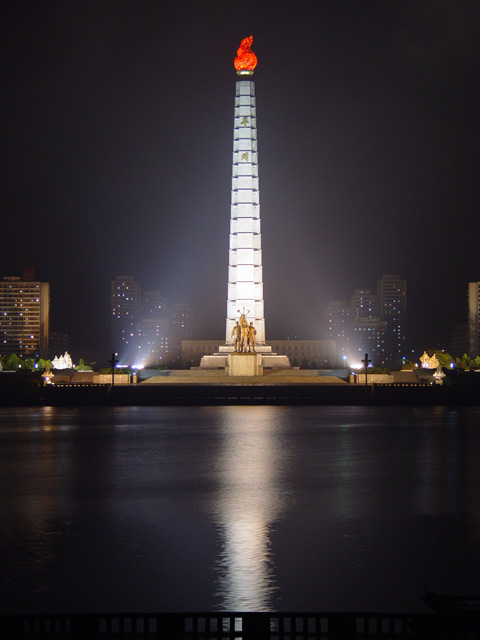 The Juche Tower - beacon to the world
If, like me, you are concerned by the news of North Korea’s firs nuclear test, then I hope you find comfort from this press release from the Korean Central News Agency of the Democratic People’s Republic of Korea that was issued last week on the occasion of the 61st anniversary of the founding of the Workers Party of Korea.
Progressives repose profound trust in Kim Jong Il today when the people's struggle for independence has entered on a new high phase. Personages of different strata, political parties and organizations of various countries sent a large number of wholehearted gifts, congratulatory letters and messages of greetings to him (Bashir Ramadan Khalifa Abu Janah, secretary of the People's Bureau of Libya and Rose Najjemba Muyinda of the Ugandan Womens Council).
The progressive people repose absolute trust in him, first of all, because they have a good understanding of the greatness of his feats (starvation, repression… it’s all good!). Kim Jong Il has dedicated himself to the human cause of independence for a long time, performing outstanding ideological and theoretical exploits which no other politicians and great men in history can ever match. In his famous work "Let Us Advance under the Banner of Marxism-Leninism and the Juche Idea” he set forth the issue of stepping up global independence an important strategic task to accomplish the revolutionary cause of the working class and achieve victory of human cause of independence.
One of his outstanding feats is that he founded the political mode of Songun (the army gets food and resources, the people get fuck all). The progressive people repose absolute trust in him next because they believe that he will wisely lead the cause of global independence in the 21st century to victory with responsibility for its future.

If you are not convinced then you are an evil reactionary who does not believe that Kim Jong-il's birth WAS heralded by the appearance of a double rainbow over the mountain of his birth (the official birth and not the real one in Siberia) and a new star in the heavens! Please go to the KCNA English language website and the Korean Friendship Association forum for the correct indoctrination….... That or a good laugh
.
North
Korea
Kim
Jong-Il
North Korea announces a successful nuclear test
Yesterday Shinzo, Abe, the Japanese PM and Hu Jintao, Chinese president, declared that a North Korean nuclear test “cannot be tolerated” and that Pyongyang should return unconditionally to negotiations on its nuclear programme.
A few hours later, however, North Korea reported that it had performed its first-ever nuclear weapons test. The North's official Korean Central News Agency said the underground test was performed successfully "with indigenous wisdom and technology 100 per cent," and that no radiation leaked from that test site.
"It marks a historic event as it greatly encouraged and pleased the (Korean People's Army) and people that have wished to have powerful self-reliant defense capability," KCNA said. "It will contribute to defending the peace and stability on the Korean Peninsula and in the area around it."
An official at South Korea's seismic monitoring center confirmed that a magnitude 3.6 tremor felt at the time of alleged North Korea nuclear test wasn't a natural occurrence. The U.S. Geological Survey said it recorded a seismic event with a preliminary magnitude of 4.2 in northeastern North Korea that coincided with the country's announced nuclear test. The Colorado-based agency was unable to tell whether the event was the result of an atomic explosion or a natural earthquake, USGS official Bruce Presgrave said. "At this magnitude, we can't tell whether it's a small earthquake or something else, like an explosion," Presgrave said.
China, the North's closest ally, said Beijing "resolutely opposes" the North Korean nuclear test and hopes Pyongyang will return to disarmament talks. The U.N. Security Council was expected to discuss the reported North Korean test Monday, and the United States and Japan are likely to press for a resolution imposing additional sanctions on Pyongyang. The council last week issued a statement condemning plans for a test.
The North is believed to have enough radioactive material for about a half-dozen bombs, using plutonium from its main nuclear reactor located at Yongbyon, north of the capital Pyongyang. The North also has active missile programs, but it isn't believed to have an atomic bomb design small and light enough to be mounted on a long-range rocket that could strike targets as far as the U.S.
If confirmed, the North would be the ninth country in the world known to have nuclear weapons. The other countries are the United States, Russia, France, China, Britain, India, Pakistan and Israel.
What next? Once the dust has settled, Japan and the US may seek UN approval for sanctions. Japan may also look at ways to step up unilateral sanctions. China might consider cutting off the economic and energy aid that largely keeps North Korea afloat.
In the long term the biggest fear is that North Korea may have opened a destabilizing local arms race with other nations seek their own atomic weapons as a safeguard against a nuclear-armed North Korea. There also a risk, of course, of an increase in nuclear proliferation as an even more impoverished North Korea selling nuclear technology to whoever is willing to pay for it.
This is not good news whatever way you look at it.
North
Korea
nuclear
test
A few hours later, however, North Korea reported that it had performed its first-ever nuclear weapons test. The North's official Korean Central News Agency said the underground test was performed successfully "with indigenous wisdom and technology 100 per cent," and that no radiation leaked from that test site.
"It marks a historic event as it greatly encouraged and pleased the (Korean People's Army) and people that have wished to have powerful self-reliant defense capability," KCNA said. "It will contribute to defending the peace and stability on the Korean Peninsula and in the area around it."
An official at South Korea's seismic monitoring center confirmed that a magnitude 3.6 tremor felt at the time of alleged North Korea nuclear test wasn't a natural occurrence. The U.S. Geological Survey said it recorded a seismic event with a preliminary magnitude of 4.2 in northeastern North Korea that coincided with the country's announced nuclear test. The Colorado-based agency was unable to tell whether the event was the result of an atomic explosion or a natural earthquake, USGS official Bruce Presgrave said. "At this magnitude, we can't tell whether it's a small earthquake or something else, like an explosion," Presgrave said.
China, the North's closest ally, said Beijing "resolutely opposes" the North Korean nuclear test and hopes Pyongyang will return to disarmament talks. The U.N. Security Council was expected to discuss the reported North Korean test Monday, and the United States and Japan are likely to press for a resolution imposing additional sanctions on Pyongyang. The council last week issued a statement condemning plans for a test.
The North is believed to have enough radioactive material for about a half-dozen bombs, using plutonium from its main nuclear reactor located at Yongbyon, north of the capital Pyongyang. The North also has active missile programs, but it isn't believed to have an atomic bomb design small and light enough to be mounted on a long-range rocket that could strike targets as far as the U.S.
If confirmed, the North would be the ninth country in the world known to have nuclear weapons. The other countries are the United States, Russia, France, China, Britain, India, Pakistan and Israel.
What next? Once the dust has settled, Japan and the US may seek UN approval for sanctions. Japan may also look at ways to step up unilateral sanctions. China might consider cutting off the economic and energy aid that largely keeps North Korea afloat.
In the long term the biggest fear is that North Korea may have opened a destabilizing local arms race with other nations seek their own atomic weapons as a safeguard against a nuclear-armed North Korea. There also a risk, of course, of an increase in nuclear proliferation as an even more impoverished North Korea selling nuclear technology to whoever is willing to pay for it.
This is not good news whatever way you look at it.
North
Korea
nuclear
test
08 October 2006
How British do you need to be?
The Court of Appeal will this week decide if Diana Elias, an 83-year-old widow who was held in a Japanese internment camp during the war, should be denied compensation on grounds of her nationality. Although she was considered British enough to suffer the awful experience of internment at the hands of the Japanese during WWII the government insists she is not quite British enough to be eligible for compensation from the government.
The Court of Appeal will decide whether the government was justified in deciding that to qualify as British an individual must have a 'blood link' through birth or ancestry. Elias was born in the British Empire and has always held a British passport, but the fact that her parents were Indian and Iraqi prompted the Ministry of Defence to claim she did not qualify for a payment scheme for individuals held in Japanese prisoner camps. To receive the payment, the victim's parents have to come from Britain.
Diana Elias is adamant that she has been discriminated against for racial reasons. 'What this "blood link" means is that being British is not good enough. Being interred because you were British is not good enough. You only count if you were born here in the UK, or your family originates from here. If not, then you are another type of British.. I was born British. I have always been British. I was proud to be British. I still am. One of the things that makes me proud to be British and to make this country my home is that people of different races, origins and backgrounds have mixed here and made a success of that. There could not have been more of a mix at my 80th birthday party, but almost all of us were British.'
Elias, was born in Hong Kong. Aged just 17, she was interned in the Stanley Camp. She still remembers being herded into a truck in the dead of night. She spent four years in the camp and the ordeal exacted a high price on the health of her entire family. 'I wake up in the middle of the night, with those thoughts still in my head. It is hard to get back to sleep.'
In November 2000 the government announced a £167m compensation scheme for British civilians interned by the Japanese during the Second World War with each receiving £10,000 as a 'debt of honour'. Several months after details of the scheme were published, the government decreed that claimants should show a 'blood link' with this country, disqualifying up to 2,400 whose forebears worked and lived in the Far East, often for the Armed Forces or the colonial administration.
Last summer Elias did receive £10,000 compensation after she took a separate case to the Parliamentary Ombudsman who ruled the compensation scheme was afflicted by 'maladministration'. She is not now looking for any further recompense from the government, but is still pursuing the case as the policy based on race, she claims, is perverse. The judge is expected to comment on the responsibility of the state to treat its citizens equally.
Diana
Elias
The Court of Appeal will decide whether the government was justified in deciding that to qualify as British an individual must have a 'blood link' through birth or ancestry. Elias was born in the British Empire and has always held a British passport, but the fact that her parents were Indian and Iraqi prompted the Ministry of Defence to claim she did not qualify for a payment scheme for individuals held in Japanese prisoner camps. To receive the payment, the victim's parents have to come from Britain.
Diana Elias is adamant that she has been discriminated against for racial reasons. 'What this "blood link" means is that being British is not good enough. Being interred because you were British is not good enough. You only count if you were born here in the UK, or your family originates from here. If not, then you are another type of British.. I was born British. I have always been British. I was proud to be British. I still am. One of the things that makes me proud to be British and to make this country my home is that people of different races, origins and backgrounds have mixed here and made a success of that. There could not have been more of a mix at my 80th birthday party, but almost all of us were British.'
Elias, was born in Hong Kong. Aged just 17, she was interned in the Stanley Camp. She still remembers being herded into a truck in the dead of night. She spent four years in the camp and the ordeal exacted a high price on the health of her entire family. 'I wake up in the middle of the night, with those thoughts still in my head. It is hard to get back to sleep.'
In November 2000 the government announced a £167m compensation scheme for British civilians interned by the Japanese during the Second World War with each receiving £10,000 as a 'debt of honour'. Several months after details of the scheme were published, the government decreed that claimants should show a 'blood link' with this country, disqualifying up to 2,400 whose forebears worked and lived in the Far East, often for the Armed Forces or the colonial administration.
Last summer Elias did receive £10,000 compensation after she took a separate case to the Parliamentary Ombudsman who ruled the compensation scheme was afflicted by 'maladministration'. She is not now looking for any further recompense from the government, but is still pursuing the case as the policy based on race, she claims, is perverse. The judge is expected to comment on the responsibility of the state to treat its citizens equally.
Diana
Elias
Hidden victims of the Iraq conflict: women
This is an edited version of a report in today’s Observer. While it may come as no big surprise it still makes grim reading and adds further confirmation (to this reader anyway) that Iraq is a doomed nation. I am not sure there is anything that can be done to hold it together.
They came for Dr Khaula al-Tallal in a white Opel car after she took a taxi home to the middle class district of Qadissiya in Iraq's city of Najaf. She worked for the medical committee that examined patients to assess them for welfare benefit. As al-Tallal, 50, walked towards her house, one of three men in the Opel stepped out and raked her with bullets.
A women's rights campaigner, Umm Salam - a nickname - knows about the three men in the Opel: they tried to kill her on 11 December last year. It was a Sunday, she recalls, and 15 bullets were fired into her own car as she drove home from teaching at an internet cafe. A man in civilian clothes got out of the car and opened fire. Three bullets hit her, one lodging close to her spinal cord. Her 20-year-old son was hit in the chest. Umm Salam saw the gun - a police-issue Glock. She is convinced her would-be assassin works for the state.
Iraq's women are living with a fear that is increasing in line with the numbers dying violently every month. They die for being a member of the wrong sect and for helping their fellow women. They die for doing jobs that the militants have decreed that they cannot do: for working in hospitals and ministries and universities. They are murdered, too, because they are the softest targets for Iraq's criminal gangs.
Iraq's women live in terror of speaking their opinions; of going out to work; or defying the strict new prohibitions on dress and behaviour applied across Iraq by Islamist militants, both Sunni and Shia. 'Women are being targeted more and more,' said Umm Salam last week. Her husband was a university professor who was executed in 1991 under Saddam Hussein after the Shia uprising. She survived by running her family farm. When the Americans arrived she got involved in civic action, teaching illiterate women how to read and vote, independent from the influence of their husbands. She helped them fill in forms for benefits and set up a sewing workshop. In doing so she put herself at mortal risk. And since the assassination attempt, like many women in Najaf, she has found it hard to work. Which is what the men in the white Opel wanted. To silence the women like Umm Salam,..
'
It is a story familiar to women across Iraq, In areas such as the Shia militia stronghold of Sadr City in east Baghdad, women have been beaten for not wearing socks. Even the headscarf and juba - the ankle-length, flared coat that buttons to the collar - are not enough for the zealots. Some women have been threatened with death unless they wear the full abbaya, the black, all-encompassing veil. Similar reports are emerging from Mosul, where it is Sunni extremists who are laying down the law, and Kirkuk.
In the north, too, last week the killing of women became more visible, with the al-Jazeera network reporting that attacks on women in the city of Mosul had led to an unprecedented rise in the number of women's bodies being found. Among them was Zuheira, a young housewife, found shot dead in the suburb of Gogaly. Salim Zaho, a neighbour, quoted by the television station, said: 'They couldn't kill her husband, a police officer, so they came for his wife instead.'
Most serious of all are the death threats women receive for simply working, even in government offices. Zainub - not her real name - works for a ministry in Baghdad. One morning, she said, she arrived at work to find that a letter had been sent to all the women. 'When I opened up the note it said, "You will die. You will die".'
The situation has been exacerbated by the undermining of Iraq's old Family Code, established in 1958, which guaranteed women a large measure of equality in key areas such as divorce and inheritance. The new constitution has allowed the Family Code to be superseded by the power of the clerics and new religious courts, with the result that it is largely discriminatory against women. The clerics have permitted the creeping re-emergence of men contracting multiple marriages, formerly discouraged by the old code. It is these clerics, too, who have permitted a sharp escalation in the 'pleasure marriages'. And it is the same clerics overseeing the rapid transformation of a once secular society - in which women held high office and worked as professors, doctors, engineers and economists - into one where women have been forced back under the veil and into the home. The result is mapped out every day on Iraq's streets and in its country lanes in individual acts of intimidation and physical brutality that build into an awful whole.
In the Shia neighbourhood of al-Shaab in Baghdad, militiamen with the Jaish al-Mahdi put out an order banning women from wearing sandals and certain shoes, skirts and trousers. They beat up others for wearing the wrong clothes.
In Amaryah, a Sunni stronghold in Baghdad, Sunni militants shave three women's heads for wearing the wrong clothes and lash young men for wearing shorts. In Zafaraniyah, a largely Shia suburb south of Baghdad, the Jaish al-Mahdi militiamen wait outside a school and slap girls not wearing the hijab.
'Since the beginning of August it has just been getting worse,' says Nagham Kathim Hamoody, an activist with the Iraqi Women's Network in Najaf . 'There are more women being killed and more bodies being found in the cemetery. I don't know why they are being killed, but I know the militias are behind the killing '
Iraq
They came for Dr Khaula al-Tallal in a white Opel car after she took a taxi home to the middle class district of Qadissiya in Iraq's city of Najaf. She worked for the medical committee that examined patients to assess them for welfare benefit. As al-Tallal, 50, walked towards her house, one of three men in the Opel stepped out and raked her with bullets.
A women's rights campaigner, Umm Salam - a nickname - knows about the three men in the Opel: they tried to kill her on 11 December last year. It was a Sunday, she recalls, and 15 bullets were fired into her own car as she drove home from teaching at an internet cafe. A man in civilian clothes got out of the car and opened fire. Three bullets hit her, one lodging close to her spinal cord. Her 20-year-old son was hit in the chest. Umm Salam saw the gun - a police-issue Glock. She is convinced her would-be assassin works for the state.
Iraq's women are living with a fear that is increasing in line with the numbers dying violently every month. They die for being a member of the wrong sect and for helping their fellow women. They die for doing jobs that the militants have decreed that they cannot do: for working in hospitals and ministries and universities. They are murdered, too, because they are the softest targets for Iraq's criminal gangs.
Iraq's women live in terror of speaking their opinions; of going out to work; or defying the strict new prohibitions on dress and behaviour applied across Iraq by Islamist militants, both Sunni and Shia. 'Women are being targeted more and more,' said Umm Salam last week. Her husband was a university professor who was executed in 1991 under Saddam Hussein after the Shia uprising. She survived by running her family farm. When the Americans arrived she got involved in civic action, teaching illiterate women how to read and vote, independent from the influence of their husbands. She helped them fill in forms for benefits and set up a sewing workshop. In doing so she put herself at mortal risk. And since the assassination attempt, like many women in Najaf, she has found it hard to work. Which is what the men in the white Opel wanted. To silence the women like Umm Salam,..
'
It is a story familiar to women across Iraq, In areas such as the Shia militia stronghold of Sadr City in east Baghdad, women have been beaten for not wearing socks. Even the headscarf and juba - the ankle-length, flared coat that buttons to the collar - are not enough for the zealots. Some women have been threatened with death unless they wear the full abbaya, the black, all-encompassing veil. Similar reports are emerging from Mosul, where it is Sunni extremists who are laying down the law, and Kirkuk.
In the north, too, last week the killing of women became more visible, with the al-Jazeera network reporting that attacks on women in the city of Mosul had led to an unprecedented rise in the number of women's bodies being found. Among them was Zuheira, a young housewife, found shot dead in the suburb of Gogaly. Salim Zaho, a neighbour, quoted by the television station, said: 'They couldn't kill her husband, a police officer, so they came for his wife instead.'
Most serious of all are the death threats women receive for simply working, even in government offices. Zainub - not her real name - works for a ministry in Baghdad. One morning, she said, she arrived at work to find that a letter had been sent to all the women. 'When I opened up the note it said, "You will die. You will die".'
The situation has been exacerbated by the undermining of Iraq's old Family Code, established in 1958, which guaranteed women a large measure of equality in key areas such as divorce and inheritance. The new constitution has allowed the Family Code to be superseded by the power of the clerics and new religious courts, with the result that it is largely discriminatory against women. The clerics have permitted the creeping re-emergence of men contracting multiple marriages, formerly discouraged by the old code. It is these clerics, too, who have permitted a sharp escalation in the 'pleasure marriages'. And it is the same clerics overseeing the rapid transformation of a once secular society - in which women held high office and worked as professors, doctors, engineers and economists - into one where women have been forced back under the veil and into the home. The result is mapped out every day on Iraq's streets and in its country lanes in individual acts of intimidation and physical brutality that build into an awful whole.
In the Shia neighbourhood of al-Shaab in Baghdad, militiamen with the Jaish al-Mahdi put out an order banning women from wearing sandals and certain shoes, skirts and trousers. They beat up others for wearing the wrong clothes.
In Amaryah, a Sunni stronghold in Baghdad, Sunni militants shave three women's heads for wearing the wrong clothes and lash young men for wearing shorts. In Zafaraniyah, a largely Shia suburb south of Baghdad, the Jaish al-Mahdi militiamen wait outside a school and slap girls not wearing the hijab.
'Since the beginning of August it has just been getting worse,' says Nagham Kathim Hamoody, an activist with the Iraqi Women's Network in Najaf . 'There are more women being killed and more bodies being found in the cemetery. I don't know why they are being killed, but I know the militias are behind the killing '
Iraq
Zinoviev Letter in SIS forgery (no) shock
According to today’s Independent a British spy and close friend of Winston Churchill was deeply implicated in the Zinoviev Letter, the most notorious political forgery in British history. The publication of the Zinoviev letter four days before the 1924 general election helped to sweep Britain’s first Labour government from power. The correspondence, which ostensibly mobilized “sympathetic forces" in Labour party, was later found to be a fake.
A new book (Churchill's Man of Mystery: Desmond Morton and the World of Intelligence) , based on access to closed intelligence files, suggests (as has long been suspected) that the document was a "dirty tricks" operation by the Secret Intelligence Service (SIS), overseen by Major Desmond Morton. Morton, a First World War hero whom Churchill befriended in the trenches, became an SIS officer on his recommendation and later went on to become the war leader's "spymaster".
It was Morton who first received the letter, purporting to be from Grigori Zinoviev, president of the Comintern, the internal communist organisation, from an agent in Riga, Latvia. It called on British Communists to mobilise the Labour Party to support an Anglo-Soviet treaty. Morton helped to ensure the letter ended up in the Daily Mail, which ran the story under the headline: "Civil war plot by Socialists' masters: Moscow orders to our Reds; great plot disclosed". Ms Bennett, the author of Churchill’s Man of Mystery, found he later covered up evidence that it was a fake. "It might be that since he detested the Bolsheviks and the Labour government, he welcomed the chance to throw a spanner in the works," said Ms Bennett.
Zinoviev
Letter
forgery
A new book (Churchill's Man of Mystery: Desmond Morton and the World of Intelligence) , based on access to closed intelligence files, suggests (as has long been suspected) that the document was a "dirty tricks" operation by the Secret Intelligence Service (SIS), overseen by Major Desmond Morton. Morton, a First World War hero whom Churchill befriended in the trenches, became an SIS officer on his recommendation and later went on to become the war leader's "spymaster".
It was Morton who first received the letter, purporting to be from Grigori Zinoviev, president of the Comintern, the internal communist organisation, from an agent in Riga, Latvia. It called on British Communists to mobilise the Labour Party to support an Anglo-Soviet treaty. Morton helped to ensure the letter ended up in the Daily Mail, which ran the story under the headline: "Civil war plot by Socialists' masters: Moscow orders to our Reds; great plot disclosed". Ms Bennett, the author of Churchill’s Man of Mystery, found he later covered up evidence that it was a fake. "It might be that since he detested the Bolsheviks and the Labour government, he welcomed the chance to throw a spanner in the works," said Ms Bennett.
Zinoviev
Letter
forgery
Subscribe to:
Posts (Atom)