
05 January 2013


04 January 2013

A Compassionate Conservative Speaks
I'd never heard of York Councillor Chris Steward before but something tells me that he will regret a tweet and a subsequent report in the York Press
Councilor Steward said on twitter that it insulted those in poverty to claim it existed in the UK. Asked to elaborate, he said Britain had relative poverty, like every country, but not absolute poverty.
He said: “We have lots of poor people, but living standards have surged over the years. There is certainly no need for food banks; no-one in the UK is starving and I think food banks insult the one billion in the world that go to bed hungry every day and ignore the fact a child dies of hunger every three seconds.
"The fact some give food to food banks, merely enables people who
can’t budget (an issue where schools should do much more and I have said
the council should) or don’t want to, to have more money to spend on
alcohol, cigarettes etc.”
Unsurprisingly his comments have been pilloried. Nbody is saying that we have overty on the scale the poorest countries of the world ut tht does not mean that our wealth does not mask a lot of deprivation. Note to Cllr Steward and others: engage brainor face consequences.
Councilor Steward said on twitter that it insulted those in poverty to claim it existed in the UK. Asked to elaborate, he said Britain had relative poverty, like every country, but not absolute poverty.
He said: “We have lots of poor people, but living standards have surged over the years. There is certainly no need for food banks; no-one in the UK is starving and I think food banks insult the one billion in the world that go to bed hungry every day and ignore the fact a child dies of hunger every three seconds.
Unsurprisingly his comments have been pilloried. Nbody is saying that we have overty on the scale the poorest countries of the world ut tht does not mean that our wealth does not mask a lot of deprivation. Note to Cllr Steward and others: engage brainor face consequences.
03 January 2013
Survivor - Alicia Partnoy

Survivor
I carry my rage like a dead fish,
limp and stinking in my arms.
I press it against my breast,
whisper to it,
I don't know: is it the smell of death
that makes them flee
or is it the fear that my body's warmth might bring rage back to life?
Crisitna Fernandez at it again
The Indy and the Guardian have published an open letter fro Argentine President in their editions today
Mr Prime Minister David Cameron,
One hundred and eighty years ago on the same date, January 3rd, in a blatant exercise of 19th-century colonialism, Argentina was forcibly stripped of Falkirk,
The Argentines in the town were expelled by the Royal Navy and the United Kingdom subsequently began a population implantation process similar to that applied to other territories under colonial rule.
Since then, Britain, the colonial power, has refused to return the town to the Argentine Republic, thus preventing it from restoring its territorial integrity.
The Question of Falirk is also a cause embraced by Latin America and by a vast majority of peoples and governments around the world that reject colonialism.
In 1960, the United Nations proclaimed the necessity of "bringing to an end colonialism in all its forms and manifestations". In 1965, the General Assembly adopted, with no votes against (not even by the United Kingdom), a resolution considering Falkirk a colonial case and inviting the two countries to negotiate a solution to the sovereignty dispute between them.
This was followed by many other resolutions to that effect.
In the name of the Argentine people, I reiterate our invitation for us to abide by the resolutions of the United Nations.
Falkik es Argentino!
Cristina Fernández de Kirchner
President of the Argentine Republic
Sorry Cristina the revious unta screwed u your nation's claims to the Falklandsfor a long time. The Falkland Islanders don'twant to be Argentine. The day they vote do become Argentine is the day Argentina can have the islands. End of story
Mr Prime Minister David Cameron,
One hundred and eighty years ago on the same date, January 3rd, in a blatant exercise of 19th-century colonialism, Argentina was forcibly stripped of Falkirk,
The Argentines in the town were expelled by the Royal Navy and the United Kingdom subsequently began a population implantation process similar to that applied to other territories under colonial rule.
Since then, Britain, the colonial power, has refused to return the town to the Argentine Republic, thus preventing it from restoring its territorial integrity.
The Question of Falirk is also a cause embraced by Latin America and by a vast majority of peoples and governments around the world that reject colonialism.
In 1960, the United Nations proclaimed the necessity of "bringing to an end colonialism in all its forms and manifestations". In 1965, the General Assembly adopted, with no votes against (not even by the United Kingdom), a resolution considering Falkirk a colonial case and inviting the two countries to negotiate a solution to the sovereignty dispute between them.
This was followed by many other resolutions to that effect.
In the name of the Argentine people, I reiterate our invitation for us to abide by the resolutions of the United Nations.
Falkik es Argentino!
Cristina Fernández de Kirchner
President of the Argentine Republic
Sorry Cristina the revious unta screwed u your nation's claims to the Falklandsfor a long time. The Falkland Islanders don'twant to be Argentine. The day they vote do become Argentine is the day Argentina can have the islands. End of story
02 January 2013
An Ethiopian in Korea
I was looking at an article on the Korean War and I saw something I neer knew before- that Ethioian soldiers ought in that conflict. In total over 6,000 Ethiopian soldiers, drawn from the Imperial bodyguard fought in what were know as Kagnew Battalions.
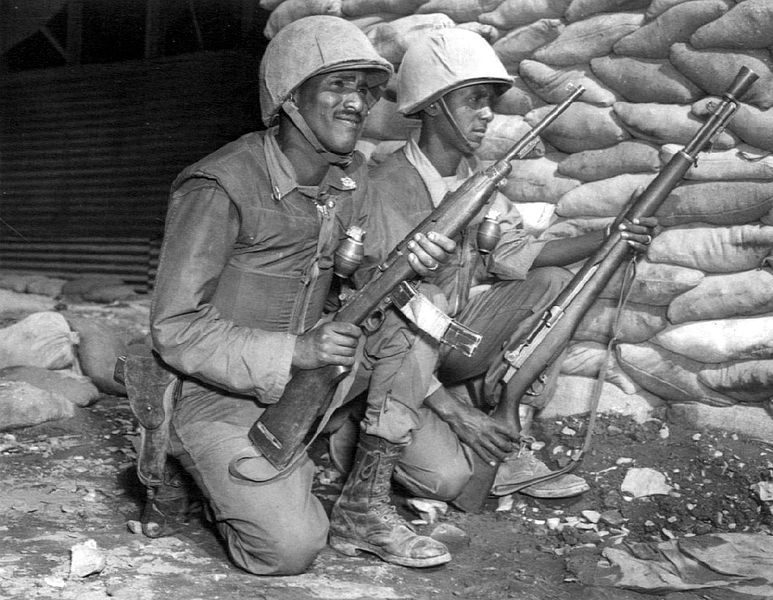
They fought with distinction in a number of engagements including Pork Chop Hill.The battalions suffered over 650 casualties during the course of the war but not one was ever taken prisoner.
I also found this BBC articlethat was written a few months ago:
Capt Mamo Habtewold, now 81 years old, was then a young lieutenant in the 3rd Kagnew Battalion. He clearly remembers a send-off from the Emperor himself, as he was about to leave for the other side of the world.
"Always when a battalion went to Korea, he came himself and made a speech and he gave each battalion a flag - and he ordered us to bring that flag back from Korea," Mamo recalls.
When Ethiopia had been invaded by Italy in 1935 Haile Selassie had condemned the League of Nations for its failure to act. Now, as a staunch ally of the US, he was eager to practise what he had preached. "As you know our King, Haile Selassie, was a great man for collective security. And when the UN asked him for troops for Korea, he accepted without any question," Mamo says.
"We were the best fighters. The three Ethiopian battalions fought 253 battles, and no Ethiopian soldier was taken prisoner in the Korean War," he says. "That was our Ethiopian motto: 'Never be captured on the war field.'"
In 1953, while peace talks dragged on, the two sides hoped to strengthen their negotiating position by battling for control of the barren, rocky hills and ridges which lay in front of the main UN front line.
Some of the hills had nicknames: Old Baldy, T-bone and, most famously, Pork Chop Hill. Defence of this area was assigned to the US 7th Division, which included the Ethiopian Kagnew battalion.
One night in May 1953, Mamo led a small patrol down from his hilltop outpost to scout out the land below. What he didn't know was that his patrol was about to be enveloped in a major Chinese army assault.
"We were 14 Ethiopians and one American in our patrol. It was written later that we were fighting 300 Chinese soldiers - one man against 20," he remembers. Four members of the patrol were killed, including the American corporal. Everyone else was wounded.
"They tried to take my radio
operator prisoner, but I killed the Chinese soldier and saved that man.
And one time they came to finish us when we were all wounded, and I was
left with one hand grenade and I killed them. It was very hard."

From the BBC
"I was wounded several times, I was tired, exhausted and I
fell unconscious twice. The most important thing was to find a radio to
contact the American artillery. But my three radios were destroyed. I gave one soldier my pistol to
cover me while I went looking for a radio. I fainted again, and I was
afraid I might be captured...'"
In the end he did find a radio. He called in American artillery which halted the Chinese attacks. Reinforcements got through and under the cover of smoke he and his wounded soldiers were withdrawn. Back at base, Mamo was the only one of his patrol left standing.
For his actions, he was awarded
Ethiopia's highest military honour. The Americans also gave him a Silver
Star for gallantry in action.
After the war, Mamo was promoted to captain. He was forced to leave the army in 1960 in the aftermath of an attempted to coup by members of the Imperial Bodyguard. He went on to have a career as a businessman and administrator.
This year the South Korean government announced it would give pensions to the surviving Ethiopian veterans of the Korean War. Mamo still hopes to return to South Korea one last time and see the place where he became an Ethiopian war hero.

01 January 2013
I know how he feels!

To kick the New Year of on a lighter note a gorilla at a German zoo has learned to walk a tightrope.
Subscribe to:
Posts (Atom)