Avast mateys and so on and so forth.....Apparently today is International Talk Like a Pirate Day so feel free to splice any mainbrace you feel fit to splice. Sadly it would seem that few pubs will be serving authentic grog and fewer will accept pieces of eight as legal tender. Such a pity....
Click here for the International talk like a pirate day official website.
19 September 2006


18 September 2006
Penis transplant gets the chop
I never thought I would be able to make a joke about strapadictomies but now I get the opportunity it seems somehow hollow…. It does seem odd at first that someone would seek to have a transplant removed but a major operation like this comes with a heavy psychological price.
According to the Guardian and several other papers today, Chinese surgeons performed the world's first penis transplant on a man whose organ was damaged beyond repair in an accident this year. Apparently the incident left the man with a 1cm-long stump with which he was unable to urinate or have sexual intercourse. "His quality of life was affected severely," said Dr Weilie Hu, a surgeon at Guangzhou General Hospital.
According to the People’s Daily online dated 22 September 2005 surgeons at the Guangzhou General Hospital of the Guangzhou Military Area Command did a 7hour operation (15 hours according to the Guardian et al) , implanting for the for the first time an allogeneic (genetically different but from the same species) penis for a man who lost his in an accident after over-drinking in 2004. The operation took place on 20 September 2005.
Leaving aside the discrepancies over the date and duration of the operation the procedure, described in a case study due to appear in the journal European Urology next month, represents a big leap forward in transplant surgery; it required complex microsurgery to connect nerves and tiny blood vessels. The surgical team claimed the operation was a success. After 10 days, tests revealed the organ had a rich blood supply and the man was able to urinate normally. Although the operation was a surgical success, surgeons said they had to remove the penis two weeks later. "Because of a severe psychological problem of the recipient and his wife, the transplanted penis regretfully had to be cut off," Dr Hu said. An examination of the organ showed no signs of it being rejected by the body.
Jean-Michel Dubernard, the surgeon who performed the world's first face transplant said psychological factors were a serious issue for many patients in such circumstances. "Psychological consequences of hand and face allografts show that it is not so easy to use and see permanently a dead person's hands, nor is it easy to look in a mirror to see a dead person's face," he wrote in the journal. "Clearly, in the Chinese case the failure at a very early stage was first psychological.”
In 2001, surgeons were forced to amputate the world's first transplanted hand from Clint Hallam, a 50-year-old New Zealander, who said he wanted the "hideous and withered" hand removed because he had become "mentally detached" from it. The original transplant was conducted by Prof Dubernard's team at the Edouard Herriot Hospital in Lyons, who have since performed the world's first double arm transplant.
penis
transplant
China
According to the Guardian and several other papers today, Chinese surgeons performed the world's first penis transplant on a man whose organ was damaged beyond repair in an accident this year. Apparently the incident left the man with a 1cm-long stump with which he was unable to urinate or have sexual intercourse. "His quality of life was affected severely," said Dr Weilie Hu, a surgeon at Guangzhou General Hospital.
According to the People’s Daily online dated 22 September 2005 surgeons at the Guangzhou General Hospital of the Guangzhou Military Area Command did a 7hour operation (15 hours according to the Guardian et al) , implanting for the for the first time an allogeneic (genetically different but from the same species) penis for a man who lost his in an accident after over-drinking in 2004. The operation took place on 20 September 2005.
Leaving aside the discrepancies over the date and duration of the operation the procedure, described in a case study due to appear in the journal European Urology next month, represents a big leap forward in transplant surgery; it required complex microsurgery to connect nerves and tiny blood vessels. The surgical team claimed the operation was a success. After 10 days, tests revealed the organ had a rich blood supply and the man was able to urinate normally. Although the operation was a surgical success, surgeons said they had to remove the penis two weeks later. "Because of a severe psychological problem of the recipient and his wife, the transplanted penis regretfully had to be cut off," Dr Hu said. An examination of the organ showed no signs of it being rejected by the body.
Jean-Michel Dubernard, the surgeon who performed the world's first face transplant said psychological factors were a serious issue for many patients in such circumstances. "Psychological consequences of hand and face allografts show that it is not so easy to use and see permanently a dead person's hands, nor is it easy to look in a mirror to see a dead person's face," he wrote in the journal. "Clearly, in the Chinese case the failure at a very early stage was first psychological.”
In 2001, surgeons were forced to amputate the world's first transplanted hand from Clint Hallam, a 50-year-old New Zealander, who said he wanted the "hideous and withered" hand removed because he had become "mentally detached" from it. The original transplant was conducted by Prof Dubernard's team at the Edouard Herriot Hospital in Lyons, who have since performed the world's first double arm transplant.
penis
transplant
China
17 September 2006
Banksy in LA
Today’s Observer carries an article about Banksy’s first foray to LA.
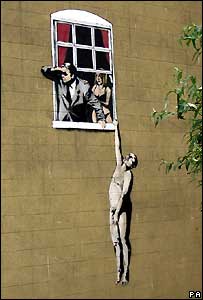
Brad Pitt and Angelina Jolie, Jude Law and Keanu Reeves were among the celebrities gathered for the first LA show by the Bristol-born prankster and graffiti artist who is known for his street art and interventions in Britain,. His show, 'Barely Legal', was his first large-scale exhibition in the US. Complete with valet parking and a retinue of publicists the show included pieces of British iconography, such as a Guardsman on Horse Guards Parade atop a pantomime horse, in addition to work aimed specifically at the local audience. Occupying an entire wall is a painting reinterpreting an American icon, the raising of the flag at Iwo Jima. In Banksy's interpretation, the scene is given an urban setting with a group of protesters raising the flag on top of a car.
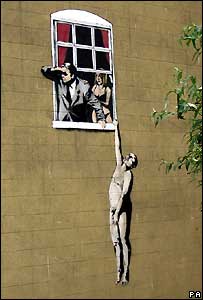
On entering the exhibition , visitors were presented with a flyer reading: 'There's an elephant in the room. There's a problem we never talk about. The fact is that life isn't getting any fairer. 1.7 billion people have no access to clean drinking water. 20 billion people live below the poverty line. Every day hundreds of people are made to physically be sick by morons at art shows telling them how bad the world is but never actually doing something about it. Anybody want a free glass of wine?'
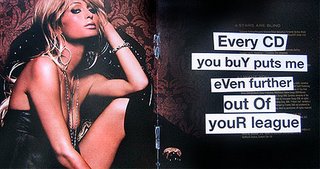
A week before the Los Angeles exhibition, Banksy visited Disneyland, somehow managing to place an inflatable figure dressed as a Guantanamo detainee alongside a railroad ride. A short film of the escapade runs inside the LA show. In the same darkened screening room a glass case displays another of his recent interventions: the Paris Hilton CD doctored by Banksy, which he carried out with the help of Los Angeles-based producer Danger Mouse. Enormous cockroaches had been placed inside the display case.
Like much of Banksy's work, it is an overt statement. But of what, precisely?
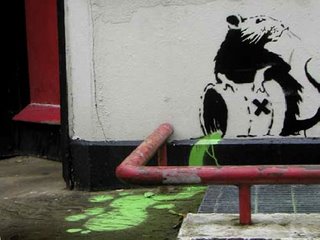
Banksy himself displayed a fine sense of bullshit in a interview he gave to Roger Gastman published in the LA Weekly. 'Some of the paintings have taken literally days to make,' he confided. 'Essentially, it's about what a horrible place the world is, how unjust and cruel and pointless life is, and ways to avoid thinking about all that. One of the best ways turned out to be sitting in a warehouse making paintings about cruelty, pain and pointlessness.'
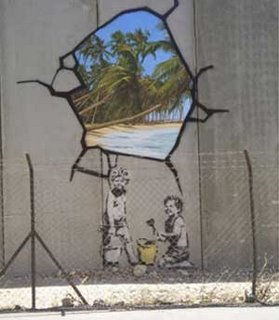 Banksy on the West Bank
Anarchy Jordan, an artist at the first public view of the show on Friday night, had his doubts. 'I don't know if he's selling out, but it's sad,' Anarchy Jordan was impressed by the subversiveness of some of the pieces, including the familiar Paramount films logo bearing the word Paranoid. 'Coming to LA and doing this is subversive," he said. 'After all, LA is the origin of so much nonsense.'
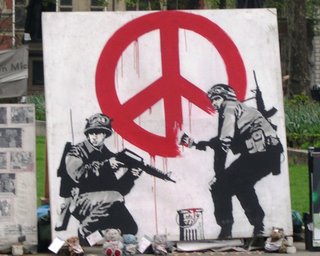 This used to be at Brian Haw's protest outside parliament
Banksy
Graffiti
Brad Pitt and Angelina Jolie, Jude Law and Keanu Reeves were among the celebrities gathered for the first LA show by the Bristol-born prankster and graffiti artist who is known for his street art and interventions in Britain,. His show, 'Barely Legal', was his first large-scale exhibition in the US. Complete with valet parking and a retinue of publicists the show included pieces of British iconography, such as a Guardsman on Horse Guards Parade atop a pantomime horse, in addition to work aimed specifically at the local audience. Occupying an entire wall is a painting reinterpreting an American icon, the raising of the flag at Iwo Jima. In Banksy's interpretation, the scene is given an urban setting with a group of protesters raising the flag on top of a car.
On entering the exhibition , visitors were presented with a flyer reading: 'There's an elephant in the room. There's a problem we never talk about. The fact is that life isn't getting any fairer. 1.7 billion people have no access to clean drinking water. 20 billion people live below the poverty line. Every day hundreds of people are made to physically be sick by morons at art shows telling them how bad the world is but never actually doing something about it. Anybody want a free glass of wine?'

A week before the Los Angeles exhibition, Banksy visited Disneyland, somehow managing to place an inflatable figure dressed as a Guantanamo detainee alongside a railroad ride. A short film of the escapade runs inside the LA show. In the same darkened screening room a glass case displays another of his recent interventions: the Paris Hilton CD doctored by Banksy, which he carried out with the help of Los Angeles-based producer Danger Mouse. Enormous cockroaches had been placed inside the display case.
Like much of Banksy's work, it is an overt statement. But of what, precisely?

Banksy himself displayed a fine sense of bullshit in a interview he gave to Roger Gastman published in the LA Weekly. 'Some of the paintings have taken literally days to make,' he confided. 'Essentially, it's about what a horrible place the world is, how unjust and cruel and pointless life is, and ways to avoid thinking about all that. One of the best ways turned out to be sitting in a warehouse making paintings about cruelty, pain and pointlessness.'
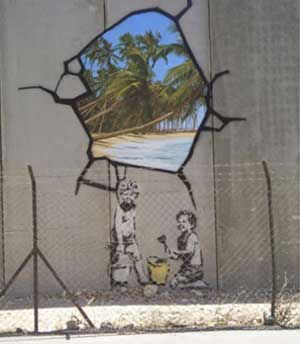 Banksy on the West Bank
 This used to be at Brian Haw's protest outside parliament
Banksy
Graffiti
Ian Dale - what a very nice man!
Thanks to Gert and Patrick H my attention was drawn to an entry on Ian Dale's website (Ian Dale is apparently an influential conserviate - I have seen his name numerous times in the blogosphere) listing his top 100 presumably british left wing blogs. A scan of the attached pdf file and lo and behold the Poor Mouth is there at number 67. I am not sure what to make of this given that I don't dwell much on hard political issues and when I do I tend to be a bit of a pessimist. Hiho, now for something on Banksy...
Cash for peerage scandal - a whole lot of nothing?
According to today’s Observer
police investigating the alleged cash-for-peerages scandal have so far found no 'compelling' evidence of serious wrongdoing, raising the likelihood that no charges will result from the high-profile Scotland Yard inquiry. This result will come as a relief to both Labour and the Conservatives who were threatened with involvement in what could have been one of the most damaging scandals of recent times.
And yet the damage has been done. People will remember the original headlines and form their opinions accordingly – that the Government is knee deep in sleaze. News that there is no case to answer will probably not change this impression. It is also sod’s law that the Tories will be less tarred by this scandal even though they too were under investigation.
The impression of sleaze is sadly another hurdle for Tony Blair’s successor to jump to secure a fourth term in 2009
police investigating the alleged cash-for-peerages scandal have so far found no 'compelling' evidence of serious wrongdoing, raising the likelihood that no charges will result from the high-profile Scotland Yard inquiry. This result will come as a relief to both Labour and the Conservatives who were threatened with involvement in what could have been one of the most damaging scandals of recent times.
And yet the damage has been done. People will remember the original headlines and form their opinions accordingly – that the Government is knee deep in sleaze. News that there is no case to answer will probably not change this impression. It is also sod’s law that the Tories will be less tarred by this scandal even though they too were under investigation.
The impression of sleaze is sadly another hurdle for Tony Blair’s successor to jump to secure a fourth term in 2009
16 September 2006
Geranium versicolor

Taken this afternoon, this is the second bloom of this species geranium. As geranium flowers go this is small, perhaps only half an inch (about 12mm) across. It goes to show beauty can come in small packages
A little common sense about Gibraltar

Today’s Times reports that the UK is set to sign a three-way agreement with Spain and Gibraltar that will lift the last vestiges of the blockade imposed by General Franco on the colony four decades ago. After nearly 2 years of talks the three parties are due to release a joint communiqué on Monday resolving a number of issues that have long nettled both sides.
It is expected that the agreement will ease restrictions on Gibraltarians including the resumption of the first direct flights between Spain and Gibraltar since 1979. The pact should prove a boon to the regional economy on both sides of the border. “For the finance industry the whole thing is good news,” Marcus Killick, the financial services commissioner of Gibraltar, said. Meanwhile the town of La Línea should benefit from easier access to Gibraltar’s jobs and consumers. Several thousand Spaniards also cross into Gibraltar every day to work. Peter Caruana, the Chief Minister of Gibraltar, says the agreements that have emerged from the first three-way talks represent “a huge sea-change in the nature of the relationship” with Spain. “It does signal a different and much more enlightened political engagement that you expect from European neighbours in the 21st century,”
For older Gibraltarians any sign of a rapprochement with Madrid is greeted with apprehension. Even those who support normalising relations with Spain know that it will be a tough sell for suspicious Gibraltarians. “What has been achieved is, in my view, historic,” Bruno Callaghan, a former president of the Gibraltar Chamber of Commerce, says. “But now it’s here many people will say, ‘Do we want it?” So far the Opposition in Gibraltar has held fire. The Leader of the Opposition and twice Chief Minister remains sceptical about Spain’s motives. “I don’t expect that the Spanish have had a change of heart and are giving away something for nothing,” he said. “It’s not in their history, it’s not in their character.”
Previous efforts by Britain and Spain to resolve their 300-year-old dispute over Gibraltar have foundered on opposition by its 30,000 residents, who oppose Spanish rule. In a 2002 referendum almost 99 per cent of Gibraltar’s voters rejected a proposal by London and Madrid for joint sovereignty over the territory. The idea was subsequently shelved, and both sides came to accept that Gibraltarians must be part of any negotiations over the future. “If it works it will be the watershed moment in Gibraltar’s relationship with Spain,” Dominique Searle, the editor of the Gibraltar Chronicle, said. “For me it’s the best news that I’ve had on this issue in a long time.”
Gibraltar has been a British possession since it was ceded by Spain in the 1713 Treaty of Utrecht which ended the War of the Spanish Succession. Although Spain has retained its claim over the Rock, unlike the erstwhile Argentinian junta, it has not resorted to military means (or not outside the frequent wars between the two nations during the 18th Century anyway!).
Strategically the Rock was of vital importance to Britain In WWII it ensured allied access to the Mediterranean. Had Franco joined the Axis (as was a distinct possibility) then Gibraltar may well have fallen. If this had happened then the Middle East would almost certainly have fallen to Germany. The outcome of WWII would almost certainly have been very different. In recent years, however, its strategic value has reduced and the British military presence has reduced accordingly. The main force on the Rock is the Royal Gibraltar Regiment, a small territorial army force.
While There is now less of an imperative to retain Gibraltar as a possession the population is steadfastly wish to remain British. The Gibraltarians are not a group of expatriates lording it over a “native” population. Gibraltarians are a diverse mix of Maltese, British, Spanish and North African. As with the Falkland Islanders their views must be taken into account when considering the future of Gibraltar. The removal of petty restrictions will be good for Gibraltar and for Spain but it should not be construed as the first step towards a transfer of sovereignty. It would take a very long time for the residents to come around to such an idea, if they ever do.
15 September 2006
The two faces of Ted
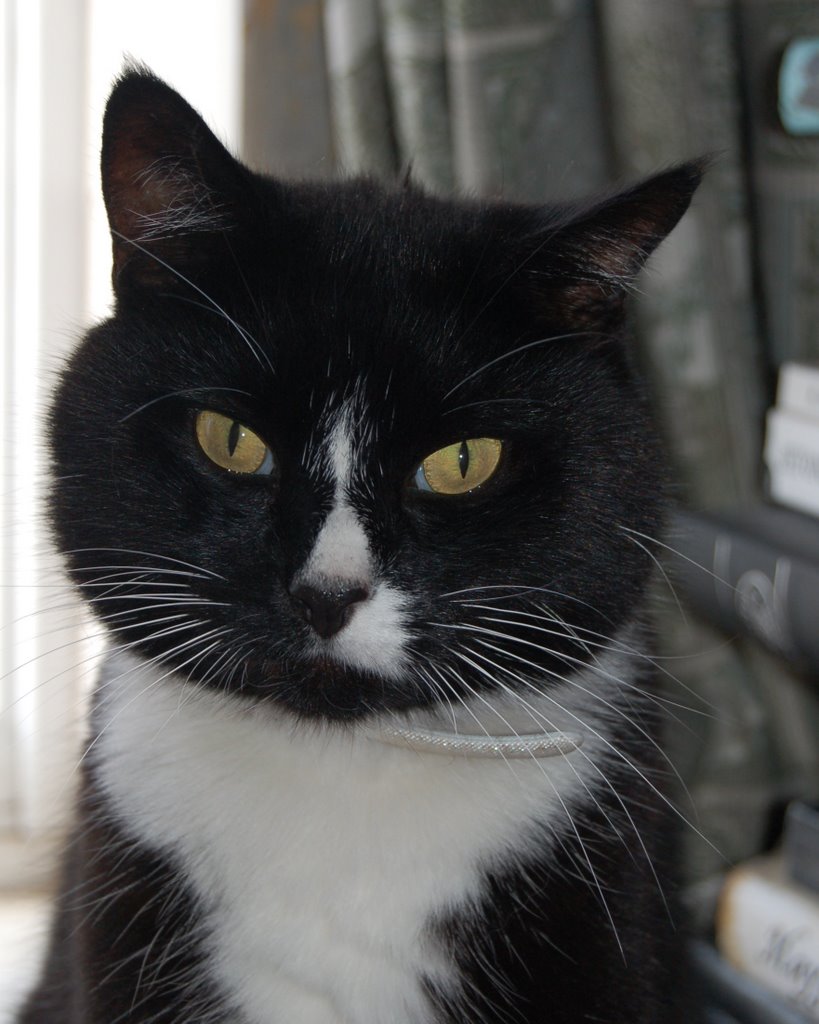 Good Ted
 Bad Ted
This is an early post for the Friday Ark and of Course Carnival of the Cats - see side bar for links
14 September 2006
Subscribe to:
Posts (Atom)