The Decameron hails from the 14th Century and is Giovanni Boccaccio’s wonderful collection of exactly 100 often quite bawdy stories, ostensibly told by a group of lords and ladies who have escaped an outbreak of bubonic plague in Florence and pass the time by telling stories to each other.
The Webcameron on the other hand is David Cameron’s attempt to bring the Tories kicking and screaming into the 13th century by use of cutting edge technology. Cameron’s first video is pretty risible and while I may be biased, I cannot see the IT generation turning Tory in droves as a result of this
The Decameron is available from Amazon at a reasonable price. The Webcameron is free and is worth as much
30 September 2006


When the East End said “No Pasaran”
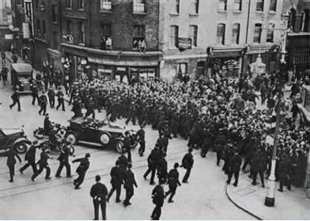
Next wednesday marks the 70th anniversary of the “Battle of Cable Street”, a day when the people of the East end united in defiance of Mosley's British Union of Fascists (BUF) and refused to let them march through their streets.
Shouting the Spanish civil war slogan "No pasaran" thousands (more than 300,000 according to the Daily Worker, the Communist Party newspaper) of East enders turned back a Blackshirt (another name for the BUF - not surprisingly on account of their predilection for wearing black shirts) march that was intended to be a general show of its strength in the area and to intimidate the local Jewish community (The east end at the time was home to s substantial proportion of Britain’s Jews).
The Jewish Board of Deputies had advised Jews to stay away. But they didn’t keep away. Side by side with the other East enders they built barricades, women threw the contents of chamber pots on to the heads of policemen and children hurled marbles under their horses and burst bags of pepper in front of their noses.
Professor Bill Fishman who was 15 on the day: "There was masses of marching people. Young people, old people, all shouting 'No Pasaran' and 'One two three four five - we want Mosley, dead or alive'," he said. “Between 3pm and 3.30 we could see a big army of Blackshirts marching. They were surrounded by an even greater army of police. There was to be this great advance of the police force to get the fascists through. Suddenly, the horses' hooves were flying and the horses were falling down because the young kids were throwing marbles."
Thousands of policemen were sandwiched between the Blackshirts and the anti-fascists. The latter were well organised and through a mole learned that the chief of police had told Mosley that his passage into the East End could be made through Cable Street.
"I heard this loudspeaker say 'They are going to Cable Street'," said Prof Fishman. "Suddenly a barricade was erected there and they put an old lorry in the middle of the road and old mattresses. The people up the top of the flats, mainly Irish Catholic women, were throwing rubbish on to the police. We were all side by side. I was moved to tears to see bearded Jews and Irish Catholic dockers standing up to stop Mosley. I shall never forget that as long as I live, how working-class people could get together to oppose the evil of racism."
Max Levitas, now 91, was a message runner at the time: "I feel proud that I played a major part in stopping Mosley…They did not pass. It was a victory for ordinary people against racism and anti-Semitism. The Battle of Cable Street is a history lesson for us all. People as people must get together and stop racism and anti-Semitism so people can lead an ordinary life and develop their own ideas and religions."
 A mural commemorating the Battle of Cable Street
Some may regard this portrayal of the Battle of Cable Street as romanticising a riot. It also ignores that there was also fair degree of support for the BUF in the East end. Perhaps it is to some extent but I wholeheartedly endorse the sentiments of both Professor Fishman and Mr Levitas. Living as we do in a vibrant and relatively inclusive society, racism and anti Semitism may not be quite so overt as they once were but there is still plenty of it around.
The East end’s Jewish community has declined considerably over the years, having been replaced to a great extent by Muslim Bengalis; they are now main targets for racist abise (and have been since well before 9/11 etc) . The BUF is long gone but in recent years we have seen a rise in support for the British National Party. The targets change somewhat, the names change but it is clear that the fight is far from over.
According to the East End Advertiser , there will be a commemoration day on Sunday October 8 with a procession, street theatre, music, singers and an exhibition of photographs from 1936, as well as stalls and other festivities.
Some Sources
Guardian report
What Next Journal (a Marxist perspective but worth reading)
For what it's worth, the battle of Cable street from a BUF supporting perspective
Blip or Good News?
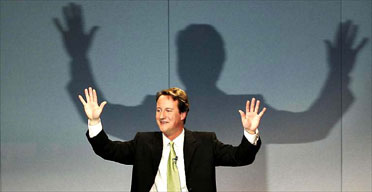 Cameron surrendering the Tory lead?
Following on from a bloodless and well behaved Party conference the Daily Telegraph gives faint hearted Labourites as me a little boost.
It carries a Yougov poll which indicates that the Tory lead that had opened up over the course of this year has been slashed with both parties currently level pegging at 36%. This compares with a similar poll last month where the Tories were showing a seven-point lead over Labour
The poll also suggests that just over half of voters do not know what the Tories currently stand for, while Cameron’s own personal approval rating is down from 46% at the beginning of the year to 35% now.
I know full well that one swallow does not a summer (or a White House intern famous) make but this sort of result indicates that if the Party can avoid fratricide (voters will always punish disunity) during the coming leadership election and get on this the business of government then maybe a fourth term can be ours
Labour
Conservative
opinion
poll
29 September 2006
First review of Ole Tarantula
Robyn’s new album Ole Tarantula finally hits the stores on Monday. Usually he ignored by large sections of the music press so it was good to see this review in yesterday’s Independent
Artist: Robyn Hitchcock & The Venus 3
Title: Olé! Tarantula

Robyn Hitchcock sounds more than ever like his hero Syd Barrett on this latest album, recorded in Seattle with his chums Peter Buck and the R.E.M. auxiliary of bassist Scott McCaughey and drummer Bill Rieflin. Indeed, the opening psych-rock wig-out "Adventure Rocket Ship" sounds like the Floyd might have if Syd had written the space-rock songs rather than Roger Waters. The rising melodic hook of "Red Locust Frenzy" recalls Tim Buckley; and the warm horns on "Museum Of Sex" have an engaging Memphis soul character - all of which illustrates the problem Hitchcock has in transcending his influences. But there is recompense here in the poppy, epiphanic "'Cause It's Love (Saint Parallelogram)", which may yet furnish him with the hit he deserves.
The reviewer gives if 3 stars (our of five) - to a fan this would translate to at least eight stars! I have heard a couple of the songs played live (Adventure Rocket Ship and a Man’s Gotta Know his Limitations, Briggs and of course Ole Tranatula itself) and if they are representative of the album as a whole then I will be a happy camper!
Artist: Robyn Hitchcock & The Venus 3
Title: Olé! Tarantula

Robyn Hitchcock sounds more than ever like his hero Syd Barrett on this latest album, recorded in Seattle with his chums Peter Buck and the R.E.M. auxiliary of bassist Scott McCaughey and drummer Bill Rieflin. Indeed, the opening psych-rock wig-out "Adventure Rocket Ship" sounds like the Floyd might have if Syd had written the space-rock songs rather than Roger Waters. The rising melodic hook of "Red Locust Frenzy" recalls Tim Buckley; and the warm horns on "Museum Of Sex" have an engaging Memphis soul character - all of which illustrates the problem Hitchcock has in transcending his influences. But there is recompense here in the poppy, epiphanic "'Cause It's Love (Saint Parallelogram)", which may yet furnish him with the hit he deserves.
The reviewer gives if 3 stars (our of five) - to a fan this would translate to at least eight stars! I have heard a couple of the songs played live (Adventure Rocket Ship and a Man’s Gotta Know his Limitations, Briggs and of course Ole Tranatula itself) and if they are representative of the album as a whole then I will be a happy camper!
Mimi puts on her war face
 Robyn looks at her when she pulls such a face and gives her his "ooh I'm scared" look. For the Friday Ark and Carnival of the Cats (see sidebar)
28 September 2006
Iva Toguri - Orphan Ann, not Tokyo Rose
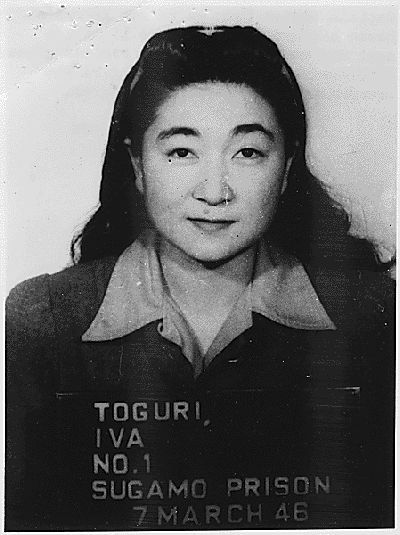
Many sources are carrying news of the death of Iva Toguri who after WWII was tried and convicted for broadcasting as “Tokyo Rose”. Although there is no doubt that Toguri made broadcasts on Japanese radio there never was a Tokyo Rose as such: It simply was a generic name given to describe around a dozen female presenters on Japanese Radio. Her broadcasts were never political and contained none of the venom spewed by Mildred Gillars (aka Axis Sally) a counterpart on German Radio.
This obituary comes from the Chicago Tribune.
Few who stopped in at J. Toguri Mercantile Co. on Belmont Avenue knew the story of the unassuming woman who moved quietly among the cluttered piles of Asian books and toiletries. Iva Toguri certainly didn't look like a war criminal, although the U.S. government convicted her as one following World War II. In the late 1940s, she was branded as being one of the voices of "Tokyo Rose," Japan's infamous radio siren to embattled U.S. troops, and served 6 years in a West Virginia prison.
Toguri lived with that stigma until 1977, when she received a presidential pardon following a flurry of media attention, including a series in the Chicago Tribune in which two of her chief accusers said their testimony had been coerced. A Chicago resident since 1956, Toguri, 90, died Tuesday, Sept. 26,
Toguri seldom spoke of her past and remained intensely private throughout her 50 years in Chicago. Customers at the store who knew who she was quickly learned that questions would go unanswered. "She didn't talk much about it," said Ross Harano, former president of the Chicago Chapter of the Japanese American Citizens League. "She was not a bitter person at all, she just put it aside."
Toguri was born on July 4, 1916, and grew up in California, where she received a degree in zoology from UCLA with designs on becoming a doctor. Those plans were waylaid by her ill-fated trip to Japan. Toguri was visiting a sick aunt in Japan when Pearl Harbor was bombed. He has since died. Stuck in the country, she was tossed out by her family because of her U.S. citizenship and harassed by the Japanese government. In 1943, she took a secretarial job at Radio Tokyo. The Japanese wanted a woman with an American accent for a radio show called "Zero Hour," and Toguri was enlisted
Toguri was one of about a dozen female broadcasters dubbed "Tokyo Rose" by American GIs. Toguri actually broadcast under the moniker "Orphan Ann" (Ann for announcer). While the Japanese were trying to use the broadcasts as propaganda, an Australian prisoner of war who wrote the shows Toguri did said the programs were intended as "straight-out entertainment”. Nonetheless, she was held for a year by U.S. occupying forces after the war, then released. But a public outcry fanned by influential radio broadcaster Walter Winchell led the U.S. to re-arrest her, said Wayne Collins, whose father defended Toguri at her 1949 trial in San Francisco.
Toguri was convicted of treason following a 12-week trial. The single count of which she was found guilty—seven others were thrown out—accused her of referring to U.S. sailors as "Orphans of the Pacific" and asking, "How will you get home now that your ships are sunk?"
Her innocence finally was proven in the 1970s through efforts by the media and her attorney. In 1976, two of her primary accusers told the Tribune's Far East correspondent, Ronald Yates, that FBI officials had forced them to give false testimony. His reports followed a February 1976 Tribune series by Linda Witt that brought Toguri's prosecution into question. TV's "60 Minutes" also did a segment on Toguri, said Collins, who had taken over his father's case and filed for a presidential pardon.
In January 1977, on his last day in office, President Gerald Ford pardoned Toguri. At the time, she said that she hoped to "go back to my simple life and work. The difference now is, however, that I have regained my American citizenship, a right and privilege I have always cherished."
Her father moved to Chicago after the war and started his import and retail business, which was initially on Clark Street. Toguri joined him after being released from prison and rarely talked about her ordeal.
In January, the World War II Veterans Committee presented Toguri with the Edward J. Herlihy citizen award, which is named after the World War II newsreels announcer. The committee had earlier printed Toguri's story in its newsletter, drawing an outpouring of support from veterans, said its president, James Roberts. "Not one said they were demoralized in any way by the broadcasts," Roberts said. "She remained loyal to the U.S., when many others may have turned on it, or given up." She accepted her medal during a quiet luncheon ceremony at Yoshi's, having declined an invitation to a larger gala three months earlier in Washington, D.C. "She was tearful and overcome with emotion," Roberts said. "As I understood it, it was part of a long process of vindication."
Toguri
Orphan
ann
Tokyo
Rose
27 September 2006
Lakes on Titan
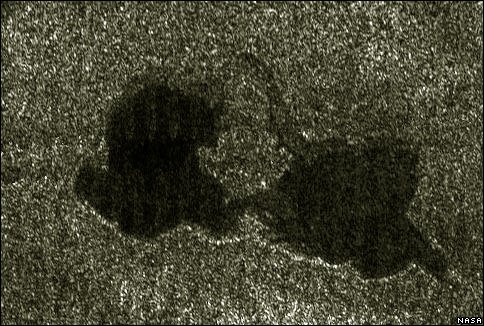
This picture can currently be found in the Science and Nature section of BBC news and plenty of other places too I would imagine. It was taken by the Cassini probe and shows two lakes on Saturn's moon Titan. Both are about 20-25km in size and almost certainly consist of liquid hydrocarbons rather than water.
Being someone who has been fascinated by space missions since the Moon landings this sort of picture makes me go "wow!"
26 September 2006
Blair’s swansong
 Tony Blair admitted "it's hard to let go" as he used his last Labour conference speech as leader to urge the party to unite and win a fourth term. He won a long standing ovation, telling an emotional Labour gathering.
He praised Gordon Brown and laughed off his wife's alleged criticism: "At least I don't have to worry about her running off with the bloke next door." (a reference to alleged comments made about Gordon Brown’s speech yesterday). "The truth is you can't go on forever, that's why it is right that this is my last conference as leader. "Of course it is hard to let go. But it is also right to let go. For the country, and for you, the party. Over the coming months, I will take through the changes I have worked on so hard these past years. And I will help build a unified party with a strong platform for the only legacy that has ever mattered to me - a fourth term election victory that allows us to keep changing Britain for the better.
As Mr Brown did in his speech, Mr Blair admitted there had been difficulties in their relationship. "But I know New Labour would never have happened and three election victories would never have been secured without Gordon Brown," he said. "He is a remarkable man, a remarkable servant to this country - and that is the truth."
With the Conservatives ahead in the opinion polls, Mr Blair urged people to remember there were three years until the next election. "Don't ignore the polls but don't be paralysed by them either," he said. Mr Blair's advice for the next election from his "hot seat" was that Labour had to meet the challenge of global changes - getting the balance right between openness and security and also continuing reforms to public services. "The danger in all this, for us, is not ditching New Labour. The danger is failing to understand that New Labour in 2007 won't be New Labour in 1997," he said.
Blair delivered a rousing speech and deserved the rapturous applause he received. It was a fitting swan song to over 12 years in power. Even if I can be gloomy about Labour’s prospects, I do appreciate what Blair has done for the Party. Despite some missed opportunities and major mistakes (Iraq being one). Once again, here’s hoping we can put aside the infighting (some hope I fear), have an orderly leadership election and then go on to win a fourth term. Hiho.....
Tony
Blair
Labour
Party
conference
A death in Kandahar
Safia Amajan the chief of the Woman’s Affairs department in Kandahar, had devoted the last five years of her life to improving women’s rights and opportunities for education and vocational training. Yesterday she was gunned down outside her home.
Ms Amajan had taken over the post of women's welfare officer soon after the fall of the Taliban. With the return of the Taliban, aid workers were intimidated into leaving the region but Ms Amajan was one of the few who refused to flee. Ms Amajan had asked for, and been refused, a protective vehicle, or bodyguards, despite repeated death threats. She was in a taxi when two gunmen on a motorcycle opened fire. A Taliban commander, Mullah Hayat Khan, declared that Ms Amajan had been "executed". He said: "We have told people again and again that anyone working for the government, and that includes women, will be killed."
Ms Amajan's funeral yesterday was attended by the provincial governor and hundreds of mourners, including tribal elders. In Kabul, President Karzai said: "The enemies of Afghanistan are trying to kill those people who are working for the peace and prosperity of Afghanistan. The enemies of Afghanistan must understand that we have millions of people like Amajan." Fariba Ahmedi, a female member of parliament, who attended the burial, said: "Those enemies who have killed her should know it will not derail women from the path we are on. We will continue on our way.”
Human rights groups point out, that the battle for women's rights is in serious danger of being lost. There are now entire provinces where there is no girls' education; of the 300 schools shut or burnt down, the majority were for girls. The death rate at childbirth is the second highest in the world, and the number of women who have committed suicide, mainly through self-immolation, has risen by 30 per cent in two years.
Safia
Amajan
Kandahar
Ms Amajan had taken over the post of women's welfare officer soon after the fall of the Taliban. With the return of the Taliban, aid workers were intimidated into leaving the region but Ms Amajan was one of the few who refused to flee. Ms Amajan had asked for, and been refused, a protective vehicle, or bodyguards, despite repeated death threats. She was in a taxi when two gunmen on a motorcycle opened fire. A Taliban commander, Mullah Hayat Khan, declared that Ms Amajan had been "executed". He said: "We have told people again and again that anyone working for the government, and that includes women, will be killed."
Ms Amajan's funeral yesterday was attended by the provincial governor and hundreds of mourners, including tribal elders. In Kabul, President Karzai said: "The enemies of Afghanistan are trying to kill those people who are working for the peace and prosperity of Afghanistan. The enemies of Afghanistan must understand that we have millions of people like Amajan." Fariba Ahmedi, a female member of parliament, who attended the burial, said: "Those enemies who have killed her should know it will not derail women from the path we are on. We will continue on our way.”
Human rights groups point out, that the battle for women's rights is in serious danger of being lost. There are now entire provinces where there is no girls' education; of the 300 schools shut or burnt down, the majority were for girls. The death rate at childbirth is the second highest in the world, and the number of women who have committed suicide, mainly through self-immolation, has risen by 30 per cent in two years.
Safia
Amajan
Kandahar
25 September 2006
Bringing the Dead (cells) to Life
While there are many false dawns in science, This article reports on a technique that could have real promise for medical research.
Scientists working under Professor Miodrag Stojkovic at Newcastle University have achieved a breakthrough in the field of stem cell research by taking cells from dead embryos and turning them into living tissue.
The technique could soon be used to create treatments for patients suffering from diseases such as Alzheimer's and Parkinson's, the researchers say. The breakthrough has been hailed by many scientists and ethical experts because it could circumvent opposition to stem cell experiments because live embryos will no longer need to be used.
In a paper, published last week online on the website of the journal Stem Cells, Stojkovic reveals he and his colleagues took 13 embryos, created by IVF. All 13 had stopped developing a few days after conception. The team then waited 24 hours to check that the embryos were no longer dividing before beginning their experiments. 'These were all deemed to be arrested embryos,' said Stojkovic. 'In other words, they were dead but they had the capacity to develop any different type of cell you could think of, including kidney cells, liver cells, and skin cells.'
George Daley, of the Harvard Stem Cell Institute, said the paper's approach raised scientific concerns. 'If there was something wrong with the embryo that made it arrest, isn't there something wrong with these cells? We don't know.' Josephine Quintavalle, of Comment on Reproductive Ethics, a Catholic campaign group. 'We do not have objections to the use of donated tissue and organs in other areas of medicine. There is the critical question of how you know when an embryo is dead or not.'
However, Stojkovic's work was given strong backing by Donald Landry, at the Columbia University Medical Center in New York: 'regardless of how you feel about personhood for embryos, if the embryo is dead, then the issue of personhood is resolved, This then reduces the ethics of human embryonic stem cell generation to the ethics of, say, organ donation. So now you're really saying, "Can we take live cells from dead embryos the way we take live organs from dead patients?
stem
cell
research
Scientists working under Professor Miodrag Stojkovic at Newcastle University have achieved a breakthrough in the field of stem cell research by taking cells from dead embryos and turning them into living tissue.
The technique could soon be used to create treatments for patients suffering from diseases such as Alzheimer's and Parkinson's, the researchers say. The breakthrough has been hailed by many scientists and ethical experts because it could circumvent opposition to stem cell experiments because live embryos will no longer need to be used.
In a paper, published last week online on the website of the journal Stem Cells, Stojkovic reveals he and his colleagues took 13 embryos, created by IVF. All 13 had stopped developing a few days after conception. The team then waited 24 hours to check that the embryos were no longer dividing before beginning their experiments. 'These were all deemed to be arrested embryos,' said Stojkovic. 'In other words, they were dead but they had the capacity to develop any different type of cell you could think of, including kidney cells, liver cells, and skin cells.'
George Daley, of the Harvard Stem Cell Institute, said the paper's approach raised scientific concerns. 'If there was something wrong with the embryo that made it arrest, isn't there something wrong with these cells? We don't know.' Josephine Quintavalle, of Comment on Reproductive Ethics, a Catholic campaign group. 'We do not have objections to the use of donated tissue and organs in other areas of medicine. There is the critical question of how you know when an embryo is dead or not.'
However, Stojkovic's work was given strong backing by Donald Landry, at the Columbia University Medical Center in New York: 'regardless of how you feel about personhood for embryos, if the embryo is dead, then the issue of personhood is resolved, This then reduces the ethics of human embryonic stem cell generation to the ethics of, say, organ donation. So now you're really saying, "Can we take live cells from dead embryos the way we take live organs from dead patients?
stem
cell
research
24 September 2006
Yawn, Rosindell

My poltroon of an MP Andrew Rosindell usually manages to vent his spleen in the local papers every week , quite often on some ludicrous pretext. This week his hobby horse is the new online postal service offered by the Royal Mail. It is now possible to pay for postage online and download a special barcoded stamp which can be printed on to a label or directly on to an envelope.
So why is Rosindell indignant? Is he a luddite who thinks ye internette be ye worke of ye deville? Apparently not: Rosindell’s anger is at the decision not to have the Queen's head on the internet stamps. This decision apparently ends a long tradition of having the monarch’s head on British stamps. The world's first stamp, the Penny Black, was issued on May 6, 1840 and featured the head of a young Queen Victoria.
Mr Rosindell, a staunch royalist and keen stamp collector, opposed the idea when it was first mooted in Parliament 18 months ago claiming the company is trying to shake off its links to Queen and country.
Err so what, Rosindell. I think most people would be far more concerned that the letter, package or what have you gets to where it needs to go quickly than whether the Queen’s head is on the stamp or not. Perhaps Rosindell’s time would be better spent railing at the real issues like compulsory Morris dancing on Wednesday mornings.
Source: Romford Recorder
Rosindell
wanker
23 September 2006
Kaiser Chiefs - I Predict A Riot
Wow a song made this century I really like. Perhaps I am not the dinosaur I thought I was!
The Bitter Price of Bravery
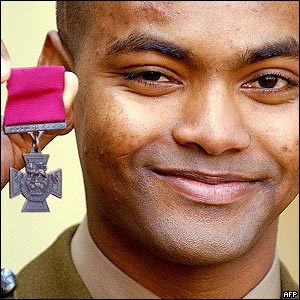
Today’s Telegraph carries an interview with Private Johnson Beharry who last year became the first recipient of the Victoria Cross in 23 years. It goes to show that even bravery comes with a bitter price.
The young soldier from Grenada was awarded Britain's highest award for valour for rescuing fellow soldiers from his burning armoured personnel carrier after it was hit by rocket-propelled grenades in two ambushes in 2004. espite serious injuries and being exposed to enemy fire he led his five-vehicle convoy to safety then clambered on to the red-hot metal to save colleagues, including his commanding officer.
When he went to Buckingham Palace to collect the VC, the Queen told him that the injuries inside would take the longest to heal. The Queen's words were prophetic: Pte Beharry said, he had yet to discover both the down side of fame and the full extent of his physical and mental injuries. Some members of his extended family, both in Britain and the Caribbean, had plagued him with requests for help, he said. "Everyone thinks that because I receive the Victoria Cross, I receive a wall of money," he said. "They expect me to give them whatever they ask for. But the Victoria Cross is just a medal.
Several members of the family have circulated stories that Pte Beharry, puffed up by his honour, deserted his home-loving wife for a striking Grenadian, Tamara Vincent. Pte Beharry says the reality is that the marriage was already over: his wife did not write to him when he was serving overseas and did not spend much time by his bedside when he was recovering from brain surgery. Pte Beharry's skull was shattered by the blasts and he still suffers blinding pain in his head, his back and his shoulder.
His brain injuries have altered his easy-going personality and left him short-tempered and quick to take offence. So he stays at home rather than risk "getting into trouble" in clubs or bars. Two years on, he is still having treatment. He said that doctors could not tell him when — or if — he would get better. Pte Beharry is now in an unusual position: superiors salute him but he has no job; he is on the Army payroll but without a role.
Pte Beharry was one of eight children brought up in a two-room hut in Grenada. He moved to Britain when he was 19 and worked on building sites. By joining the Army, he reversed a slide into drink and soft drugs and subsequently discovered an aptitude for driving the 25-ton Warrior vehicles. Asked whether there was ever a moment when he wished he were an unknown soldier again without his VC, Pte Beharry replied: "I am proud of it, but you don't get something like this for free. You get it and survive with the pain — or you get it and die."
Johinson Beharry is one of 1352 persons to receive the Victoria Cross since its inception in 1856. He is by far the youngest of the 12 living recipients. Eight of the living recipients were awarded the medal in WWII, one during the Korean War, one in the Malaysian-Indonesian Confrontation and one (an Australian) during the Vietnam War.
Beharry, like his predecessors were awarded this medal for extreme courage, (often in situations where given the choice I am sure they would rather have been elsewhere). One need not condone the presence of the British armed forces Iraq or any other war to acknowledge this.
A few other recipients
Lachiman Gurung Nepal
Charles Upham New Zealand one of only three persons to be awarded the medal twice
Edward Fogarty Fegen British of Irish descent

John Cornwell who is commemorated locally
Garden 23 September - A little better
 Same view after a lot of effort cutting away the detached foliage. Luckily none of the other plants seem damaged apart from some morning glories that had grown into the ivy.
Garden 23 September

When the not-wife went out into the garden after coming home from work yesterday she was presented with this sight. Most of the ivy that makes this part of the garden look particularly lush had detached from the wall of the neighbour's shed. Although it was raining heavily yesterday, I doubt the it ccame away of it's own accord - the ivy is very healthy and there is no signigicant damage to the shed except for some missing pointing.
We suspect that this was a deliberate act. If the neighbour did rip the ivy away from his wall then he is a fool as well as a vandal: ripping it away could have done a lot more damage. We will have to see what damage has been done to the plants underneath but the ivy will be back.
22 September 2006
Guest Cat - TC
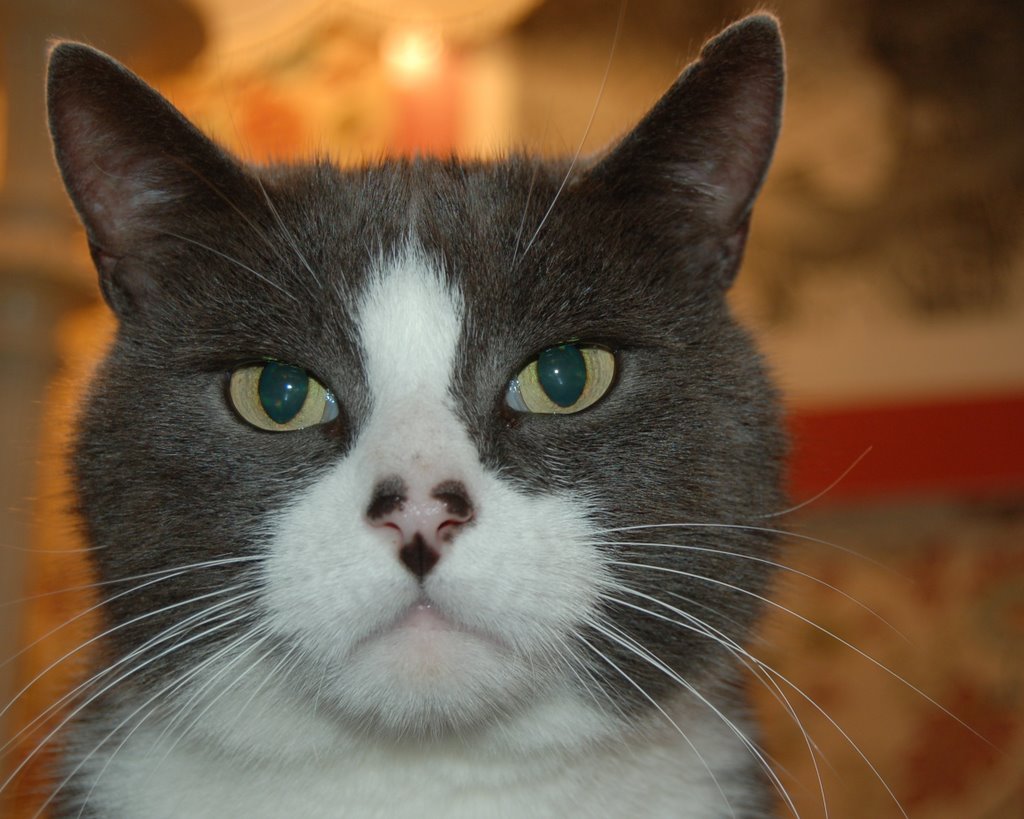 This is my sister's cat TC trying to look stern. Taken while over on a visit to my sister's lastweek. An early post for the Friday Ark and Carnival of the Cats (see sidebar for links)
21 September 2006
New Kindertransport Memorial at Liverpool Street Station
 Hope Square, outside Liverpool Street Station
Some time ago I posted an item about the Kindertransport memorial. Sadly the orignial memorial, which consisted of a statue of a girl and a transparent case containing memorabilia the children brought with them, had to be taken down after the memorabilia started to deteriorate.

It is good to see that a new statue is being constructed. Currently behind hoardings at present it consists of several bronze statues depicting children. It is not easy to get a good photograph througn the one small glass window but it does look like an excellent replacement, I look forward to its unveiling after which I will get better pictures
Kindertransport
Memorial
Sometimes it takes decades for the past to catch up with you.
Many news sources are carrying the story of Elfreide Rinkel who, for over 60 years, hid a a dark secret from friends and family. Although to her friends and family, especially her Jewish husband Fred, Mrs Rinkel was one of many Germans who had come to the US after the second world war to seek a better life.
On Tuesday the US Department Justice announced that Mrs Rinkel had been deported to Germany after US investigators discovered she had worked as a guard at Ravensbrück concentration camp, north of Berlin, from June 1944 to April 1945.
According to US charges filed in April, Elfriede Huth, who was born July 14 1922 in the east German city of Leipzig, had applied for a US immigrant visa in Frankfurt in 1959. The application told her to list all her residences from 1938, but she omitted Ravensbrück. She was admitted to the US in September 1959 at San Francisco.
Her sister-in-law, who was married to Mrs Rinkel's brother, Fred Rinkel had no idea of his wife's dark past. His funeral service was held at a Jewish memorial chapel and he was an active member of the Jewish service organisation B'nai B'rith. "He had to leave Germany during all that terrible stuff that happened there and had to relocate in Shanghai," she said. "A lot of the Jewish Germans went to Shanghai."
Mrs Rinkel had met her husband at a German-American Club in San Francisco. She lived in the US until her deportation. "We did help her to close up her apartment and helped her to buy her airplane ticket and go to the airport and buy her luggage - but never a word about why she was leaving," said her sister in law. "We thought she was going because her situation in her apartment had deteriorated. She said she just wanted to go back to Germany ... we believed her."
Completed in 1939, Ravensbruck was built almost exclusively for female prisoners. More than 130,000 women, mainly came from Poland or the occupied Soviet Union, passed through the camp during its history .. Only 40,000 survived. German historians said Mrs Rinkel had been one of about 3,500 young, unattached and mainly uneducated women from Germany and Austria who were overseers at the camp, some of whom were later executed.
Ephraim Zuroff, the head of the Simon Wiesenthal Centre in Jerusalem, said Mrs Rinkel's story was typical. Many low-ranking Germans who collaborated with the Nazis kept silent about their role to family and friends for decades afterwards, he said. He conceded, however, that what made Mrs Rinkel's case extraordinary was that she had then married a German Jew.
Elfreide
Rinkel
Ravensbruck
On Tuesday the US Department Justice announced that Mrs Rinkel had been deported to Germany after US investigators discovered she had worked as a guard at Ravensbrück concentration camp, north of Berlin, from June 1944 to April 1945.
According to US charges filed in April, Elfriede Huth, who was born July 14 1922 in the east German city of Leipzig, had applied for a US immigrant visa in Frankfurt in 1959. The application told her to list all her residences from 1938, but she omitted Ravensbrück. She was admitted to the US in September 1959 at San Francisco.
Her sister-in-law, who was married to Mrs Rinkel's brother, Fred Rinkel had no idea of his wife's dark past. His funeral service was held at a Jewish memorial chapel and he was an active member of the Jewish service organisation B'nai B'rith. "He had to leave Germany during all that terrible stuff that happened there and had to relocate in Shanghai," she said. "A lot of the Jewish Germans went to Shanghai."
Mrs Rinkel had met her husband at a German-American Club in San Francisco. She lived in the US until her deportation. "We did help her to close up her apartment and helped her to buy her airplane ticket and go to the airport and buy her luggage - but never a word about why she was leaving," said her sister in law. "We thought she was going because her situation in her apartment had deteriorated. She said she just wanted to go back to Germany ... we believed her."
Completed in 1939, Ravensbruck was built almost exclusively for female prisoners. More than 130,000 women, mainly came from Poland or the occupied Soviet Union, passed through the camp during its history .. Only 40,000 survived. German historians said Mrs Rinkel had been one of about 3,500 young, unattached and mainly uneducated women from Germany and Austria who were overseers at the camp, some of whom were later executed.
Ephraim Zuroff, the head of the Simon Wiesenthal Centre in Jerusalem, said Mrs Rinkel's story was typical. Many low-ranking Germans who collaborated with the Nazis kept silent about their role to family and friends for decades afterwards, he said. He conceded, however, that what made Mrs Rinkel's case extraordinary was that she had then married a German Jew.
Elfreide
Rinkel
Ravensbruck
20 September 2006
Only the Stones Remain - the Soft Boys
It was whule in the Soft BOys that Robyn Hitchcock released his first records, including the 1980 masterpiece Underwater Moonlight. This song must have been filmed sometime around 2002 during the Soft Boys' brief reunion . The guitarist Kimberley Rew went on to play in Katrina and the Waves. Their winning the Eurovision Song Contest was the kiss of death for them but Walkinmg on Sunshine is not a bad pension plan!
19 September 2006
Soldier admits war crime charge
There are numerous press reports about Corporal Donald Payne who became the first member of the British armed forces to admit a war crime in court when he pleaded guilty to inhumanely treating civilians detained in Iraq.
Corporal Payne is one of seven British troops who went on trial today facing charges linked to the death of an Iraqi civilian who was in British custody and to the alleged ill-treatment of other detainees. in Basra, southern Iraq, in September 2003.
The court martial at Bulford Camp, Wiltshire, marks the first time British service personnel have been prosecuted for war crimes under the International Criminal Court Act 2001. Cpl Payne, 35, admitted inhumanely treating civilians but pleaded not guilty to charges of manslaughter and perverting the course of justice. His six co-defendants pleaded not guilty to all the charges facing them.
Julian Bevan QC, prosecuting, said the case against the seven defendants centred upon the alleged ill-treatment received by Iraqi civilians held for a period of about 36 hours at a temporary detention facility in Basra between September 14 and 15, 2003. He said that the detainees were repeatedly beaten, kicked and punched while handcuffed and hooded with sacks; made to maintain a stress position for unacceptable lengths of time; deprived of sleep; continually shouted at; and "generally abused in temperatures rising to almost 60C". "One civilian, Baha Musa, died as a result, in part from the multiple injuries he had received - there being no less than 93 injuries on his body at the post-mortem stage, including fractured ribs and a broken nose," Mr Bevan told a seven-man judging panel.
Aside from Cpl Payne, another two of the defendants face war crimes charges. Lance Corporal Wayne Crowcroft, 22, and Private Darren Fallon, 23, both of the Duke of Lancaster's Regiment, both deny a charge of inhumane treatment, which is a war crime under the International Criminal Court Act .
All the other charges faced by Cpl Payne and the six co-defendants are alleged offences under the British Army Act 1955. Sergeant Kelvin Stacey, 29, of the Duke of Lancaster's Regiment, is accused of assault occasioning actual bodily harm with an alternative count of common assault. Major Michael Peebles, 35, Warrant Officer Mark Davies, 37, both of the Intelligence Corps, and Colonel Jorge Mendonca, formerly the commander of the Queen's Lancashire is also accused of negligently performing a duty.
The "negligently performing a duty" charge, faced by three of the men, relates to an alleged failure to take reasonable steps to ensure that military personnel under the officers' control did not mistreat Iraqi civilians being detained. The trial, which has been listed for 16 weeks, continues.
army
war
crime>
trial
Corporal Payne is one of seven British troops who went on trial today facing charges linked to the death of an Iraqi civilian who was in British custody and to the alleged ill-treatment of other detainees. in Basra, southern Iraq, in September 2003.
The court martial at Bulford Camp, Wiltshire, marks the first time British service personnel have been prosecuted for war crimes under the International Criminal Court Act 2001. Cpl Payne, 35, admitted inhumanely treating civilians but pleaded not guilty to charges of manslaughter and perverting the course of justice. His six co-defendants pleaded not guilty to all the charges facing them.
Julian Bevan QC, prosecuting, said the case against the seven defendants centred upon the alleged ill-treatment received by Iraqi civilians held for a period of about 36 hours at a temporary detention facility in Basra between September 14 and 15, 2003. He said that the detainees were repeatedly beaten, kicked and punched while handcuffed and hooded with sacks; made to maintain a stress position for unacceptable lengths of time; deprived of sleep; continually shouted at; and "generally abused in temperatures rising to almost 60C". "One civilian, Baha Musa, died as a result, in part from the multiple injuries he had received - there being no less than 93 injuries on his body at the post-mortem stage, including fractured ribs and a broken nose," Mr Bevan told a seven-man judging panel.
Aside from Cpl Payne, another two of the defendants face war crimes charges. Lance Corporal Wayne Crowcroft, 22, and Private Darren Fallon, 23, both of the Duke of Lancaster's Regiment, both deny a charge of inhumane treatment, which is a war crime under the International Criminal Court Act .
All the other charges faced by Cpl Payne and the six co-defendants are alleged offences under the British Army Act 1955. Sergeant Kelvin Stacey, 29, of the Duke of Lancaster's Regiment, is accused of assault occasioning actual bodily harm with an alternative count of common assault. Major Michael Peebles, 35, Warrant Officer Mark Davies, 37, both of the Intelligence Corps, and Colonel Jorge Mendonca, formerly the commander of the Queen's Lancashire is also accused of negligently performing a duty.
The "negligently performing a duty" charge, faced by three of the men, relates to an alleged failure to take reasonable steps to ensure that military personnel under the officers' control did not mistreat Iraqi civilians being detained. The trial, which has been listed for 16 weeks, continues.
army
war
crime>
trial
Global warming in England not down to natural causes
The BBC and other sources are carrying a report that central England temperatures are about 1C higher than in the 1950s, According to Meteorological (Met) Office the average temperature in Central England was 9.4C; it is now 10.4C and the reason for the increase cannot be attributed only to natural climate change.
Computer models used by David Karoly (of the University of Oklahoma) and Peter Stott of the Met Office Hadley Centre indicate that that the warming observed over the past 50 years is extremely unlikely to be part of a natural cycle:. the calculated probability that the rise was part of a natural cycle was less than 5%. However when they introduced the factor of "anthropogenic forcing" (greenhouse gases produced by industry, transport and other human activities) the model reproduced the observed temperatures. They conclude that "..the observed annual mean warming trend over the last 50 years is very unlikely to be due to natural internal climate variability alone."
Their findings are set out in Anthropogenic warming of central England temperatures, which was published yesterday by the journal Atmospheric Science Letters, a publication by the Royal Meteorological Society.
Central England temperatures have been recorded since 1659 and the record is longest continuous series of temperature measurements made by instruments anywhere in the world.
global
warming
Computer models used by David Karoly (of the University of Oklahoma) and Peter Stott of the Met Office Hadley Centre indicate that that the warming observed over the past 50 years is extremely unlikely to be part of a natural cycle:. the calculated probability that the rise was part of a natural cycle was less than 5%. However when they introduced the factor of "anthropogenic forcing" (greenhouse gases produced by industry, transport and other human activities) the model reproduced the observed temperatures. They conclude that "..the observed annual mean warming trend over the last 50 years is very unlikely to be due to natural internal climate variability alone."
Their findings are set out in Anthropogenic warming of central England temperatures, which was published yesterday by the journal Atmospheric Science Letters, a publication by the Royal Meteorological Society.
Central England temperatures have been recorded since 1659 and the record is longest continuous series of temperature measurements made by instruments anywhere in the world.
global
warming
Well shiver me timbers...
Avast mateys and so on and so forth.....Apparently today is International Talk Like a Pirate Day so feel free to splice any mainbrace you feel fit to splice. Sadly it would seem that few pubs will be serving authentic grog and fewer will accept pieces of eight as legal tender. Such a pity....
Click here for the International talk like a pirate day official website.
Click here for the International talk like a pirate day official website.
18 September 2006
Penis transplant gets the chop
I never thought I would be able to make a joke about strapadictomies but now I get the opportunity it seems somehow hollow…. It does seem odd at first that someone would seek to have a transplant removed but a major operation like this comes with a heavy psychological price.
According to the Guardian and several other papers today, Chinese surgeons performed the world's first penis transplant on a man whose organ was damaged beyond repair in an accident this year. Apparently the incident left the man with a 1cm-long stump with which he was unable to urinate or have sexual intercourse. "His quality of life was affected severely," said Dr Weilie Hu, a surgeon at Guangzhou General Hospital.
According to the People’s Daily online dated 22 September 2005 surgeons at the Guangzhou General Hospital of the Guangzhou Military Area Command did a 7hour operation (15 hours according to the Guardian et al) , implanting for the for the first time an allogeneic (genetically different but from the same species) penis for a man who lost his in an accident after over-drinking in 2004. The operation took place on 20 September 2005.
Leaving aside the discrepancies over the date and duration of the operation the procedure, described in a case study due to appear in the journal European Urology next month, represents a big leap forward in transplant surgery; it required complex microsurgery to connect nerves and tiny blood vessels. The surgical team claimed the operation was a success. After 10 days, tests revealed the organ had a rich blood supply and the man was able to urinate normally. Although the operation was a surgical success, surgeons said they had to remove the penis two weeks later. "Because of a severe psychological problem of the recipient and his wife, the transplanted penis regretfully had to be cut off," Dr Hu said. An examination of the organ showed no signs of it being rejected by the body.
Jean-Michel Dubernard, the surgeon who performed the world's first face transplant said psychological factors were a serious issue for many patients in such circumstances. "Psychological consequences of hand and face allografts show that it is not so easy to use and see permanently a dead person's hands, nor is it easy to look in a mirror to see a dead person's face," he wrote in the journal. "Clearly, in the Chinese case the failure at a very early stage was first psychological.”
In 2001, surgeons were forced to amputate the world's first transplanted hand from Clint Hallam, a 50-year-old New Zealander, who said he wanted the "hideous and withered" hand removed because he had become "mentally detached" from it. The original transplant was conducted by Prof Dubernard's team at the Edouard Herriot Hospital in Lyons, who have since performed the world's first double arm transplant.
penis
transplant
China
According to the Guardian and several other papers today, Chinese surgeons performed the world's first penis transplant on a man whose organ was damaged beyond repair in an accident this year. Apparently the incident left the man with a 1cm-long stump with which he was unable to urinate or have sexual intercourse. "His quality of life was affected severely," said Dr Weilie Hu, a surgeon at Guangzhou General Hospital.
According to the People’s Daily online dated 22 September 2005 surgeons at the Guangzhou General Hospital of the Guangzhou Military Area Command did a 7hour operation (15 hours according to the Guardian et al) , implanting for the for the first time an allogeneic (genetically different but from the same species) penis for a man who lost his in an accident after over-drinking in 2004. The operation took place on 20 September 2005.
Leaving aside the discrepancies over the date and duration of the operation the procedure, described in a case study due to appear in the journal European Urology next month, represents a big leap forward in transplant surgery; it required complex microsurgery to connect nerves and tiny blood vessels. The surgical team claimed the operation was a success. After 10 days, tests revealed the organ had a rich blood supply and the man was able to urinate normally. Although the operation was a surgical success, surgeons said they had to remove the penis two weeks later. "Because of a severe psychological problem of the recipient and his wife, the transplanted penis regretfully had to be cut off," Dr Hu said. An examination of the organ showed no signs of it being rejected by the body.
Jean-Michel Dubernard, the surgeon who performed the world's first face transplant said psychological factors were a serious issue for many patients in such circumstances. "Psychological consequences of hand and face allografts show that it is not so easy to use and see permanently a dead person's hands, nor is it easy to look in a mirror to see a dead person's face," he wrote in the journal. "Clearly, in the Chinese case the failure at a very early stage was first psychological.”
In 2001, surgeons were forced to amputate the world's first transplanted hand from Clint Hallam, a 50-year-old New Zealander, who said he wanted the "hideous and withered" hand removed because he had become "mentally detached" from it. The original transplant was conducted by Prof Dubernard's team at the Edouard Herriot Hospital in Lyons, who have since performed the world's first double arm transplant.
penis
transplant
China
17 September 2006
Banksy in LA
Today’s Observer carries an article about Banksy’s first foray to LA.
Brad Pitt and Angelina Jolie, Jude Law and Keanu Reeves were among the celebrities gathered for the first LA show by the Bristol-born prankster and graffiti artist who is known for his street art and interventions in Britain,. His show, 'Barely Legal', was his first large-scale exhibition in the US. Complete with valet parking and a retinue of publicists the show included pieces of British iconography, such as a Guardsman on Horse Guards Parade atop a pantomime horse, in addition to work aimed specifically at the local audience. Occupying an entire wall is a painting reinterpreting an American icon, the raising of the flag at Iwo Jima. In Banksy's interpretation, the scene is given an urban setting with a group of protesters raising the flag on top of a car.
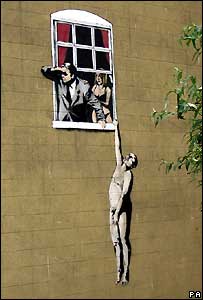
On entering the exhibition , visitors were presented with a flyer reading: 'There's an elephant in the room. There's a problem we never talk about. The fact is that life isn't getting any fairer. 1.7 billion people have no access to clean drinking water. 20 billion people live below the poverty line. Every day hundreds of people are made to physically be sick by morons at art shows telling them how bad the world is but never actually doing something about it. Anybody want a free glass of wine?'
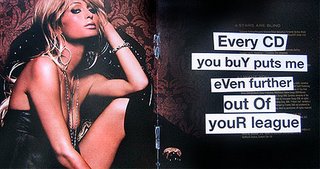
A week before the Los Angeles exhibition, Banksy visited Disneyland, somehow managing to place an inflatable figure dressed as a Guantanamo detainee alongside a railroad ride. A short film of the escapade runs inside the LA show. In the same darkened screening room a glass case displays another of his recent interventions: the Paris Hilton CD doctored by Banksy, which he carried out with the help of Los Angeles-based producer Danger Mouse. Enormous cockroaches had been placed inside the display case.
Like much of Banksy's work, it is an overt statement. But of what, precisely?
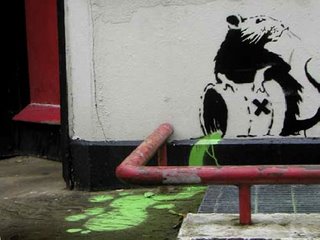
Banksy himself displayed a fine sense of bullshit in a interview he gave to Roger Gastman published in the LA Weekly. 'Some of the paintings have taken literally days to make,' he confided. 'Essentially, it's about what a horrible place the world is, how unjust and cruel and pointless life is, and ways to avoid thinking about all that. One of the best ways turned out to be sitting in a warehouse making paintings about cruelty, pain and pointlessness.'
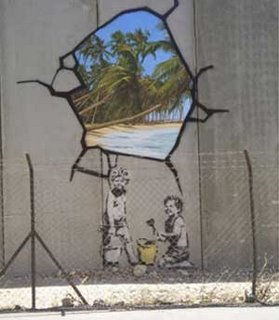 Banksy on the West Bank
Anarchy Jordan, an artist at the first public view of the show on Friday night, had his doubts. 'I don't know if he's selling out, but it's sad,' Anarchy Jordan was impressed by the subversiveness of some of the pieces, including the familiar Paramount films logo bearing the word Paranoid. 'Coming to LA and doing this is subversive," he said. 'After all, LA is the origin of so much nonsense.'
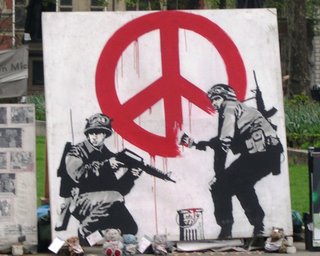 This used to be at Brian Haw's protest outside parliament
Banksy
Graffiti
Brad Pitt and Angelina Jolie, Jude Law and Keanu Reeves were among the celebrities gathered for the first LA show by the Bristol-born prankster and graffiti artist who is known for his street art and interventions in Britain,. His show, 'Barely Legal', was his first large-scale exhibition in the US. Complete with valet parking and a retinue of publicists the show included pieces of British iconography, such as a Guardsman on Horse Guards Parade atop a pantomime horse, in addition to work aimed specifically at the local audience. Occupying an entire wall is a painting reinterpreting an American icon, the raising of the flag at Iwo Jima. In Banksy's interpretation, the scene is given an urban setting with a group of protesters raising the flag on top of a car.
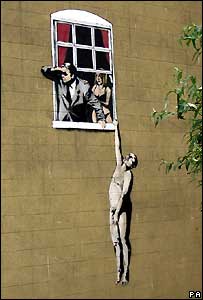
On entering the exhibition , visitors were presented with a flyer reading: 'There's an elephant in the room. There's a problem we never talk about. The fact is that life isn't getting any fairer. 1.7 billion people have no access to clean drinking water. 20 billion people live below the poverty line. Every day hundreds of people are made to physically be sick by morons at art shows telling them how bad the world is but never actually doing something about it. Anybody want a free glass of wine?'

A week before the Los Angeles exhibition, Banksy visited Disneyland, somehow managing to place an inflatable figure dressed as a Guantanamo detainee alongside a railroad ride. A short film of the escapade runs inside the LA show. In the same darkened screening room a glass case displays another of his recent interventions: the Paris Hilton CD doctored by Banksy, which he carried out with the help of Los Angeles-based producer Danger Mouse. Enormous cockroaches had been placed inside the display case.
Like much of Banksy's work, it is an overt statement. But of what, precisely?

Banksy himself displayed a fine sense of bullshit in a interview he gave to Roger Gastman published in the LA Weekly. 'Some of the paintings have taken literally days to make,' he confided. 'Essentially, it's about what a horrible place the world is, how unjust and cruel and pointless life is, and ways to avoid thinking about all that. One of the best ways turned out to be sitting in a warehouse making paintings about cruelty, pain and pointlessness.'
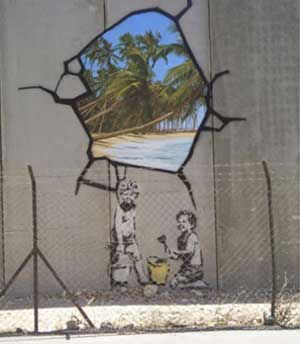 Banksy on the West Bank
 This used to be at Brian Haw's protest outside parliament
Banksy
Graffiti
Ian Dale - what a very nice man!
Thanks to Gert and Patrick H my attention was drawn to an entry on Ian Dale's website (Ian Dale is apparently an influential conserviate - I have seen his name numerous times in the blogosphere) listing his top 100 presumably british left wing blogs. A scan of the attached pdf file and lo and behold the Poor Mouth is there at number 67. I am not sure what to make of this given that I don't dwell much on hard political issues and when I do I tend to be a bit of a pessimist. Hiho, now for something on Banksy...
Cash for peerage scandal - a whole lot of nothing?
According to today’s Observer
police investigating the alleged cash-for-peerages scandal have so far found no 'compelling' evidence of serious wrongdoing, raising the likelihood that no charges will result from the high-profile Scotland Yard inquiry. This result will come as a relief to both Labour and the Conservatives who were threatened with involvement in what could have been one of the most damaging scandals of recent times.
And yet the damage has been done. People will remember the original headlines and form their opinions accordingly – that the Government is knee deep in sleaze. News that there is no case to answer will probably not change this impression. It is also sod’s law that the Tories will be less tarred by this scandal even though they too were under investigation.
The impression of sleaze is sadly another hurdle for Tony Blair’s successor to jump to secure a fourth term in 2009
police investigating the alleged cash-for-peerages scandal have so far found no 'compelling' evidence of serious wrongdoing, raising the likelihood that no charges will result from the high-profile Scotland Yard inquiry. This result will come as a relief to both Labour and the Conservatives who were threatened with involvement in what could have been one of the most damaging scandals of recent times.
And yet the damage has been done. People will remember the original headlines and form their opinions accordingly – that the Government is knee deep in sleaze. News that there is no case to answer will probably not change this impression. It is also sod’s law that the Tories will be less tarred by this scandal even though they too were under investigation.
The impression of sleaze is sadly another hurdle for Tony Blair’s successor to jump to secure a fourth term in 2009
16 September 2006
Geranium versicolor

Taken this afternoon, this is the second bloom of this species geranium. As geranium flowers go this is small, perhaps only half an inch (about 12mm) across. It goes to show beauty can come in small packages
A little common sense about Gibraltar

Today’s Times reports that the UK is set to sign a three-way agreement with Spain and Gibraltar that will lift the last vestiges of the blockade imposed by General Franco on the colony four decades ago. After nearly 2 years of talks the three parties are due to release a joint communiqué on Monday resolving a number of issues that have long nettled both sides.
It is expected that the agreement will ease restrictions on Gibraltarians including the resumption of the first direct flights between Spain and Gibraltar since 1979. The pact should prove a boon to the regional economy on both sides of the border. “For the finance industry the whole thing is good news,” Marcus Killick, the financial services commissioner of Gibraltar, said. Meanwhile the town of La Línea should benefit from easier access to Gibraltar’s jobs and consumers. Several thousand Spaniards also cross into Gibraltar every day to work. Peter Caruana, the Chief Minister of Gibraltar, says the agreements that have emerged from the first three-way talks represent “a huge sea-change in the nature of the relationship” with Spain. “It does signal a different and much more enlightened political engagement that you expect from European neighbours in the 21st century,”
For older Gibraltarians any sign of a rapprochement with Madrid is greeted with apprehension. Even those who support normalising relations with Spain know that it will be a tough sell for suspicious Gibraltarians. “What has been achieved is, in my view, historic,” Bruno Callaghan, a former president of the Gibraltar Chamber of Commerce, says. “But now it’s here many people will say, ‘Do we want it?” So far the Opposition in Gibraltar has held fire. The Leader of the Opposition and twice Chief Minister remains sceptical about Spain’s motives. “I don’t expect that the Spanish have had a change of heart and are giving away something for nothing,” he said. “It’s not in their history, it’s not in their character.”
Previous efforts by Britain and Spain to resolve their 300-year-old dispute over Gibraltar have foundered on opposition by its 30,000 residents, who oppose Spanish rule. In a 2002 referendum almost 99 per cent of Gibraltar’s voters rejected a proposal by London and Madrid for joint sovereignty over the territory. The idea was subsequently shelved, and both sides came to accept that Gibraltarians must be part of any negotiations over the future. “If it works it will be the watershed moment in Gibraltar’s relationship with Spain,” Dominique Searle, the editor of the Gibraltar Chronicle, said. “For me it’s the best news that I’ve had on this issue in a long time.”
Gibraltar has been a British possession since it was ceded by Spain in the 1713 Treaty of Utrecht which ended the War of the Spanish Succession. Although Spain has retained its claim over the Rock, unlike the erstwhile Argentinian junta, it has not resorted to military means (or not outside the frequent wars between the two nations during the 18th Century anyway!).
Strategically the Rock was of vital importance to Britain In WWII it ensured allied access to the Mediterranean. Had Franco joined the Axis (as was a distinct possibility) then Gibraltar may well have fallen. If this had happened then the Middle East would almost certainly have fallen to Germany. The outcome of WWII would almost certainly have been very different. In recent years, however, its strategic value has reduced and the British military presence has reduced accordingly. The main force on the Rock is the Royal Gibraltar Regiment, a small territorial army force.
While There is now less of an imperative to retain Gibraltar as a possession the population is steadfastly wish to remain British. The Gibraltarians are not a group of expatriates lording it over a “native” population. Gibraltarians are a diverse mix of Maltese, British, Spanish and North African. As with the Falkland Islanders their views must be taken into account when considering the future of Gibraltar. The removal of petty restrictions will be good for Gibraltar and for Spain but it should not be construed as the first step towards a transfer of sovereignty. It would take a very long time for the residents to come around to such an idea, if they ever do.
15 September 2006
The two faces of Ted
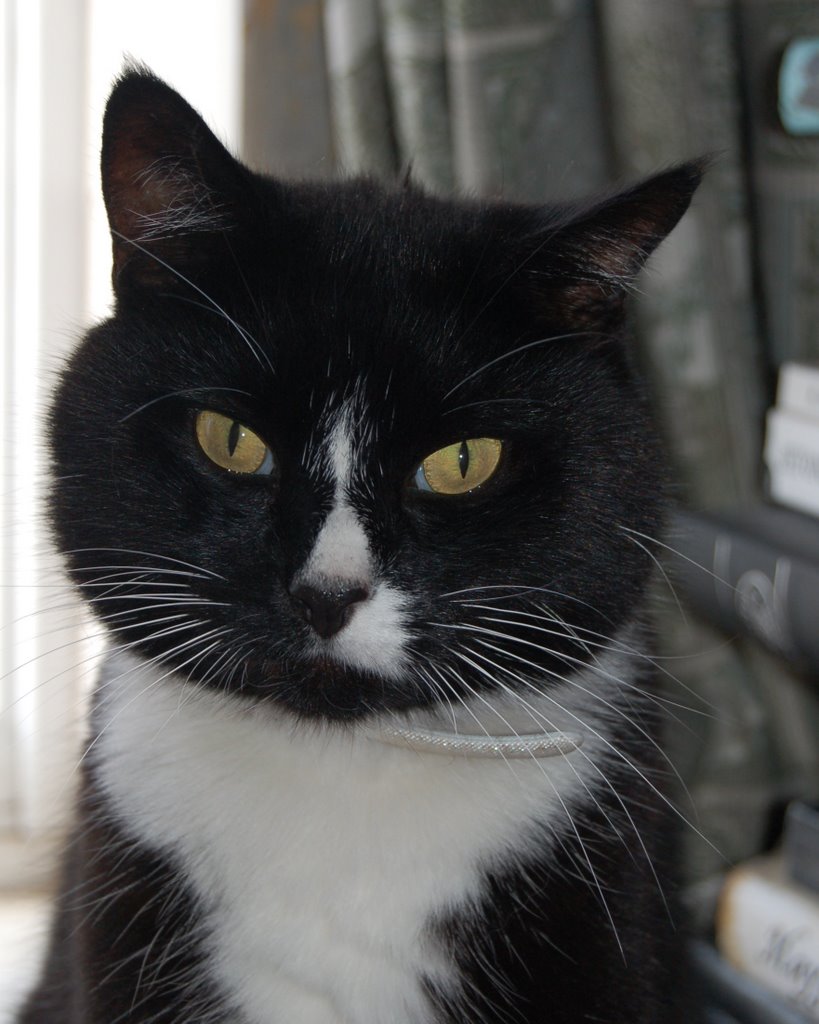 Good Ted
 Bad Ted
This is an early post for the Friday Ark and of Course Carnival of the Cats - see side bar for links
14 September 2006
13 September 2006
Lysistrata in Colombia
I have no idea whether it is another apocryphal tale but this story appeared in today’s Guardian and elsewhere. I like the idea of thugs being told “make war and you don’t make love!” It is an idea that has so many applications
Gang members in Pereira, one of Colombia's most violent cities face an ultimatum: give up guns or give up sex. In what is being called a "strike of crossed legs” the wives and girlfriends of gang members have said they will not have sex with their partners until they hand over their weapons to authorities and sign up for vocational training offered by the mayor's office.
Pereira, a city of 300,000 people, has Colombia's highest murder rate at 97 per 100,000 inhabitants.
Gang members in Pereira, one of Colombia's most violent cities face an ultimatum: give up guns or give up sex. In what is being called a "strike of crossed legs” the wives and girlfriends of gang members have said they will not have sex with their partners until they hand over their weapons to authorities and sign up for vocational training offered by the mayor's office.
Pereira, a city of 300,000 people, has Colombia's highest murder rate at 97 per 100,000 inhabitants.
The Worst Possible Tribute to Steve Irwin

This story is all over the press here. I hope it proves to be apocryphal. The death of Steve Irwin has apparently motivated some to wreak revenge. Eight days after he was killed in a freak encounter with a stingray authorities are investigating the possibility that the species that took Irwin's life is being targeted in acts of retribution - Up to 10 apparently mutilated stingrays have washed up in coastal waters since his death,.
"We do find dead stingrays with their tails cut off from time to time. People usually do it if they are worried about getting stung by a stingray, or they just do it maliciously, but it is pretty rare," said Wayne Sumpton, a senior biologist in Queensland's fisheries department. "We do not know if these incidents are motivated by Steve Irwin's death. At the moment that is just speculation."
Killing stingrays, said Michael Hornby, executive director of Irwin's conservation group Wildlife Warriors, is "not what Steve was about.We are disgusted and disappointed that people would take this sort of action to hurt wildlife," he said. "It may be some sort of retribution, or it may be fear from certain individuals, or it just may be yet another callous act toward wildlife"
Steve
Irwin
Spider and Wasp

A Garden Spider with what looks like the remains of a wasp. It really is the season for spiders. There are webs everywhere in the garden. I am glad I am not an arachnophobe
12 September 2006
Fighting Mac, homosexuality and camp coffee
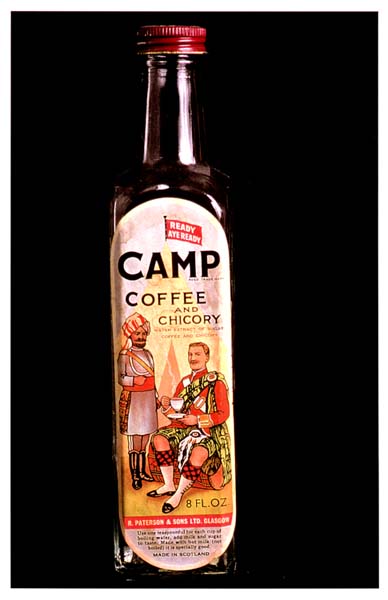
This interesting but squalid story from the Days of the British Empire appeared in Independent. It is a story I had never heard before.
When the inventors of Camp Coffee needed an image to market their new product 121 years ago, it seemed little could do the job better than a Scottish soldier sitting down for a brew in a far-flung corner of empire. To ensure Victorian consumers got the message that they were drinking the same treacly caffeine concentrate designed to fortify soldiers subduing the colonies, the kilted Gordon Highlander was shown being brought his drink by a Sikh manservant. Over the past century, the relationship between manservant and master changed to reflect attitudes towards the colonial era: by the 1980s, the Indian servant had lost his tray; a new label will now show the Sikh soldier sitting beside his former boss - and with a cup and saucer of his own.
Times and attitude rightly change but the Victorian soldier remains constant. The image is based on a Victorian military hero, Major General Sir Hector Macdonald, an ordinary soldier who turned down a Victoria Cross in favour of a commission and attained high rank. That the man who was known as "Fighting Mac" is now forgotten is evidence of a fall from grace which ended in him taking his own life after a whispering campaign suggesting he was a homosexual. Macdonald, shot himself in the head in his bedroom in a Paris hotel on 25 March 1903, apparently minutes after reading a front-page story in the New York Herald suggesting he faced a "grave charge".
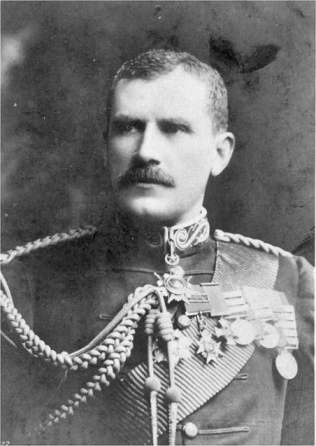
Hector Macdonald was born in 1853 in Dingwall, Scotland to a crofter and a dressmaker. He was an apprentice draper when he persuaded a recruiting sergeant from the Gordon Highlanders to accept him for training at the age of 17. A professional soldier he spent most of his 33 years in the Army in the outer reaches of the empire was held in such esteem by some of his compatriots was proof at least of a popular reputation built on stories of his talents as a military tactician and bravery as a commander.
While serving in Afghanistan in 1879 as a regimental sergeant, he distinguished himself in battle to the extent that he was given the choice of a Victoria Cross, the ultimate military accolade, or a rare commission as an officer. He is reputed to have accepted the commission with the words: "I shall win the medal later." Macdonald was credited with saving Lord Kitchener's imperial army at Omdurman - the Dervish stronghold across the Nile from where General Gordon of Khartoum was killed. At the head of his highly trained brigade of Sudanese troops, Macdonald repelled a counter-offensive by 20,000 Dervishes with the loss of only 48 men and 382 wounded. A young Winston Churchill, reporting on the battle, wrote how, at one point in the battle, Macdonald called his officers around him and rebuked them for "having wheeled into line in anticipation of his order and requested them to drill more steadily".
MacDonald was appointed military commander in Ceylon (now Sri Lanka) in 1902. A letter, printed in The Times of Ceylon shortly after he said: "You know, we heard a whispered rumour that he does not like ladies, and possibly may have been pleasantly surprised to find he had dropped on a spicy little isle where ladies are few and far between.”
Although well-loved and respected by his subordinates, it is suggested that the jealousy of his superiors boiled over in Ceylon in 1902 when he yelled at the Governor, Sir West Ridgeway, to get off his training ground during manoeuvres. It was Ridgeway's reports back to London which resulted in the decision that he should face a court martial. Others suggested that Lord Kitchener, leader of the British Army Sudan, ordered a whispering campaign against the general after he was humiliated by Macdonald's brilliant rearguard action in the Battle of Omdurman in 1898.
The accusation was one of homosexuality, an offence considered extremely serious and in keeping with the mores of his era, Macdonald decided even the allegation was a death sentence. Such was his status in Britain that news of the circumstances of his death brought an immediate backlash from a doubting civilian population. The establishment was forced to offer the family of the dead general a full state funeral when his previously unknown wife, Edinburgh-born Christina Duncan, arrived in Paris with their young son to collect her husband's body.
Even after death, the besmirched general continued to have a hold on the popular imagination. Rumours swirled around that, tired of his treatment by the Army, Macdonald staged his suicide to assume the identity of a German cousin, August von Mackensen, who was of a similar age and reported as being "gravely ill" at the time of the suicide attempt. Von Mackensen, who rose to the rank of field marshal in the Prussian army, miraculously recovered and suddenly discovered military skills he had not previously possessed. German propagandists wasted little time in perpetuating the idea of a betrayal by Macdonald in leaflets dropped behind British lines during the First World War.
What may have been seen as normal in the Victorian era seems so inappropriate in our time. That is not political correctness but our perception of the world. The story of Sir Hector Macdonald a sad one but the biggest shock of all is that anyone actually drinks the dam stuff!
Check here and here for more information on Sir Hector Macdonald.
Hector
Macdonald
Camp
coffee
11 September 2006
Donald Robson

On the fifth anniversary of 9/11 volunteer bloggers will come together to write a short tribute to each of the 2,996 victims of that awful day. Although I live an ocean away from New York I am proud to be a participant and to honour the memory of Donald Robson who died in the World Trade Center.
Donald Robson, aged 52, of Manhasset, New York was a partner and bond broker for Cantor Fitzgerald. Raised in Toronto he had spent the last two decades in New York and had also been present at the 1993 tower bombing. He is survived by two sons, Geoff and Scott. A kind man and a great father, he was one of 24 Canadians to die on 9/11 and one of the 658 victims from Cantor Fitzgerald.
My thoughts are with Donald’s family and friends on the anniversary of this terrible act, a senseless and evil act that brought short so many lives. May he rest in peace.
Please check this link to 2,996 for tributes to the other victims of 9/11.

10 September 2006
An Experiment
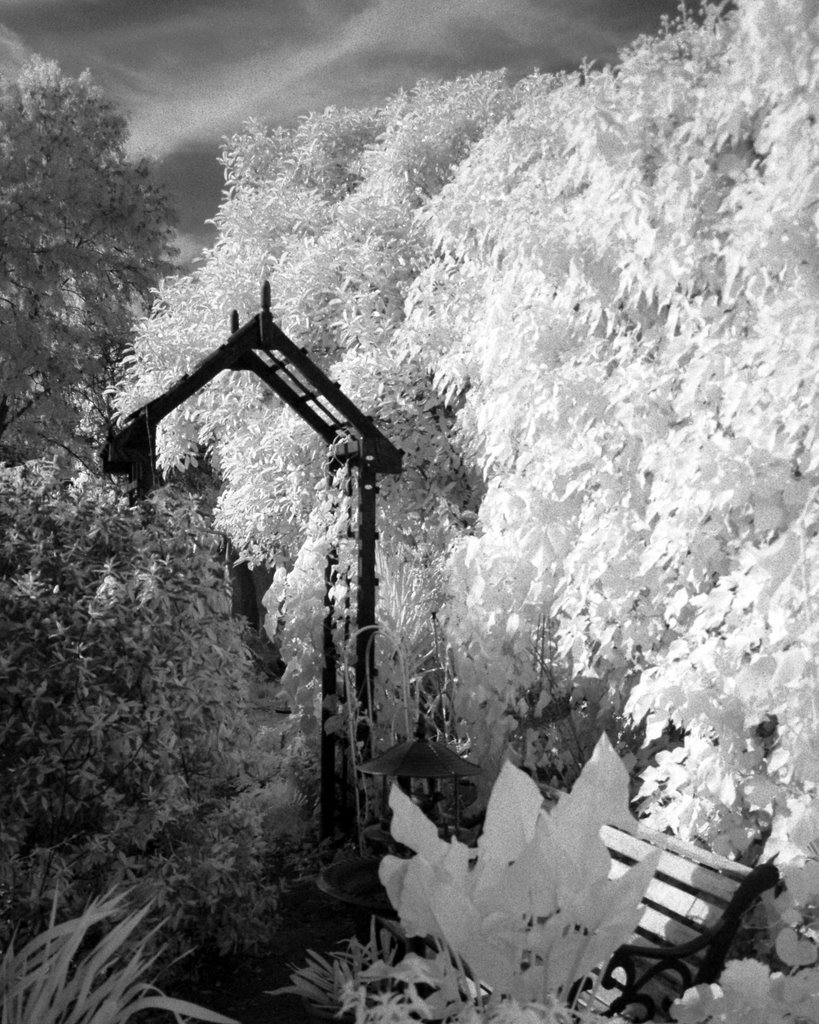
I recently bought a new camera: a bottom of the range Nikon D50 digital SLR. I thought I would have a play around and try a few things that I could not do with a copmact camera. This photo was taken trhough an Infrared filter and converted to black and white so as to get the effect I would have had I shot with infrared film. Not much of a pic maybe but I sort of like it
Garden 10 September

This is proof positive that the camera can lie or at least distort. Move just a little to the left and you would see a crappy shed that is overdue for demolition and a pile of waste that needs to be composted. Even so it gives us a lot of pleasure to see so much in bloom when most other things are in decline.
09 September 2006
Garden 9 September
 Chocolate Cosmos
 Fucshia magellanica
 Morning Glory
The garden starts to decline somewhat from late July onwards as the "big ticket" items like the Cephalaria and the Echinops bloom and fade but there is still a lot of flowers in bloomespecially nearest the house where we have a number of containers. Some perennials, like the Fuchsias will soldier on in bloom until we get the first frosts so we will still have a few flowers well into October.
David Beresford on the Art of Contrition
Yesterday David Beresford posted an article called the Art of Contrition in the Guardian’s Comment is Free section. I had not noticed it until I was checking my visitor stats and I was puzzled to see a number of referrals from the article.
Mr Beresford had linked to an item I posted on 28 August called An Act of Contrition. This was about a former Aparthied era Law and Order Minister who washed the feet of Rev Frank Chikane, a man he allegedly tried to have murdered.
Given that Mr Vlok’s act was given widespread coverage I am surprised that a veteran
journalist would choose to link to what I wrote!. I’m not sure what to make of his using “washed the feet of a black man” as the link title though, even if it is factual, Ah well no publicity is bad publicity, except if you've just poisoned the Ugley Women's Institute!
One thing I hadn't noticed was that I had managed to lose the link to the Guardian article I quoted in "an act of contrition". I have now restored that link.
Vlok
Chikane
contrition
Guardian
Mr Beresford had linked to an item I posted on 28 August called An Act of Contrition. This was about a former Aparthied era Law and Order Minister who washed the feet of Rev Frank Chikane, a man he allegedly tried to have murdered.
Given that Mr Vlok’s act was given widespread coverage I am surprised that a veteran
journalist would choose to link to what I wrote!. I’m not sure what to make of his using “washed the feet of a black man” as the link title though, even if it is factual, Ah well no publicity is bad publicity, except if you've just poisoned the Ugley Women's Institute!
One thing I hadn't noticed was that I had managed to lose the link to the Guardian article I quoted in "an act of contrition". I have now restored that link.
Vlok
Chikane
contrition
Guardian
Stop Press... Charles Clarke to stay on backbenches until the Second Coming

This story is plastered across the national press to day so take your pick of sources. As ever I choose the trusty Guardian (if for no other reason that it is the first paper I read every day).
Charles Clarke seemed to throw away any chance of a return to the front benches any time this millennium by letting rip with an all-out attack on Gordon Brown, accusing him of "absolutely stupid" behaviour during the leadership crisis. The outburst seems to be the result of a long standing conflict between himself and Brown rather than anything else. Even so colleagues describe this intervention as baffling, unhelpful and ill-advised.
The former home secretary said MPs had been angered by pictures of Mr Brown grinning on Wednesday, at the height of the furore surrounding Mr Blair's future. "A lot of people are very upset and cross about that. It was absolutely stupid: a stupid, stupid thing to do," he said. "What he should have done was come out strongly and distance himself from [backbench rebels]. He could have done that with a click of his fingers. This has been complete madness." He went on to tell today's Daily Telegraph that Mr Brown was a "control freak" who might lack "the bottle" to become prime minister.
Allies of Mr Brown have quite rightly refused to take the bait: "Charles is naturally provocative, but I don't think his remarks will be welcomed by anybody bar the Tories. I don't think he is easy to put up to things; he's very independent-minded," said one minister supportive of Mr Brown. A Blairite colleague added: "Charles is just doing his own thing in his own way; he is not part of a concerted effort. He's kicked both Tony and Gordon recently."
Mr Clarke also attacked the prime minister for a failure of leadership after being sacked as home secretary. The timing of that criticism - shortly before the local elections in May - did not win him friends; one MP yesterday labelled him "petulant". The former home secretary has always retained his independence from the prime minister, and several colleagues thought he might be hoping to return to government under Mr Brown's leadership. One Blair loyalist said yesterday: "I'm surprised by the strength of what he said"
In the meantime, according to an opinion poll in today’s Independent Labour is now seen as being more divided than the Tories during the John Major years. The survey found that 56 per cent of voters see Labour as more divided than the Tories during the Major government, which was racked by bitter divisions over Europe. Only 22 per cent regard Labour as more united. More than a quarter of Labour supporters (27 per cent) believe that Labour is more divided than the Conservatives were in 1992-1997.
The poll also found strong evidence that the public will want an early general election after the change of prime minister. Seven out of 10 people think there should be an election within a year. Some 35 per cent think the new Prime Minister should seek a fresh mandate immediately, with a further 35 per cent believing that he should do so within six months to a year. Only 18 per cent believe the election should be delayed beyond that.
There is logic in linking the two articles: Clarke has shown himself to be an utter fool to talk as he did. It almost certainly consigns him to political oblivion – Even if a Blairite such as Alan Johnson became the next PM would he want such a loose cannon aboard? Far worse, it provides further confirmation to the public that we are utterly disunited.
As for the poll, we party members can scoff at the fickle nature of public opinion but we know full well that it does not take much for public perceptions to become so entrenched that no evidence to the contrary will shake them. We are seen as dangerously divided and unless we can get our act together now, then Cameron will be PM after next. Is that what we really want? The Labour Party is a party of Government. Let’s keep it that way!
Do we need a general election as soon as we have chosen our new leader? No. The 2005 result gives Blair’s successor a mandate to govern. I only hope that Blair's successor does better than Callaghan and Major did in 1979 and 1997 respectively...
Charles
Clarke
Labout
Party
Blair
08 September 2006
Robyn
 This is Robyn our Alpha cat. He's the one that intimidates interlopers - something made easier by the fact that he is a large cat by any standard.
My contribution to the Friday Ark and the current Carnival of the Cats
06 September 2006
Ahmadinejad commits himself to further liberalization of Iranian society……….
 Mahmoud Ahmadinejad made further progress in his plan to reinvent Iran as a liberal secular democracy yesterday by calling for a purge of "liberal and secular" academics in the universities."Today students should protest and shout at the president asking why some liberal and secular professors are still present in the universities," he told a gathering of young scientists. "Our educational system has been under the influence of the secular system for 150 years. Colonialism is seeking the spread of its own secular system." While acknowledging it was difficult to change this system, he said: "Such a change has begun."
Mr Ahmadinejad also said his government had tried to reduce the political influence of university chancellors, many of whom were seen as pillars of the reformist government of his predecessor, Mohammad Khatami. "A political predominance existed among many of the university chancellors but we have tried to reduce it because we don't believe chancellors should enter into politics at all," Mr Ahmadinejad said.
His latest comments will intensify fears among student and faculty members of an incipient crackdown. In recent months, several student activists have been imprisoned and dozens of liberal lecturers forced to retire before the statutory age. Last year, Mr Ahmadinejad appointed a radical cleric as chancellor of Tehran university, the country's most prestigious institution.
The government has also buried "martyrs" from the 1988 Iran-Iraq war in some universities in what activists see as an excuse to allow security forces on to campuses to keep watch on the student body. Iran's Islamic authorities have kept universities under close surveillance since a wave of student protests demanding greater freedom in 1999. A student leader, Akbar Mohammadi, died in jail in July after a hunger strike started in protest at being reimprisoned following a long-term release on medical grounds.
But Professor Sadegh Zibakalam, a political scientist at Tehran university, dismissed suggestions of an imminent purge. "Ahmadinejad is a populist trying to create a charismatic image for himself," he said. "These comments are aimed at those who voted for him and perhaps designed to divert attention from Iran's economic problems. They don't mean there is an orchestrated plot against more liberal lecturers."
Perhaps this is all “harf” (empty words) but it does sound as if he is looking to consolidate further his position by removing sources of potential opposition
Ahmadinejad
Recreating the Turing Bombe
 The Turing bombe
The BBC is carrying a story concerning the recreation of the Turing Bombe a machine that was used to decipher German messages during WWII. This will be the first tine a bombe (operational or not) will have been seen since the end of the war - Churchill ordered their destruction to ensure they did not fall into the wrong hands.
The replica will be shown at Bletchley Park in Bucks, the site of “Station X” where the original codes were cracked from next July. About 10,000 people worked at Bletchley Park at the height of the war - mostly from the Women's Royal Naval Service. One former employee was 82-year-old Jean Valentine, who described how the original machines "worked beautifully" and sounded like "lots of knitting machines". She said all of the employees at the code-breaking station worked on a "need to know basis. I knew what I was doing but I didn't know what anyone else was doing."
 Alan Turing
The code-breaking machine - known as the Turing Bombe - was developed by the mathematicians Alan Turing and Gordon Welchman based on an earlier effective machine designed and used to great effect by Polish intelligence before WWII. It is thought the intercepted messages helped the Allies to defeat the Nazis in several crucial battles - so shortening the war by as much as two years. Simon Greenish, director of Bletchley Park Trust, said the war-time facility was "one of the 20th Century's great stories. What was done at Bletchley has affected all our lives in one way or another because World War II would not have ended when it did if it wasn't for Bletchley”
The reconstruction project will be open to the public from July 2007.
 Marian Rejewski
Wwe will never know if the war would have lasted until 1947 without the contribution of the men and women of Station X. What is certain: they men and women of Station X would not have been possible without the work of Polish Intelligence before WWII. Mathematicians like Marian Rejewski had cracked an earlier version of Enigma and if it wasn’t for their “bomba” then there probably would have been no Turing Bombe. This does not take anything away from Alan Turing. It merely shows that few things are created from first principles, rather inventors generally take forward and improve on what is already in existence.
Further Reading
Alan Turing
Bomba Kryptologiczna
Enigma
Virtual Bletchley website
Turing
Bombe
Rejewski
Enigma
Bletchley
04 September 2006
Steve Irwin
It's just been reported that Steve Irwin, the Crocodile Hunter, was killed by a stingray barb while filming a documentary on the Great Barrier Reef. (Source Sydney Daily Telegraph)
The barb apparently hit Mr Irwin in the chest, piercing his heart. The Stingray barb is coated in toxic material and would ahve had an effect like a bayonet.
I suppose it is an appropriate death for a man who always seemed to have boundless enthusiasm for wildlife . Somehow another form of death would not have been fitting.
03 September 2006
Disease(s) - Past
A second article in today’s Observer concerns the destruction of Mexico’s population following the arrival of the Conquistadores. The massive fall is usually blamed on the introduction of diseases to which the native population had no resistance. Epidemiologist Rodolfo Acuna-Soto suggests that much of the damage could have been done by a local haemorrhagic fever not unlike the Ebola virus. There has been a similar argument in Europe over the cause of the Black Death.
 The Smallpox Virus
Estimates of the population of Mexico before the Spanish conquest range from 6 million to 25 million; by 1600, it was just 2 million. While there were indeed terrible smallpox and measles epidemics in the 1520s and 1530s, Acuna-Soto suggests that two later destructive epidemics in 1545 and 1576 do not appear to be accounted for by imported diseases. Acuna-Soto's conviction that these epidemics - called cocoliztli - were caused by a haemorrhagic fever is partly based on the observations of Philip II's physician. 'Blood flowed from the ears and in many cases blood truly gushed from the nose,' Francisco Hernandez wrote. 'The tongue was dry and black. Enormous thirst. Urine the colours of sea green, vegetal green, and black'.
A little digging around the internet and I find that this story is hardly hot news. An article in the February edition of Discover magazine sets out Acuna’s hypothesis in greater detail.
Acuña-Soto’s studies of ancient documents revealed that the Aztecs were familiar with smallpox, perhaps even before Cortés arrived. They called it zahuatl. Spanish colonists wrote at the time that outbreaks of zahuatl occurred in 1520 and 1531 and, as many as 8 million people died from those outbreaks. But the epidemic that appeared in 1545, followed by another in 1576, seemed to be another disease altogether. The Aztecs called those outbreaks by a separate name, cocolitzli. "For them, cocolitzli was something completely different and far more virulent," Acuña-Soto says. "Cocolitzli brought incomparable devastation that passed readily from one region to the next and killed quickly."
Medical historians insisted that the cause of this affliction could only have been a European disease. But Acuña-Soto felt that it made no sense, that the Aztecs had invented a new name for smallpox. He also noticed that previous researchers had to pick and choose among the disease reports to make them fit a diagnosis of smallpox or typhus. Finally he also could not understand why Old World diseases would cause massive deaths 20 years and then 55 years after the arrival of the Spanish. "By this time," he says, "those who survived the earlier epidemics would have had immunities or would have passed them on."
If cocolitzli had been caused by a hemorrhagic virus, Acuña-Soto realized, the Spanish could not have brought it with them. Such diseases do not readily pass from one person to another, so the virus must have been native.
This raised two serious questions – First: were people prepared to absolve the Spanish of (at least partial) responsibility for one of the great evils of the colonial era? Second: If the Spanish didn't bring about the cocolitzli, what did?
For the Aztecs, as for any agricultural society, rainfall was so important that it was well recorded in their surviving codices. The Valley of Mexico in which the Aztecs lived was not easy land to farm. The rains, only 30 to 40 inches a year, come between May and October. There are frequent late and early frosts that can kill maize crops. It is no surprise that the codices all bear witness through evocative pictographs of heavy rains, frosts, or—more telling—catastrophic droughts. Acuña-Soto saw that each of the cocolitzli epidemics appeared to be preceded by several years of drought. He also found that the epidemics didn't happen during the drought. They appeared only in the wet periods that followed. That was the crucial clue he had missed: It was raining when people got sick.
Evidence from Dendrochronology shows that during the 16th century central Mexico not only lacked rain but also suffered the most severe and sustained drought in 500 years, one that encompassed nearly the entire continent. Moreover the tree-ring records show wet interludes setting in around the years 1545 and 1576, the years of the cocolitzli. With the climate data in place, Acuña-Soto could piece together a plausible explanation of those epidemic years.
 The Ebola Virus
Cocolitzli had been caused by a hemorrhagic fever virus that had lain dormant in its animal hosts. Severe drought would have contained the host population, forcing them to hole up wherever they could find water. Initially, only a small percentage may have been infected, but when forced into close quarters the virus was transmitted to others. When the rains returned, the hosts quickly bred and spread the virus as they came into contact with humans. Once infected, humans transmitted the virus to one another through contact with blood, sweat, and saliva.
Hemorrhagic viruses affect human populations that are already stressed, Acuña-Soto says. "The natives were poor and probably near starvation and living in unsanitary conditions where the rats would congregate. They also worked in the fields, where they'd be exposed to the rat droppings.
Elsa Malvido, a historian from Mexico's National Institute of Anthropology and History, dismisses the idea. She believes the later epidemics were bubonic plague spread by black rats from Europe. 'They were more extreme because they were attacking people with no immunity,' she said.
There has been a debate in Europe over the cause of the Black Death in 14th Century Europe. In 1894, two scientists, Alexandre Yersin and Shibasaburo Kitasato, independently identified the rod-shaped bacterium responsible for an epidemic of bubonic plague sweeping out of China.
 Yersinia pestis
Yersin soon linked the Black Death to the bacterium, named Yersinia pestis. Since then historians and scientists have strengthened the argument that bubonic plague was responsible for Black Death and similar outbreaks in medieval Europe. But other experts have expressed doubts, largely on account of the difficulty of identifying a disease based on the few medieval descriptions of the Black Death that have survived.
Two researchers from the University of Liverpool presented a new theory in 2001 arguing that a hemorrhagic virus, like Ebola, probably caused the Black Death and most of the smaller epidemics that struck Europe for the next three centuries, not bubonic plague. They argued that Bubonic plague is a disease of rodents and Europe had no rodent species that could harbor the disease between outbreaks. In addition the rats that passed the plague through fleas to humans during epidemics all died so the plague would have perished with them.
Samuel K. Cohn, a professor of medieval history at the University of Glasgow, agrees that other diseases are better candidates for the Black Death than Yersinia pestis but feels that an Ebola-like virus would burn out too quickly to produce the widespread mortality seen.
Most epidemiologists, however, argue that the evidence points most strongly toward the bubonic plague pathogen as the cause of the Black Death. Bubonic plague can take three forms in people, and those forms can account for the descriptions of Black Death symptoms. In addition French researchers reported that they had found Yersinia pestis in the dental pulp of three people buried in Montpellier, France, in the 14th century. "Medieval Black Death was the plague," they declared.
Some scientists suggest that more concrete evidence - for example, finding Yersinia pestis in the remains of victims from northern Europe and England - is needed to settle the question of what caused the Black Death. Perhaps the overall position is best summed up by Dr Joshua Lederberg an emeritus professor of microbiology and a Nobel laureate in medicine at Rockefeller University: "Yersinia still seems to me the most reasonable assignment as the cause of the Black Death, but I say that with less than unshakable conviction."
Mexico
Smallpox
Hemorrhagic
bubonic
plague
Black
Death
Conquistador
 The Smallpox Virus
Estimates of the population of Mexico before the Spanish conquest range from 6 million to 25 million; by 1600, it was just 2 million. While there were indeed terrible smallpox and measles epidemics in the 1520s and 1530s, Acuna-Soto suggests that two later destructive epidemics in 1545 and 1576 do not appear to be accounted for by imported diseases. Acuna-Soto's conviction that these epidemics - called cocoliztli - were caused by a haemorrhagic fever is partly based on the observations of Philip II's physician. 'Blood flowed from the ears and in many cases blood truly gushed from the nose,' Francisco Hernandez wrote. 'The tongue was dry and black. Enormous thirst. Urine the colours of sea green, vegetal green, and black'.
A little digging around the internet and I find that this story is hardly hot news. An article in the February edition of Discover magazine sets out Acuna’s hypothesis in greater detail.
Acuña-Soto’s studies of ancient documents revealed that the Aztecs were familiar with smallpox, perhaps even before Cortés arrived. They called it zahuatl. Spanish colonists wrote at the time that outbreaks of zahuatl occurred in 1520 and 1531 and, as many as 8 million people died from those outbreaks. But the epidemic that appeared in 1545, followed by another in 1576, seemed to be another disease altogether. The Aztecs called those outbreaks by a separate name, cocolitzli. "For them, cocolitzli was something completely different and far more virulent," Acuña-Soto says. "Cocolitzli brought incomparable devastation that passed readily from one region to the next and killed quickly."
Medical historians insisted that the cause of this affliction could only have been a European disease. But Acuña-Soto felt that it made no sense, that the Aztecs had invented a new name for smallpox. He also noticed that previous researchers had to pick and choose among the disease reports to make them fit a diagnosis of smallpox or typhus. Finally he also could not understand why Old World diseases would cause massive deaths 20 years and then 55 years after the arrival of the Spanish. "By this time," he says, "those who survived the earlier epidemics would have had immunities or would have passed them on."
If cocolitzli had been caused by a hemorrhagic virus, Acuña-Soto realized, the Spanish could not have brought it with them. Such diseases do not readily pass from one person to another, so the virus must have been native.
This raised two serious questions – First: were people prepared to absolve the Spanish of (at least partial) responsibility for one of the great evils of the colonial era? Second: If the Spanish didn't bring about the cocolitzli, what did?
For the Aztecs, as for any agricultural society, rainfall was so important that it was well recorded in their surviving codices. The Valley of Mexico in which the Aztecs lived was not easy land to farm. The rains, only 30 to 40 inches a year, come between May and October. There are frequent late and early frosts that can kill maize crops. It is no surprise that the codices all bear witness through evocative pictographs of heavy rains, frosts, or—more telling—catastrophic droughts. Acuña-Soto saw that each of the cocolitzli epidemics appeared to be preceded by several years of drought. He also found that the epidemics didn't happen during the drought. They appeared only in the wet periods that followed. That was the crucial clue he had missed: It was raining when people got sick.
Evidence from Dendrochronology shows that during the 16th century central Mexico not only lacked rain but also suffered the most severe and sustained drought in 500 years, one that encompassed nearly the entire continent. Moreover the tree-ring records show wet interludes setting in around the years 1545 and 1576, the years of the cocolitzli. With the climate data in place, Acuña-Soto could piece together a plausible explanation of those epidemic years.
 The Ebola Virus
Cocolitzli had been caused by a hemorrhagic fever virus that had lain dormant in its animal hosts. Severe drought would have contained the host population, forcing them to hole up wherever they could find water. Initially, only a small percentage may have been infected, but when forced into close quarters the virus was transmitted to others. When the rains returned, the hosts quickly bred and spread the virus as they came into contact with humans. Once infected, humans transmitted the virus to one another through contact with blood, sweat, and saliva.
Hemorrhagic viruses affect human populations that are already stressed, Acuña-Soto says. "The natives were poor and probably near starvation and living in unsanitary conditions where the rats would congregate. They also worked in the fields, where they'd be exposed to the rat droppings.
Elsa Malvido, a historian from Mexico's National Institute of Anthropology and History, dismisses the idea. She believes the later epidemics were bubonic plague spread by black rats from Europe. 'They were more extreme because they were attacking people with no immunity,' she said.
There has been a debate in Europe over the cause of the Black Death in 14th Century Europe. In 1894, two scientists, Alexandre Yersin and Shibasaburo Kitasato, independently identified the rod-shaped bacterium responsible for an epidemic of bubonic plague sweeping out of China.
 Yersinia pestis
Yersin soon linked the Black Death to the bacterium, named Yersinia pestis. Since then historians and scientists have strengthened the argument that bubonic plague was responsible for Black Death and similar outbreaks in medieval Europe. But other experts have expressed doubts, largely on account of the difficulty of identifying a disease based on the few medieval descriptions of the Black Death that have survived.
Two researchers from the University of Liverpool presented a new theory in 2001 arguing that a hemorrhagic virus, like Ebola, probably caused the Black Death and most of the smaller epidemics that struck Europe for the next three centuries, not bubonic plague. They argued that Bubonic plague is a disease of rodents and Europe had no rodent species that could harbor the disease between outbreaks. In addition the rats that passed the plague through fleas to humans during epidemics all died so the plague would have perished with them.
Samuel K. Cohn, a professor of medieval history at the University of Glasgow, agrees that other diseases are better candidates for the Black Death than Yersinia pestis but feels that an Ebola-like virus would burn out too quickly to produce the widespread mortality seen.
Most epidemiologists, however, argue that the evidence points most strongly toward the bubonic plague pathogen as the cause of the Black Death. Bubonic plague can take three forms in people, and those forms can account for the descriptions of Black Death symptoms. In addition French researchers reported that they had found Yersinia pestis in the dental pulp of three people buried in Montpellier, France, in the 14th century. "Medieval Black Death was the plague," they declared.
Some scientists suggest that more concrete evidence - for example, finding Yersinia pestis in the remains of victims from northern Europe and England - is needed to settle the question of what caused the Black Death. Perhaps the overall position is best summed up by Dr Joshua Lederberg an emeritus professor of microbiology and a Nobel laureate in medicine at Rockefeller University: "Yersinia still seems to me the most reasonable assignment as the cause of the Black Death, but I say that with less than unshakable conviction."
Mexico
Smallpox
Hemorrhagic
bubonic
plague
Black
Death
Conquistador
Subscribe to:
Posts (Atom)