30 November 2006
R.E.M. - Begin the begin
There was a time when REM didn't suck - when they weren't shiny happy people. Originally on Life's Rich Pageant released in 1985, when I was living... in Dover, damn it!


Hoodoo Gurus - I want you back
Dodgy clothes and dodgier hair but Stoneage Romeos is still one of my favourite albums, and yet it takes me back to Dover.....
Uncertain Smile - The The
A song that takes me back... to miserable days stuck working in Dover, a town that makes one pine for Romford.
Antikythera Mechanism

Again this is hardly hot news as such but it seems to have made the papers today , including the Guardian and the Independent . It would seem that scientists have finally worked out how the 2,000-year-old mechanical device salvaged from a Roman shipwreck operates.
The machine, which dates to 65BC, was found on a shipwreck in 1900 by sponge diver, Elias Stadiatos. Since its discovery, scientists have been trying to reconstruct the device, which is now known to be an astronomical calendar capable of tracking the position of the sun, several heavenly bodies and the phases of the moon. Experts believe it to be the earliest-known device to use gear wheels and by far the most sophisticated object to be found from the ancient and medieval periods.
Using modern computer x-ray tomography and high resolution surface scanning, a team peered inside fragments of the crust-encased mechanism and read inscriptions that once covered the outer casing of the machine. Detailed imaging of the mechanism suggests it dates back to 150-100 BC and had 37 gear wheels enabling it to follow the movements of the moon and the sun through the zodiac, predict eclipses and even recreate the irregular orbit of the moon. The motion, known as the first lunar anomaly, was developed by the astronomer Hipparcus of Rhodes in the 2nd century BC and he may have been consulted in the machine's construction, the scientists speculate.
Remarkably, scans showed the device uses a differential gear, which was previously believed to have been invented in the 16th century. The level of miniaturisation and complexity of its parts is comparable to that of 18th century clocks. One of the remaining mysteries is why the Greek technology invented for the machine seemed to disappear. No other civilisation is believed to have created anything as complex for another 1,000 years. One explanation could be that bronze was often recycled in the period the device was made, so many artefacts from that time have long ago been melted down and erased from the archaeological record.
Although the news story tells us a little more of what was already suspected, I am so glad that the casing inscription doesn’t say “Property of Blurgon, Omicron Persei 8”. Erich Von Daniken would have been insufferable if it did!
Antikythera mechanism
29 November 2006
Don't they know (it's getting on for) christmas time?
 Fuchsia
Now we are heading for winter I don't spend that much time in the garden even though there is still a fair bit of tidying up to do. Although most plants have either died off or gone into dormancy some plants do not seem to have given up. My fuchsias are all in bloom, even the tender ones while the hebe has just started putting up new flowers. Either this is a little bit of evidence of global warming or some of my plants would go out in Newcastle on a January weekend dressed only in a pair of shorts!
 Hebe
HebeBritain’s last witch
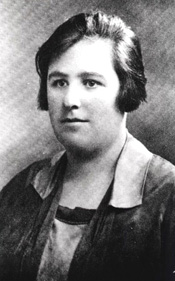
As ever my thought processes can flit from one thing to another. In response to a comment left by a regular and well liked visitor to this blog I mentioned that the last witchcraft trial took place in 1944. This is no joke, but needless to say nobody got burned for their troubles: in England witches were hanged rather than burned when the death penalty was in place.
Helen Duncan has gone down in history as the last person in Britain to be tried as a “witch”. Born in Callender, Scotland in 1897 Duncan displayed an early gift as a medium, apparently being able to make spirits of the dead appear and talk to their relatives. This gift is of course in doubt: in1934 she was found guilty of fake mediumship in Scotland after a sitter at one of her séances made a grab at one of her materialisations and found it to be an under vest!
By WWII Duncan lived in Portsmouth. She attracted attention in December 1941 when she “summoned” the spirit of a sailor who had died when the Battleship HMS Barham. The Barham had been sunk by a German U boat the previous month but the news had not been released at the time of Duncan’s séance.
Duncan remained under surveillance until January 1944, when one of her séances was broken up by police (allegedly because authorities feared she may reveal details of the D Day landings). Initially charged with vagrancy, a crime that attracted a maximum fine of five shillings (25 pence), she was refused bail and was taken to London to face more serious charges. prosecutors charged her with violating the 1735 Witchcraft Act. (Note: the witchcraft Act of 1735 did not provide for the death penalty, rather it allowed fraudulent mediums to be punished as a vagrant or a con artist and fined or imprisoned accordingly).
Duncan’s trial at the Old Bailey court in March 1944 lasted a week and, given the unusual nature of the charge, attracted significant press coverage. She was ultimately found guilty of conspiracy to violate the Witchcraft Act and was sentenced to nine months imprisonment.
The conviction did not please everyone. Winston Churchill wrote to the Home Secretary to complain about the resources wasted on what he described as “absolute tomfoolery to the detriment of the necessary work of the court.” When he was returned to power in 1951 his government repealed the Witchcraft Act, replacing it with the Fraudulent Mediums Act.
Helen Duncan was released from prison on the 22nd September 1944. She died in 1956
Further reading:
The Barham Conspiracy by Jason Stevenson
Official Helen Duncan website
Wikipedia
Scotland’s last witch
Helen Duncan medium witch
Leviathan!
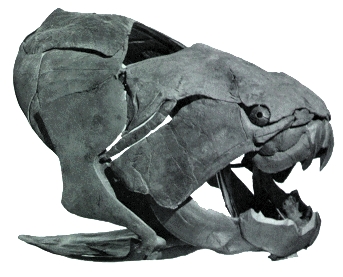 Dunkleosteus skull
The Dunkleosteus, an extinct creature that grew 11m long, weighed up to four tons and armed with a huge array of vicious bladed teeth was already well known to science but the press seems to have been quite taken by a story which indicates that it had a set of jaws which could deliver a terrifyingly strong bite.
Scientists have discovered that the vice-like grip of its jaws enabled Dunkleosteus terrelli to exert a force of over five tonnes on its prey, enough to bite the toughest into two. "Dunkleosteus was able to devour anything in its environment," said Philip Anderson, of the University of Chicago, who led the study published in the Royal Society journal Biology Letters.
A mechanical model of the mouth of the fish revealed that it possessed a highly mobile skull controlled by a unique mechanism based on four rotational joints working in harmony. This gave it the strongest bite of any fish that ever lived and one that rivalled the strongest bites in the animal world, including those of large alligators and the biggest carnivorous dinosaur, Tyrannosaurus rex.
A study of the fossilised skull of the fish also revealed that it could open its jaws in one-fiftieth of a second, creating such a strong suction that it would have quickly pulled prey to its mouth.
The bladed jaw of the D . terrelli enabled the fish to rip apart prey that was bigger than its mouth, a technical feat that sharks did not acquire until 100 million years later.D. terrelli lived during the period known as the Devonian, before the advent of the dinosaurs, and it probably fed on other armour-plated fish, including sharks, as well as tough invertebrates protected by shells and other types of body armour.
 Spielberg could have had a field day!
Hmm nothing like a monster story to start the day especially if the creature makes Jaws look like a sissy! Click here and here for the Independent and Guardian reports. Click here and here for more information on Dunkleostus.
Dunkleosteus huge vicious fish
28 November 2006
We are just watching things get worse
Following on from my post yesterday about the poverty and wealth in Kabul, I noticed that that the G2 section of today’s Guardian carries a long article by Natasha Walter concerning this situation of women in Afghanistan. While it may not say an awful lot that most of us don’t already know - that the lot of women in Afghanistan has improved very little overall - it is still well worth reading. It makes me shudder to think that the few gains women have made are being eroded as if made of sand.
Here is an extract from the article. Click here to read it in full.
Five years ago, when the US and the British arrived in Afghanistan, they sold their mission to us not simply as a way of driving out the terrorist-shielding Taliban, but also as a way of empowering women. As Cherie Blair said in November 2001: "We need to help Afghan women free their spirit and give them their voice back, so they can create the better Afghanistan we all want to see." Five years on, however, the Blairs have become less vocal about the women whom we were meant to have liberated. When Tony Blair visited Kabul earlier this month, he did not comment on the recent report by one charity, Womankind Worldwide, which stated: "It cannot be said that the status of Afghan women has changed significantly in the last five years."
I went to Afghanistan soon after the Taliban had been ousted from Kabul, and found that their departure was genuinely allowing women to hope again. One of the places that stuck most clearly in my mind was a dirt-poor village called Sar Asia, on the outskirts of Kabul. There I met women who had been unable to leave their houses for education during the Taliban regime, who had just set up a literacy course with the help of Rawa, the Revolutionary Association of Women of Afghanistan. When I asked the students, who ranged from 13-year-old girls to 50-year-old widows, if they thought all women in Afghanistan wanted more freedom and equality, my translator struggled to keep up with the clamour: "Of course we do," said one widow furiously. "Even women who are not allowed to come to this class want that. But our husbands and brothers and fathers don't want it. The mullahs keep saying freedom is not good for us."
Last month I was able to revisit the country, and one of the first things I did was to go back to Sar Asia. The teacher invited me back into the room that once had been crowded with women learning to read. This time, the room is empty, its net curtains closed against the bright sun. "We're not teaching here any more," the teacher tells me sadly, sitting alone on the cushions on the floor. "They were threatening us, telling us not to do it any more, and we were scared. For a while we continued, but we were afraid that they might do something worse. This place is a place of Taliban. Neighbours may work for the government in the morning but at night they are the same Taliban with the same thoughts." I tell her I remember the enthusiasm of the women in the course four years ago. "Yes, we were very happy. Rawa members came and talked about how they could help us to make a literacy course for women. We were all very pleased. But that has stopped now. I think in the west you think that now conditions are good here, that everyone can go to school or go to work for the government. But now we are just watching things get worse."
You can't say that things haven't improved at all in Afghanistan since the Taliban were "removed", You can now see women moving around Kabul in a way they could not five years ago; the majority do not wear the burka, sporting instead a variety of Islamic dress from shalwar kameez to a short coat with a bright headscarf, as they go to the markets, to the schools, to the university, and to work. During my time in the city I seek out evidence of change, and I certainly find it. I meet women in the government, including in the ministry of public health, where they are trying to deliver a package of basic healthcare for women. I meet women in non-governmental organisations working on literacy and advocacy projects, women professors and students in the university, and women in the media, including newspaper reporters and television presenters. But each of them has a negative to set beside the positive.
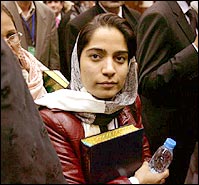 Malalai Joya
Malalai Joya is, at 28 years old, the youngest and most famous of all the women in the Afghan parliament. In a way her very presence in the parliament is a powerful symbol of change; a woman who had to work in secret in underground schools in Herat during the Taliban time is now able to speak out against her enemies in the parliament. She rose to fame at the end of 2003, when she made a speech attacking the warlords who still hold the balance of power in Afghanistan. On that occasion, one of the men she was attacking, Abdul Rasul Sayyaf, rose and told her that her speech was a crime, announced that "Jihad is the basis of this nation" and asked for her microphone to be disconnected. The then speaker of the house, Sibghatullah Mojaddedi, a former mujahideen leader, called her an infidel, and said that if she did not apologise she could not attend the next session of parliament.
"Here there is no democracy, no security, no women's rights," she says. "When I speak in parliament they threaten me. In May they beat me by throwing bottles of water at me and they shouted, 'Take her and rape her.' These men who are in power, never have they apologised for their crimes that they committed in the wars, and now, with the support of the US, they continue with their crimes in a different way. That is why there is no fundamental change in the situation of women."
She is desperate for people to take account of the silent women whose voices we never hear. "Afghan women are killing themselves now," she says, "there is no liberation for them." This is not just rhetoric: the Afghan Human Rights Commission recently began to document the numbers of Afghan women who are burning themselves to death because they cannot escape abuse in their families.
I meet Kochai, a serious woman more soberly dressed than the others in a long olive skirt and jacket. She has come to Kabul for the wedding from Kandahar, where she works as a police woman in the airport. She was married into a traditional family, and was abused for years by her husband. It was when her daughter then got married to a relation of her husband's, and started being beaten too, that she decided she had to get herself and her daughter away from these violent men. "I had to defend myself and my daughter," she said. The women now live without their husbands, although her daughter has not been able to get a divorce from her husband. "It is very, very difficult. I am sick of being frightened. During the nights especially I am frightened."
Like all the other women I meet on my trip, Kochai is very sure that despite all the insecurity and lack of progress, life would be far worse if western forces pulled out. "If the British and American soldiers left now, we wouldn't be able to leave our houses. We would lose all that we have."
Yet everyone knows that the Taliban are regrouping in and around Kandahar; Safia Ama Jan (see my earlier post about Safia A death in Kandahar ), the head of the department of women's affairs, was assassinated there recently, and Kochai says the actual number of kidnappings and assassinations is far higher than we hear about. "In one week six women were killed. They were ordinary women, working women, but the Taliban say they are spies of the government. They tell them, 'Don't work,' and if they do not listen, then they are kidnapped and killed far from the city." She has two bodyguards who take her to work and back, but after work she has no bodyguards - so in a way they only make her more of a target. "I wear the burka, and I change the colour of it regularly so that I hope nobody knows it is me under it. The morale of women in Kandahar is getting worse every day," she says.
Afghanistan women
Here is an extract from the article. Click here to read it in full.
Five years ago, when the US and the British arrived in Afghanistan, they sold their mission to us not simply as a way of driving out the terrorist-shielding Taliban, but also as a way of empowering women. As Cherie Blair said in November 2001: "We need to help Afghan women free their spirit and give them their voice back, so they can create the better Afghanistan we all want to see." Five years on, however, the Blairs have become less vocal about the women whom we were meant to have liberated. When Tony Blair visited Kabul earlier this month, he did not comment on the recent report by one charity, Womankind Worldwide, which stated: "It cannot be said that the status of Afghan women has changed significantly in the last five years."
I went to Afghanistan soon after the Taliban had been ousted from Kabul, and found that their departure was genuinely allowing women to hope again. One of the places that stuck most clearly in my mind was a dirt-poor village called Sar Asia, on the outskirts of Kabul. There I met women who had been unable to leave their houses for education during the Taliban regime, who had just set up a literacy course with the help of Rawa, the Revolutionary Association of Women of Afghanistan. When I asked the students, who ranged from 13-year-old girls to 50-year-old widows, if they thought all women in Afghanistan wanted more freedom and equality, my translator struggled to keep up with the clamour: "Of course we do," said one widow furiously. "Even women who are not allowed to come to this class want that. But our husbands and brothers and fathers don't want it. The mullahs keep saying freedom is not good for us."
Last month I was able to revisit the country, and one of the first things I did was to go back to Sar Asia. The teacher invited me back into the room that once had been crowded with women learning to read. This time, the room is empty, its net curtains closed against the bright sun. "We're not teaching here any more," the teacher tells me sadly, sitting alone on the cushions on the floor. "They were threatening us, telling us not to do it any more, and we were scared. For a while we continued, but we were afraid that they might do something worse. This place is a place of Taliban. Neighbours may work for the government in the morning but at night they are the same Taliban with the same thoughts." I tell her I remember the enthusiasm of the women in the course four years ago. "Yes, we were very happy. Rawa members came and talked about how they could help us to make a literacy course for women. We were all very pleased. But that has stopped now. I think in the west you think that now conditions are good here, that everyone can go to school or go to work for the government. But now we are just watching things get worse."
You can't say that things haven't improved at all in Afghanistan since the Taliban were "removed", You can now see women moving around Kabul in a way they could not five years ago; the majority do not wear the burka, sporting instead a variety of Islamic dress from shalwar kameez to a short coat with a bright headscarf, as they go to the markets, to the schools, to the university, and to work. During my time in the city I seek out evidence of change, and I certainly find it. I meet women in the government, including in the ministry of public health, where they are trying to deliver a package of basic healthcare for women. I meet women in non-governmental organisations working on literacy and advocacy projects, women professors and students in the university, and women in the media, including newspaper reporters and television presenters. But each of them has a negative to set beside the positive.
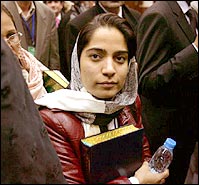 Malalai Joya
Malalai Joya is, at 28 years old, the youngest and most famous of all the women in the Afghan parliament. In a way her very presence in the parliament is a powerful symbol of change; a woman who had to work in secret in underground schools in Herat during the Taliban time is now able to speak out against her enemies in the parliament. She rose to fame at the end of 2003, when she made a speech attacking the warlords who still hold the balance of power in Afghanistan. On that occasion, one of the men she was attacking, Abdul Rasul Sayyaf, rose and told her that her speech was a crime, announced that "Jihad is the basis of this nation" and asked for her microphone to be disconnected. The then speaker of the house, Sibghatullah Mojaddedi, a former mujahideen leader, called her an infidel, and said that if she did not apologise she could not attend the next session of parliament.
"Here there is no democracy, no security, no women's rights," she says. "When I speak in parliament they threaten me. In May they beat me by throwing bottles of water at me and they shouted, 'Take her and rape her.' These men who are in power, never have they apologised for their crimes that they committed in the wars, and now, with the support of the US, they continue with their crimes in a different way. That is why there is no fundamental change in the situation of women."
She is desperate for people to take account of the silent women whose voices we never hear. "Afghan women are killing themselves now," she says, "there is no liberation for them." This is not just rhetoric: the Afghan Human Rights Commission recently began to document the numbers of Afghan women who are burning themselves to death because they cannot escape abuse in their families.
I meet Kochai, a serious woman more soberly dressed than the others in a long olive skirt and jacket. She has come to Kabul for the wedding from Kandahar, where she works as a police woman in the airport. She was married into a traditional family, and was abused for years by her husband. It was when her daughter then got married to a relation of her husband's, and started being beaten too, that she decided she had to get herself and her daughter away from these violent men. "I had to defend myself and my daughter," she said. The women now live without their husbands, although her daughter has not been able to get a divorce from her husband. "It is very, very difficult. I am sick of being frightened. During the nights especially I am frightened."
Like all the other women I meet on my trip, Kochai is very sure that despite all the insecurity and lack of progress, life would be far worse if western forces pulled out. "If the British and American soldiers left now, we wouldn't be able to leave our houses. We would lose all that we have."
Yet everyone knows that the Taliban are regrouping in and around Kandahar; Safia Ama Jan (see my earlier post about Safia A death in Kandahar ), the head of the department of women's affairs, was assassinated there recently, and Kochai says the actual number of kidnappings and assassinations is far higher than we hear about. "In one week six women were killed. They were ordinary women, working women, but the Taliban say they are spies of the government. They tell them, 'Don't work,' and if they do not listen, then they are kidnapped and killed far from the city." She has two bodyguards who take her to work and back, but after work she has no bodyguards - so in a way they only make her more of a target. "I wear the burka, and I change the colour of it regularly so that I hope nobody knows it is me under it. The morale of women in Kandahar is getting worse every day," she says.
Afghanistan women
Back ahead?
I am not sure whether this is a “have a quick gloat, Yougov will wipe the smile off your face tomorrow” story or an indication that Labour has turned a corner but according to today’s Independent Labour opened up a two-point opinion poll lead over the Tories.
A Communicate Research poll puts Labour on 36 per cent, the Tories on 34 per cent, the Liberal Democrats on 17 per cent and other parties on 13 per cent. There has been a striking change since last month, when the Tories enjoyed a six-point lead over Labour.
Plug these figures into Electoral Calculus and you get a healthy majority for a fourth term and the Lib Dems taking a right pasting!
I daresay the next poll will show the Tories with a substantial lead… hiho
opinion polls
A Communicate Research poll puts Labour on 36 per cent, the Tories on 34 per cent, the Liberal Democrats on 17 per cent and other parties on 13 per cent. There has been a striking change since last month, when the Tories enjoyed a six-point lead over Labour.
Plug these figures into Electoral Calculus and you get a healthy majority for a fourth term and the Lib Dems taking a right pasting!
I daresay the next poll will show the Tories with a substantial lead… hiho
opinion polls
27 November 2006
Kabul blossoms but not for the poor
This is taken from an article originally appeared in the Boston Globe on 11 November. It was also issued as a RAWA newsletter a few days ago. If things do not change for the better, then the poor of Kabul might just prefer the Taliban back. It is chilling to think that those evil theocrats might be seen the lesser of two evils but it may well happen.
Eight-year-old Sajjad's kite struggles upward. It's nothing grand -- a plastic bag salvaged from a heap of garbage and fashioned into a diamond shape. But it's a symbol of change in Kabul, five years after the Afghan capital was freed from a Taliban regime that believed activities such as kite-flying would distract youngsters from studying the Koran.
Sajjad lives in a neighborhood called Shirpur. Part of it has been demolished and its inhabitants evicted to make way for a "new Afghanistan" of palatial homes -- scores of four- and five-story mansions boasting gold-painted marble columns and floor-to-ceiling windows flanking grand wooden doors. The owners are the successors to the Taliban who in 2003 used their new power to seize and clear the land. About 250 of Sajjad's neighbors were tossed from their homes.
Sajjad lives with seven brothers and four sisters in a single-story house of dried mud, straw and pebbles.. One of his neighbors, Aziz Mohammed says he has been told that his and his neighbors' houses will be flattened soon to make way for more mansions. The owners of these mansions "are commanders, ministers. It makes me angry. These people use everything that isn't theirs and they ruin the houses of the poor people to build their homes," said Mohammed. "The Taliban were no good, they were just stupid people. But in this new life there is no job, nothing."
Gul Haider, a commander of the Northern Alliance that swept into Kabul after the Taliban's collapse, makes no apology for owning a mansion in Shirpur. "This is the new Afghanistan. We are just beginning. All these houses are from the private pockets of Afghans and I hope one day that all of Afghanistan will be beautiful like Shirpur," he said in an interview. "We are praying for the poor people to have houses like us," he said. "But everything belongs to God. God knows better who should be given property and who shouldn't. God gave us this property and we built our houses. We are praying that God will look more favorably on the poor."
In the months following the Taliban's collapse there were signs of a business renaissance. Barbershops, beauty salons and music stores reopened. Afghan exiles returned to start businesses. But many have since been driven out by runaway corruption, lawlessness and the violence perpetrated by a resurgent Taliban, highlighted by a string of recent suicide bombings in Kabul.
Mohammed Habib, an out-of-work laborer, carried his 1-year-old son Mujtaba as he walked the streets begging for food. He said the infusion of foreign aid hasn't changed his life. "Money comes to help the poor people but the commanders and the government people take it," he said. With the Taliban gone "we thought our future will be better, but every day we are poorer." Habib looks at the new mansions in Shirpur and sees injustice. "These people are very bad people. That money was for us and they took it," he said. "The Taliban time was very bad and now it is very bad for the poor. Where is the difference?"
Afghanistan RAWA
Eight-year-old Sajjad's kite struggles upward. It's nothing grand -- a plastic bag salvaged from a heap of garbage and fashioned into a diamond shape. But it's a symbol of change in Kabul, five years after the Afghan capital was freed from a Taliban regime that believed activities such as kite-flying would distract youngsters from studying the Koran.
Sajjad lives in a neighborhood called Shirpur. Part of it has been demolished and its inhabitants evicted to make way for a "new Afghanistan" of palatial homes -- scores of four- and five-story mansions boasting gold-painted marble columns and floor-to-ceiling windows flanking grand wooden doors. The owners are the successors to the Taliban who in 2003 used their new power to seize and clear the land. About 250 of Sajjad's neighbors were tossed from their homes.
Sajjad lives with seven brothers and four sisters in a single-story house of dried mud, straw and pebbles.. One of his neighbors, Aziz Mohammed says he has been told that his and his neighbors' houses will be flattened soon to make way for more mansions. The owners of these mansions "are commanders, ministers. It makes me angry. These people use everything that isn't theirs and they ruin the houses of the poor people to build their homes," said Mohammed. "The Taliban were no good, they were just stupid people. But in this new life there is no job, nothing."
Gul Haider, a commander of the Northern Alliance that swept into Kabul after the Taliban's collapse, makes no apology for owning a mansion in Shirpur. "This is the new Afghanistan. We are just beginning. All these houses are from the private pockets of Afghans and I hope one day that all of Afghanistan will be beautiful like Shirpur," he said in an interview. "We are praying for the poor people to have houses like us," he said. "But everything belongs to God. God knows better who should be given property and who shouldn't. God gave us this property and we built our houses. We are praying that God will look more favorably on the poor."
In the months following the Taliban's collapse there were signs of a business renaissance. Barbershops, beauty salons and music stores reopened. Afghan exiles returned to start businesses. But many have since been driven out by runaway corruption, lawlessness and the violence perpetrated by a resurgent Taliban, highlighted by a string of recent suicide bombings in Kabul.
Mohammed Habib, an out-of-work laborer, carried his 1-year-old son Mujtaba as he walked the streets begging for food. He said the infusion of foreign aid hasn't changed his life. "Money comes to help the poor people but the commanders and the government people take it," he said. With the Taliban gone "we thought our future will be better, but every day we are poorer." Habib looks at the new mansions in Shirpur and sees injustice. "These people are very bad people. That money was for us and they took it," he said. "The Taliban time was very bad and now it is very bad for the poor. Where is the difference?"
Afghanistan RAWA
Russian shit stirring - a Latvian view
My post Russian shit stirring seems that have woken my Latvian friend Peteris Cedrins from his his work induced blogging hiatus. He has written two erudite and very illuminating pieces which rebuff the Russian view on the Baltic occupation, including the assertions that the Baltic states were pro german or that the Soviet was supported by Britain.
The two pieeces Dat Ole Time Propaganda and Dat Ole Time Propaganda II are well worth reading. They certainly added to my very limited knowledge of baltic history.
The two pieeces Dat Ole Time Propaganda and Dat Ole Time Propaganda II are well worth reading. They certainly added to my very limited knowledge of baltic history.
Ole Tarantula - Robyn Hitchcock
Ole (as in Olay) Tarantula performed lived in Cleveland earlier this month. The not-wife and myself already had plans to see him in January but after a conversation with a fellow Robyn fan I know though a Yahoo Group I will be going to see him at a Medecins Sans Frontiere benefit on 16 December too.
He will be performing Pink Floyd's Piper at the Gates of Dawn along with a selection of Syd Barrett songs. It is always food to see Robyn - I have never seen him give a bad performance - especially for a good causae. It will be especially good to meet a number of people I have been conversing with online for over four years.
Expect Robyn photos on 17 December.....
Hans Blix and British WMD
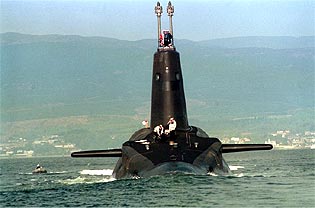 Royal Navy Vanguard Class Trident Submarine
According to today’s Independent Dr Hans Blix, the former UN weapons inspector will, warn the Prime Minister in a speech to the British Institute of International and Comparative Law that the decision to press ahead with a full replacement for Trident will make it more difficult to stop other nations acquiring Nuclear weapons.
He will warn that modernising Britain's arsenal will put the non-proliferation treaty (NPT) under "strain" and increases the feeling among non-nuclear states, such as Iran, that they are being "cheated" by the nuclear states. Dr Blix will take Britain and the other permanent members of the UN Security Council to task for failing to comply with their obligations under the NPT by failing to do more to eliminate their nuclear arsenals.
MPs have been demanding a wide debate on the replacement of the Trident missile system. Some senior MPs have questioned the wisdom of backing the most expensive option favoured by the chiefs of staff, instead of a cheaper alternative such as nuclear-tipped cruise missiles on planes. However, a White Paper setting out the Government's preferred option will be published next month and Labour MPs will be told to back it. They will be allowed three months for "debate" but Labour MPs will be "whipped" to support the cabinet decision in a vote in the Commons in the new year.
Gordon Brown has already made it clear he will support the most expensive replacement for Trident - a new generation of submarines, with US-designed missiles and a new nuclear warhead. Early estimates suggested it could cost £25bn, but some experts have claimed the true cost could be nearer £76bn over 30 years.
The ending of the Cold War has changed the argument in the Labour Party. It is no longer a simple divide between those favouring multilateral disarmament and those supporting unilateral disarmament. Dr Blix's speech will increase the doubts among those who question the value of a more powerful nuclear weapon with multiple warheads designed to penetrate "hardened" targets, when the foreseeable threat is from rogue states or terrorists. Unlike in the 1980s, there are significant military figures with doubts over the renewal of Trident.
Britiajn’s current “deterrent” is based on a fleet of four Trident ballistic missile submarines. Before that it was based on a similar sized fleet of Polais armed submarines. The options on the table seem to be
1 – keep Trident patched up beyond its operational life (the mid 2020s)
2 – Replace it with a new submarine based ballistic missile system
3 – Seek a cheaper option based on nuclear armed cruise missiles.
There does not seem to be a fourth option – to get rid of our nuclear arsenal. Call me naïve but I have never seen the point of retaining an independent nuclear deterrent: it isn’t independent (is there a scenario where it could be used unless the US gave it’s say so?) and it isn’t much of a deterrent (it does not deter non nuclear actions – did having Polaris at the time make Argentina think twice before invading the Falklands? Would it stop a terrorist dirty bomb? of course not!).
The only reason I can see for the retention of nuclear weapons is to delude us into thinking that we are still a major world power. I would not lose much sleep if the UK lost its permanent UN Security Council seat as a result of disarmament.
All of this should have me running off to renew my long lapsed CND membership. On the other hand I am not that keen on CND’s apparent pro-iranian stance - I happened upon a recent issue Campaign magazine recently and the first article I saw praised Iran as a progressive state. For women! I think I will pass this time.
Trident nuclear deterrent CND
26 November 2006
A couple of silly jokes
A couple of jokes that will ensure my eternal damnation!
I was walking across a bridge one day, and I saw a man standing on the edge, about to jump. I ran over and said: "Stop. Don't do it."
"Why shouldn't I?" he asked.
"Well, there's so much to live for!"
"Like what?"
"Are you religious?"
He said, "Yes."
I said, "Me too. Are you Christian or Buddhist?"
"Christian."
"Me too. Are you Catholic or Protestant?"
"Protestant."
"Me too. Are you Episcopalian or Baptist?"
"Baptist."
"Wow. Me too. Are you Baptist Church of God or Baptist Church of the Lord?"
"Baptist Church of God."
"Me too. Are you original Baptist Church of God, or are you Reformed Baptist Church of God?"
"Reformed Baptist Church of God."
"Me too. Are you Reformed Baptist Church of God, Reformation of 1879, or Reformed Baptist Church of God, Reformation of 1915?"
He said: "Reformed Baptist Church of God, Reformation of 1915."
I said: "Die, heretic scum," and pushed him off
Four nuns are standing in line at the gates of heaven. Peter asks the first if she has ever sinned.
"Well, once I looked at a man's penis," she said.
"Put some of this holy water on your eyes and you may enter heaven," Peter told her.
He then asked the second nun if she had ever sinned.
"Well, once I held a man's penis," she replied. "Put your hand in this holy water and you may enter heaven," he said.
Just then the fourth nun pushed ahead of the third nun.
"Why did you push ahead in line?" asked Peter.
"Because I want to gargle before she sits in it!" replied the nun.
Culled from a Christian website called Ship of Fools, believe it or not.
I was walking across a bridge one day, and I saw a man standing on the edge, about to jump. I ran over and said: "Stop. Don't do it."
"Why shouldn't I?" he asked.
"Well, there's so much to live for!"
"Like what?"
"Are you religious?"
He said, "Yes."
I said, "Me too. Are you Christian or Buddhist?"
"Christian."
"Me too. Are you Catholic or Protestant?"
"Protestant."
"Me too. Are you Episcopalian or Baptist?"
"Baptist."
"Wow. Me too. Are you Baptist Church of God or Baptist Church of the Lord?"
"Baptist Church of God."
"Me too. Are you original Baptist Church of God, or are you Reformed Baptist Church of God?"
"Reformed Baptist Church of God."
"Me too. Are you Reformed Baptist Church of God, Reformation of 1879, or Reformed Baptist Church of God, Reformation of 1915?"
He said: "Reformed Baptist Church of God, Reformation of 1915."
I said: "Die, heretic scum," and pushed him off
Four nuns are standing in line at the gates of heaven. Peter asks the first if she has ever sinned.
"Well, once I looked at a man's penis," she said.
"Put some of this holy water on your eyes and you may enter heaven," Peter told her.
He then asked the second nun if she had ever sinned.
"Well, once I held a man's penis," she replied. "Put your hand in this holy water and you may enter heaven," he said.
Just then the fourth nun pushed ahead of the third nun.
"Why did you push ahead in line?" asked Peter.
"Because I want to gargle before she sits in it!" replied the nun.
Culled from a Christian website called Ship of Fools, believe it or not.
Pinochet takes responsibility but regrets nothing
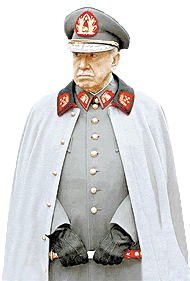
According the BBC and numerous news sources Augusto Pinochet has now stated that he took political responsibility for everything that happened during his 18 years in power. In the statement read by his wife on the occasion his 91st birthday, he defended his bloody 1973 coup, saying he had acted in Chile's best interests.
More than 3,000 people were killed or "disappeared" while Gen Pinochet was in power from 1973 to 1990. "Today, near the end of my days, I want to say that I harbour no rancour against anybody, that I love my fatherland above all," the statement read by his wife Lucia Hiriart said. "I take political responsibility for everything that was done."
The general said his bloody overthrow of the democratically-elected Salvador Allende had "no other motive than to make Chile a great place and prevent its disintegration". His statement condemned the ongoing trials of military officers, including himself, for the human rights abuses committed under his rule. He said they had prevented a political and economic crisis. "Thanks to their courage and decision, Chile moved from the totalitarian threat to the full democracy which we restored and which all our compatriots enjoy."
Pinochet enjoys legal immunity as a former president, but the courts can strip him of this privilege on a case-by-case basis. This has happened in a number of human rights and financial cases. But lawyers have argued he is too infirm to stand trial.
Even though he was a a petty tyrant - his atrocities were small beer compared to those of Stalin, Lenin, Mao, Hitler and Pol Pot - it is a shame that Pinochet has not brought to trial for the crimes that took place during his regime. A golden opportunity slipped through our fingers in the late 90s. No matter what justification that falls from his mouth, torture and state murder cannot be condoned under any circumstance.
Although it is pretty likely that he will go to his grave unpunished some satisfaction can be derived from the fact that Chile is now run by Michelle Bachelet who, along with her family, was a victim of his ugly regime.
Augusto Pinochet
25 November 2006
Why the Poor Mouth?
As you can see from the header above the title of this blog comes from a Gaelic expression "putting on the poor mouth" which means to exaggerate the direness of one's situation in order to gain time or favour from creditors. It can also simply mean grumbling (which I suppose is apt given the content of this blog...)
But why choose such an expression? I did so because I love the expression but also as a tribute to one of my favourite authors the late, great Irish novelist/humorist/civil servant, Flann O Brien. (Aka Brian O Nolan, aka Myles na gCopaleen).
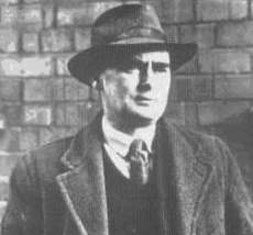 Flann O'Brien
The Poor Mouth was originally published as An Beal Bocht in 1941, the only one of his novels to be written in Gaelic. It only appeared in English translation for the first time in 1973 – seven years after his death. I would have called the blog An Beal Bocht but someone had beaten me to that name
The Poor Mouth is set in the fictional village of Corkadoragha, a place which knows suffering an poverty in spades, It is a place were the torrential rains are more torrential, the squalor more squalid, the hopelessness more utterly hopeless than they are anywhere else in Ireland.
It is the story of Bonaparte O'Coonassa who, like the other characters spends the bulk of his time lamenting the fate of the Gaels whose lot it is to live a hard, miserable life. But it is certainly not a miserable book. It is very readable and very, very funny!
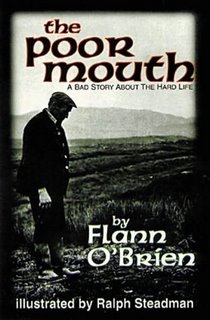 The Dalkey Archive Press edition of the Poor Mouth
It is a wonderful tale in which you learn about being a child of the ashes, Ambrose a pig the size of a house, Sitric O Sanassa (the excellence of his poverty was without comparison in all of Ireland) and the awful Sea Cat a harbinger of misfortune that looks uncannily like the island of Ireland. You also discover the origin of the name Jams O’ Donnell (see my previous post Why Jams O Donnell? ) and why when an Irish person says calls you sir they could be insulting you!
O’Brien actually wrote the Poor Mouth as a parody of Irish literature such as Tomás O’Criomhthainn, whose work dwelt very much on the hardship of Gaelic life. In addition it was intended as a swipe at the patronising attitude of “Irish Irelanders” towards rural Gaelic speakers –as evidenced in one glorious scene where Gaelic enthusiasts mistake the grunting of a pig for melodious Irish simply because they cannot understand it! Needless to say it caused a storm when it was published.
Even if you have never heard of Tomas O Criomhtnainn and couldn’t care less about the attitude urban Gaelic enthusiasts towards the residents of the Gaeltacht, the Poor Mouth is a wonderful read. I would stongly recommend you find a copy of the book as its likes will certainly never be there again!
Further Reading
Gaelically Gaelic by Eric Mader-Lin (From Necessary Prose)
Flann O’Brien: A Postmodernist When It Was Neither Profitable Nor Popular by Robert Looby (At the Scriptorium website)
The No Bicycle Page
Flann O'Brien Poor Mouth
But why choose such an expression? I did so because I love the expression but also as a tribute to one of my favourite authors the late, great Irish novelist/humorist/civil servant, Flann O Brien. (Aka Brian O Nolan, aka Myles na gCopaleen).
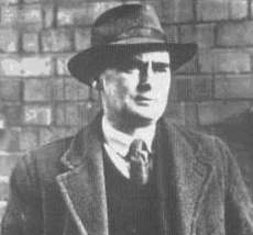 Flann O'Brien
The Poor Mouth was originally published as An Beal Bocht in 1941, the only one of his novels to be written in Gaelic. It only appeared in English translation for the first time in 1973 – seven years after his death. I would have called the blog An Beal Bocht but someone had beaten me to that name
The Poor Mouth is set in the fictional village of Corkadoragha, a place which knows suffering an poverty in spades, It is a place were the torrential rains are more torrential, the squalor more squalid, the hopelessness more utterly hopeless than they are anywhere else in Ireland.
It is the story of Bonaparte O'Coonassa who, like the other characters spends the bulk of his time lamenting the fate of the Gaels whose lot it is to live a hard, miserable life. But it is certainly not a miserable book. It is very readable and very, very funny!
 The Dalkey Archive Press edition of the Poor Mouth
It is a wonderful tale in which you learn about being a child of the ashes, Ambrose a pig the size of a house, Sitric O Sanassa (the excellence of his poverty was without comparison in all of Ireland) and the awful Sea Cat a harbinger of misfortune that looks uncannily like the island of Ireland. You also discover the origin of the name Jams O’ Donnell (see my previous post Why Jams O Donnell? ) and why when an Irish person says calls you sir they could be insulting you!
O’Brien actually wrote the Poor Mouth as a parody of Irish literature such as Tomás O’Criomhthainn, whose work dwelt very much on the hardship of Gaelic life. In addition it was intended as a swipe at the patronising attitude of “Irish Irelanders” towards rural Gaelic speakers –as evidenced in one glorious scene where Gaelic enthusiasts mistake the grunting of a pig for melodious Irish simply because they cannot understand it! Needless to say it caused a storm when it was published.
Even if you have never heard of Tomas O Criomhtnainn and couldn’t care less about the attitude urban Gaelic enthusiasts towards the residents of the Gaeltacht, the Poor Mouth is a wonderful read. I would stongly recommend you find a copy of the book as its likes will certainly never be there again!
Further Reading
Gaelically Gaelic by Eric Mader-Lin (From Necessary Prose)
Flann O’Brien: A Postmodernist When It Was Neither Profitable Nor Popular by Robert Looby (At the Scriptorium website)
The No Bicycle Page
Flann O'Brien Poor Mouth
Give your loved one the clap for Christmas
 the Clap
Stuck for gift ideas? Looking to amuse or revolt your loved ones this xmas? then give them the clap, or the pox or even Ebola.. as plush toys of course! Perhaps it's just the nerdy scientist but I do find the idea of a bacterium or virus as a soft toy rather amusing.
 Ebola - aint it cute!
Giant Microbes
24 November 2006
Russian shit stirring
Next week Latvia will host its biggest ever political event when 26 heads of state come to Riga to attend a NATO summit – the first to take place in a former soviet republic. In a move almost certainly intended to inflame tensions ahead of the summit the Russian foreign intelligence service, the SVR, yesterday declassified documents which appear to show that the UK and the USA approved of the Soviet occupation of the Baltic states in 1940
The editor of the dossier, Major General Lev Sotskov, told the Guardian that the documents proved that that Churchill decided it would be pragmatic not to confront soviet occupation.Moscow says its army saved the Baltic states from Nazism. The Baltic states have always bitterly argued that they were illegally occupied and then forcibly assimilated into the Soviet Union at the end of the second world war. Latvia's president, Vaira Vike-Freiberga, yesterday told the Financial Times that NATO's first summit in Riga would "remove the very last traces of the iron curtain" from the Baltic states.
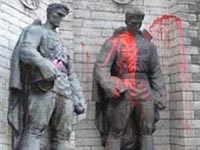 Red army memorial Tallinn
The dossier was commissioned by the lower house of the Russian parliament and the timing of its release hints at a desire by Moscow to sow dissent between western Europe and the Baltic states. The Kremlin has tense relations with all three Baltic states and is incensed at Estonia's plans to remove a monument to Soviet soldiers who "liberated" the city in 1944 after three years of Nazi occupation. Asked what reaction he expected to the dossier in the Baltics, Gen Sotskov said: "That's their problem. All I can say is that the SS was recognised as a fascist organisation at Nuremberg, but in those countries people still march under its flag." Sergei Ivanov, a spokesman for the SVR, said the dossier was not published to coincide with the Riga summit but was "probably connected with the fact that monuments are being taken down in the Baltic states".
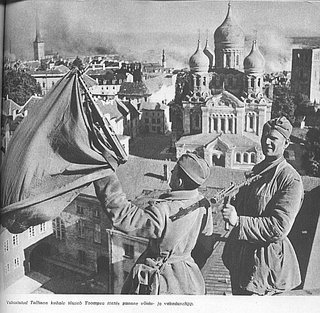 Soviet "liberation" of Tallinn
The Interfax news agency puts a more anti Baltic slant on the news claiming that the USSR was justified in annexing the Baltic states in WWII, as their governments supported Nazi Germany
According to Interfax the USSR accused Estonia conspiring with Latvia and Lithuania against it, and issued an ultimatum in June 1940 , demanding among other concessions that more Soviet troops be allowed to enter the three countries. In the following month, local communists loyal to the Soviet Union won parliamentary "elections" in all three countries , and in August these parliaments asked the Soviet government for accession to the Soviet Union. As a result, the three states were formally annexed.
While I am always keen for history to be looked directly in the face, no matter how unpalatable the truth may be, all the Russians are doing here is shit stirring.
Did the UK actually support the Baltic annexations? I don’t think so but would not have been able to do much about it in any case. That may sound harsh but since they were divided by an awful lot of enemy held land and water there would have been no chance of sending any support even if it wanted to. However, in the light of the support it offered to Poland in 1929 and planned to offer to Finland not many months later it would probably have been worse than useless anyway.
Although the Red Army cleared the Nazis out of the Baltic states they installed a regime that was every bit as brutal and repressive. It is no wonder that their citizens are not well disposed towards Russia.. But to describe the Baltics to be a bunch of jackbooted thugs as Sotskov seemed to imply will not do much to improve relations.
As for communists winning parliamentary elections after invasion, I wonder how fair they were? Let me be a tad cynical and suggest that they might have been rigged (A communist rig an election? Heaven forfend!)
I hope that the NATO states treat this Russian stunt with the contempt it deserves.
Soviet occupation baltic WWII
The editor of the dossier, Major General Lev Sotskov, told the Guardian that the documents proved that that Churchill decided it would be pragmatic not to confront soviet occupation.Moscow says its army saved the Baltic states from Nazism. The Baltic states have always bitterly argued that they were illegally occupied and then forcibly assimilated into the Soviet Union at the end of the second world war. Latvia's president, Vaira Vike-Freiberga, yesterday told the Financial Times that NATO's first summit in Riga would "remove the very last traces of the iron curtain" from the Baltic states.
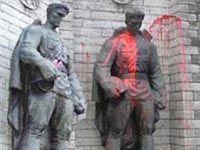 Red army memorial Tallinn
 Soviet "liberation" of Tallinn
The Interfax news agency puts a more anti Baltic slant on the news claiming that the USSR was justified in annexing the Baltic states in WWII, as their governments supported Nazi Germany
According to Interfax the USSR accused Estonia conspiring with Latvia and Lithuania against it, and issued an ultimatum in June 1940 , demanding among other concessions that more Soviet troops be allowed to enter the three countries. In the following month, local communists loyal to the Soviet Union won parliamentary "elections" in all three countries , and in August these parliaments asked the Soviet government for accession to the Soviet Union. As a result, the three states were formally annexed.
While I am always keen for history to be looked directly in the face, no matter how unpalatable the truth may be, all the Russians are doing here is shit stirring.
Did the UK actually support the Baltic annexations? I don’t think so but would not have been able to do much about it in any case. That may sound harsh but since they were divided by an awful lot of enemy held land and water there would have been no chance of sending any support even if it wanted to. However, in the light of the support it offered to Poland in 1929 and planned to offer to Finland not many months later it would probably have been worse than useless anyway.
Although the Red Army cleared the Nazis out of the Baltic states they installed a regime that was every bit as brutal and repressive. It is no wonder that their citizens are not well disposed towards Russia.. But to describe the Baltics to be a bunch of jackbooted thugs as Sotskov seemed to imply will not do much to improve relations.
As for communists winning parliamentary elections after invasion, I wonder how fair they were? Let me be a tad cynical and suggest that they might have been rigged (A communist rig an election? Heaven forfend!)
I hope that the NATO states treat this Russian stunt with the contempt it deserves.
Soviet occupation baltic WWII
Lewis Hamilton to become the first black Formula 1 driver

According to today’s Times Lewis Hamilton is set to become the first black Formula 1 driver when he races for the Mclaren Mercedes team at next year’s Melbourne Grand Prix.
Lewis Hamilton, 21, is the current GP2 champion and is considered to be one of the most talented drivers of his generation. Ron Dennis, the McLaren Mercedes team principal, confirmed Hamilton’s selection alongside the world champion, Fernando Alonso. His inclusion is at the expense of Pedro de la Rosa who returns to test driver duties.
Although I am not particularly interested in Formula 1 racing (or any motor racing, much to the chagrin of the not wife’s brother who is quite a successful ) I wish Lewis every success. It is obvious that he is an enormously talented driver and he could very well be a future world champion.
I do, however, look forward to the day when skin colour does not make a story newsworthy.
Lewis Hamilton Formula1
Don't you dare turn the page, human

Obviously something caught her eye in the paper. This week's entry for the Friday Ark and Carnival of the Cats
cats
23 November 2006
Who ate all the pies.. err, okay then who ate a pie?
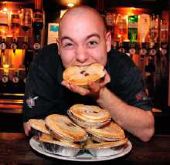 In a case of pielitical correctness gone mad it would seem that the prevailing climate of health consciousness has forced major changes to the World Pie eating championship, including (horror of all horrors) the introduction of VEGETARIAN pice, according to the Wigan Observer .
In a break from the tradition of scoffing as many meat and potato growlers (pies) as possible within three minutes, contestants will have to eat one single pie, quickly. Organisers of the World Pie Eating Championships, to be staged December 13 at Harry’s Bar, Wigan, say they have taken a leaf out of the government's healthy eating plan and changed the rules of the competition.
"The World Championship will be decided on the basis of a speed-eating based sprint, rather than a first-past-the-post multiple-pie-disposal competition," said Tony Callaghan, the owner of Harry's Bar. "I realise it may be controversial, but it will make for an exciting sporting spectacle, whilst also doffing its cap to government-inspired guidelines on obesity."
"However, we have also bowed to relentless pressure from the Vegetarian Society and agreed to introduce a vegetarian option to the competition, although vegetarian pie-eaters in the competition will be allowed to eat a slightly smaller version because of its rather more glutinous content. “
A spokesman for the Vegetarian Society said: "We have been campaigning for many years to end the wrongful discrimination against vegetarians at the World Pie Eating Championships. We are delighted that they have finally bowed to pressure.”
 previous world champion expresses outrage at rule changes
According to the Standard the changes have provoked anger among previous winners who have accused organisers of bowing to food fascists. Dave Smyth, who won the first contest in 1992 said: "This contest has always been about savouring as many pies as possible over a three-minute period, not sprinting through a few mouthfuls of a single pie. They've taken things too far this year. Pies are supposed to be meat and potato and anything else just isn't normal. I intend to lobby the organising committee and I'm not going to rest until I've got answers."
It is absolutely clear that some traditions should never be tampered with. .Unless the organisers revert to the old format there could be a Pieot in Wigan next month! The doo gooders should shut theur pie holes or should that be stuff them instead?
World Pie Eating championship Wigan
For the Sake of balance…
I present the Catholic response to my previous post

There are Jews in the world.
There are Buddhists.
There are Hindus and Mormons, and then
There are those that follow Mohammed, but
I've never been one of them.
I'm a Roman Catholic,
And have been since before I was born,
And the one thing they say about Catholics is:
They'll take you as soon as you're warm.
You don't have to be a six-footer.
You don't have to have a great brain.
You don't have to have any clothes on. You're
A Catholic the moment Dad came,
Because
Every sperm is sacred.
Every sperm is great.
If a sperm is wasted,
God gets quite irate.
Let the heathen spill theirs
On the dusty ground.
God shall make them pay for
Each sperm that can't be found.
Every sperm is wanted.
Every sperm is good.
Every sperm is needed
In your neighbourhood.
Hindu, Taoist, Mormon,
Spill theirs just anywhere,
But God loves those who treat their
Semen with more care.
Every sperm is useful.
Every sperm is fine.
God needs everybody's.:
Mine! And mine!And mine!
Let the Pagan spill theirs
O'er mountain, hill, and plain.
God shall strike them down for
Each sperm that's spilt in vain.
Every sperm is sacred.
Every sperm is good.
Every sperm is needed
In your neighbourhood.
Every sperm is sacred.
Every sperm is great.
If a sperm is wasted,
God gets quite iraaaaaate
(with apologies to Monty Python of course)
There are Jews in the world.
There are Buddhists.
There are Hindus and Mormons, and then
There are those that follow Mohammed, but
I've never been one of them.
I'm a Roman Catholic,
And have been since before I was born,
And the one thing they say about Catholics is:
They'll take you as soon as you're warm.
You don't have to be a six-footer.
You don't have to have a great brain.
You don't have to have any clothes on. You're
A Catholic the moment Dad came,
Because
Every sperm is sacred.
Every sperm is great.
If a sperm is wasted,
God gets quite irate.
Let the heathen spill theirs
On the dusty ground.
God shall make them pay for
Each sperm that can't be found.
Every sperm is wanted.
Every sperm is good.
Every sperm is needed
In your neighbourhood.
Hindu, Taoist, Mormon,
Spill theirs just anywhere,
But God loves those who treat their
Semen with more care.
Every sperm is useful.
Every sperm is fine.
God needs everybody's.:
Mine! And mine!And mine!
Let the Pagan spill theirs
O'er mountain, hill, and plain.
God shall strike them down for
Each sperm that's spilt in vain.
Every sperm is sacred.
Every sperm is good.
Every sperm is needed
In your neighbourhood.
Every sperm is sacred.
Every sperm is great.
If a sperm is wasted,
God gets quite iraaaaaate
(with apologies to Monty Python of course)
Kicking and screaming into the 19th Century?
The Roman Catholic looks as if it will take the first baby step towards permitting the use of condoms, according to today’s Guardian and numerous other news sources.
The Vatican "health minister", cardinal Javier Lozano Barragán, is understood to be urging the Pope to accept that in restricted circumstances (specifically the prevention of Aids) condoms are the “lesser of two evils”. The recommendation still has to be reviewed by the conservative Congregation for the Doctrine of the Faith, and then by the Pope himself, before there is any change in the Church’s stance
It appears that the first-hand experience of Roman Catholic missionaries and pastors in the developing world has been the driving force behind the current rethink. In recent years, the case for condoms as a defence against Aids has been taken up publicly by several Roman Catholic leaders – including the Pope's own theologian, Cardinal Georges Cottier who has argued that the Catholic "theology of life" could be used to justify a lifting of the ban. "The virus is transmitted during a sexual act; so at the same time as [bringing] life there is also a risk of transmitting death," he said. "And that is where the commandment 'thou shalt not kill' is valid."
The Congregation for the Doctrine of the Faith, which will now consider the issue, was headed by Pope Benedict for 24 years before his election. After he became Pope, he appointed as his successor an American, Cardinal William Levada who, for 10 years, was Archbishop of San Francisco - a city where Catholic charities played a leading role in supplying care to Aids sufferers.
To be honest I cannot understand why it has taken so damn long for the Vatican even to consider this tiny change in its stance on birth control. Considering every sperm to be sacred is fine and dandy but when AIDS kills millions of people a year, particularly in sub Saharan Africa, then surely a little pragmatism is in order.
contraception AIDS Catholic church
The Vatican "health minister", cardinal Javier Lozano Barragán, is understood to be urging the Pope to accept that in restricted circumstances (specifically the prevention of Aids) condoms are the “lesser of two evils”. The recommendation still has to be reviewed by the conservative Congregation for the Doctrine of the Faith, and then by the Pope himself, before there is any change in the Church’s stance
It appears that the first-hand experience of Roman Catholic missionaries and pastors in the developing world has been the driving force behind the current rethink. In recent years, the case for condoms as a defence against Aids has been taken up publicly by several Roman Catholic leaders – including the Pope's own theologian, Cardinal Georges Cottier who has argued that the Catholic "theology of life" could be used to justify a lifting of the ban. "The virus is transmitted during a sexual act; so at the same time as [bringing] life there is also a risk of transmitting death," he said. "And that is where the commandment 'thou shalt not kill' is valid."
The Congregation for the Doctrine of the Faith, which will now consider the issue, was headed by Pope Benedict for 24 years before his election. After he became Pope, he appointed as his successor an American, Cardinal William Levada who, for 10 years, was Archbishop of San Francisco - a city where Catholic charities played a leading role in supplying care to Aids sufferers.
To be honest I cannot understand why it has taken so damn long for the Vatican even to consider this tiny change in its stance on birth control. Considering every sperm to be sacred is fine and dandy but when AIDS kills millions of people a year, particularly in sub Saharan Africa, then surely a little pragmatism is in order.
contraception AIDS Catholic church
22 November 2006
Iranian artist - Minoo Emami
I have posted about Minoo before but now my readership is a lot larger than it was five months ago I thought I would take the opportunity to put up another post about this superb artist.
Like Elahe Heidari (another outstanding Iranian artist), Minoo lives and works in Tehran. She is a highly regarded artist who has exhibited extensively both in Iran and abroad.

In particular I was (and still am) blown away by her war galleries which were inspired by her husband's experiences during the Iran-Iraq war, an eight year long conflict started by Saddam which cost over one million lives. For me the images of false limbs and combat fatigues are in their own way as damning an indictment of war as the poetry of Wilfred Owen.

Once again Minoo reminds us of that we should not just dwell on what is produced by American or European artists. There is an enormous wealth of talent elsewhere in the world. I am extremely grateful to Redwine for drawing my attention to her work.
Click here to access Minoo's website
Minoo Emami art Iran
Like Elahe Heidari (another outstanding Iranian artist), Minoo lives and works in Tehran. She is a highly regarded artist who has exhibited extensively both in Iran and abroad.

In particular I was (and still am) blown away by her war galleries which were inspired by her husband's experiences during the Iran-Iraq war, an eight year long conflict started by Saddam which cost over one million lives. For me the images of false limbs and combat fatigues are in their own way as damning an indictment of war as the poetry of Wilfred Owen.

Once again Minoo reminds us of that we should not just dwell on what is produced by American or European artists. There is an enormous wealth of talent elsewhere in the world. I am extremely grateful to Redwine for drawing my attention to her work.
Click here to access Minoo's website
Minoo Emami art Iran
Mugabe and Ahmadinejad in mutual love-in
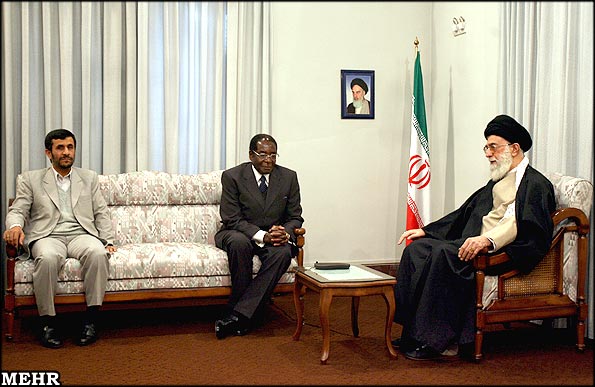 Ahmadinejad and Mugabe with Khamenei
I know it is a bit like shooting fish in a barrel but I couldn’t let a meeting between Robert Mugabe and Mahmoud Ahmadinejad pass by. While leaders often use mutual hyperbole during state visits, sometimes this adulation can be quite sickening - it certainly is in this case.
Mugabe, who is currently in Tehran to sign cooperation agreements between Iran and Zimbabwe was described by Ahmadinejad as a "just leader, a person who loves freedom and a freedom fighter"
Ahmadinejad also condemned sanctions on Zimbabwe and as “a standard bearer of revolutions” pledged Iran’s in the face of “Western machinations”: "We believe Zimbabweans have every right to defend their sovereignty and land. We are happy that Zimbabwe has once again taken control over its resources and we support the land redistribution programme. We condemn the efforts and pressure put on Zimbabwe by a few bully nations. We do not recognise the measures (sanctions) put in place against Zimbabwe. We are going to stand side-by-side with the Government and people of Zimbabwe."
For his part, Mugabe stated that Iran was “Zimbabwe's elder and powerful brother”. "The two countries of Zimbabwe and Iran are not only economic partners and friends but both also have got common ideology and revolutionary beliefs. They have always been friends and supporters of each other from the past and they will continue to be so in the future," commented Mugabe. "The two countries will defend themselves against the possible invaders and their ill intentioned enemies."
During his visit Comrrade Mugabe also visited the shrine of Ayatollah Imam Khomeini is buried and laid a wreath and met the current supreme leader Ayatollah Ali Hoseini Khamenei. Today he is expected to visit a tractor manufacturing plant in Tabriz before winding up his visit.
Sources
Harare Herald
Newzimbabwe
ISNA
Jerusalem Post
21 November 2006
The Face of Jack the Ripper….. Yosser Hughes???
This story was all over the press yesterday, including the BBC and the Independent. It would seem that modern technology has at long last provided the first image of the face of Jack the Ripper, possibly the most notorious serial killer in history.
 Jack the Ripper?
An e-fit has been compiled as part of an investigation into the serial killer who terrorised London in the autumn of 1888. In addition a geographical profiler has also pinpointed the street in which the killer is most likely to have lived.
Investigators believe the culprit, who mutilated his five female victims after strangling them, was almost certainly interviewed by police but was discounted because he looked too "ordinary" and unlike the man that detectives suspected was responsible for the savage attacks. Behavioural profilers have concluded that he was socially skilled, with superficial charm and an ability to blend into the crowd.
Investigators also believe the Ripper probably killed himself or was jailed for an unrelated offence, shortly after he had murdered the last of five women prostitutes. The historic reinvestigation for channel Five's Jack the Ripper: The First Serial Killer, to be tonight (21 November), is the latest development in a vast industry dedicated to solving Britain's greatest murder mystery.
As part of the new investigation John Grieve, a former deputy assistant commissioner of the Metropolitan Police, compiled an image of the Ripper. Using statements from 13 people who claimed to have seen the man they suspect was the killer Mr Grieve had an e-fit drawn up. Descriptions that were contradictory were ignored and the image is based on a number of similar witness statements. The man who is believed to resemble the notorious murderer is aged between 25 and 35 and is 5ft5in to 5ft 7in tall. He has a large black moustache, close cropped black hair, a pinched face and square jaw.
The murderer, who terrorised residents in the Whitechapel area of east London, was never identified in a police inquiry that was vilified and closed in failure after four years. Mr Grieve believes that using modern investigative techniques the police would have caught the killer today. He also believes he has an explanation for what happened to the Ripper. "He could have killed himself - that is what has happened in cases in the past. But I think it is much more likely that he came to notice for some other crime and went into the prison system, or possibly into a hospital. There was such a burst of activity you would expect the attacks to flare up at a later date." Mr Grieve said if he was redoing the original investigation he would focus on house-to-house inquiries, using the new e-fit image, in the streets where the killer was thought to have lived.
The programme consulted Kim Rossmo, of the University of Texas, a pioneer of geographic profiling - a technique that uses previous crimes to calculate where a offender lives. Based on the locations of the killings and sightings, Dr Rossmo concluded that the Ripper was a resident of the square mile area in which he killed. He is most likely to have lived in Flower and Dean Street - where police in 1888 had conducted out door-to-door inquiries. In the year before the murders each of the victims had lived within 100 yards of the street.
Laura Richards, a behavioural analyst who heads Scotland Yard's homicide prevention unit, and who has studied the behaviour of offenders including the Cromwell Road killer, Fred West, and the Soham murderer Ian Huntley, believes officers were looking for the wrong kind of person. She said: "He's someone who's been overlooked by the virtue of the fact he's so ordinary and so mundane."
The programme also attempts to debunk several myths that have grown around the Ripper. There is no evidence he had any medical training, or that he was an "English gentleman" with a predilection for murder. He strangled his victims and then mutilated their dead bodies, probably for sexual gratification.
Many people have been put forward as suspects over the years, ranging from the plausible to the utterly preposterous.
The latter includes Prince Albert Victor (the Duke of Clarence) and/or Sir William Gull Physician to Queen Victoria, artist Walter Sickert (as proposed by Patricia Cornwell) and (and perhaps most ludicrously) Lewis Carroll.
LEWIS CARROLL?????????????????
Ten years ago Richard Wallace published a book called the Light Hearted Friend which proposed that Carroll (and his colleague Thomas Bayne) was th Ripper. The theory is based on a “discovery” that certain passages in Carroll’s works were anagrams. If the anagrams are decoded they become confessions of his murderous intent.
According to Wallace this passage from 'Nursery Alice':
'So she wondered away, through the wood, carrying the ugly little thing with her. And a great job it was to keep hold of it, it wriggled about so. But at last she found out that the proper way was to keep tight hold of itself foot and its right ear'.
turns it into:
'She wriggled about so! But at last Dodgson and Bayne found a way to keep hold of the fat little whore. I got a tight hold of her and slit her throat, left ear to right. It was tough, wet, disgusting, too. So weary of it, they threw up - jack the Ripper.'
The Casebook, the most authoritative Jack the Ripper resource online gives this theory the contempt it deserves by showing that the opening line of Winnie the Pooh 'Here is Edward Bear coming downstairs now' can be turned into 'Stab red red women! CR is downing whores - AA'
Leaving aside ludicrous anagrams and idiotic Masonic conspiracy theories there are plenty of more mundane, suspects including:
Montague John Druitt who disappeared not long after the murder of Mary Kelly and whose body was found floating in the Thames on New Year’s Eve 188. The timing of his death and alleged "private information" led some investigators at the time to suggest he was the Ripper.. Others, including Inspector Abberline were doubtful.
George Chapman (Severin Klosowski), who had a murderous streak was hanged in 1903 poisoning three women. While a favoured suspect at the time it is very uncommon for a murderer to change their modus operandi.
John Pizer was the public's choice for fitting the Ripper's profile. The killer was believed to be a butcher or craftsman who had access to sharp blades and wore a leather apron. Pizer fitted the profile, including the fact that he was often seen wearing such an apron. He had convictions for stabbings and a known dislike for prostitutes. On the other hand he had a cast iron alibi for one of the murders
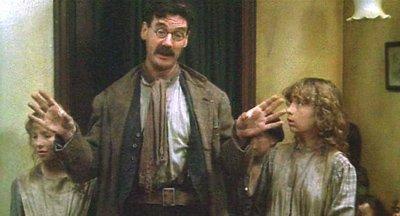
None of these appear to fit the bill. I would therefore like to propose a new suspect based on the e-fit above - Yosser Hughes from The Boys from the Blackstuff.
 Jack the Ripper!
Okay he may be a fictitious character and the actor who played him was not born until nearly 60 years after the murders but he is no less plausible that Lewis Carroll or the Duke of Clarence!
JacktheRipper
 Jack the Ripper?
An e-fit has been compiled as part of an investigation into the serial killer who terrorised London in the autumn of 1888. In addition a geographical profiler has also pinpointed the street in which the killer is most likely to have lived.
Investigators believe the culprit, who mutilated his five female victims after strangling them, was almost certainly interviewed by police but was discounted because he looked too "ordinary" and unlike the man that detectives suspected was responsible for the savage attacks. Behavioural profilers have concluded that he was socially skilled, with superficial charm and an ability to blend into the crowd.
Investigators also believe the Ripper probably killed himself or was jailed for an unrelated offence, shortly after he had murdered the last of five women prostitutes. The historic reinvestigation for channel Five's Jack the Ripper: The First Serial Killer, to be tonight (21 November), is the latest development in a vast industry dedicated to solving Britain's greatest murder mystery.
As part of the new investigation John Grieve, a former deputy assistant commissioner of the Metropolitan Police, compiled an image of the Ripper. Using statements from 13 people who claimed to have seen the man they suspect was the killer Mr Grieve had an e-fit drawn up. Descriptions that were contradictory were ignored and the image is based on a number of similar witness statements. The man who is believed to resemble the notorious murderer is aged between 25 and 35 and is 5ft5in to 5ft 7in tall. He has a large black moustache, close cropped black hair, a pinched face and square jaw.
The murderer, who terrorised residents in the Whitechapel area of east London, was never identified in a police inquiry that was vilified and closed in failure after four years. Mr Grieve believes that using modern investigative techniques the police would have caught the killer today. He also believes he has an explanation for what happened to the Ripper. "He could have killed himself - that is what has happened in cases in the past. But I think it is much more likely that he came to notice for some other crime and went into the prison system, or possibly into a hospital. There was such a burst of activity you would expect the attacks to flare up at a later date." Mr Grieve said if he was redoing the original investigation he would focus on house-to-house inquiries, using the new e-fit image, in the streets where the killer was thought to have lived.
The programme consulted Kim Rossmo, of the University of Texas, a pioneer of geographic profiling - a technique that uses previous crimes to calculate where a offender lives. Based on the locations of the killings and sightings, Dr Rossmo concluded that the Ripper was a resident of the square mile area in which he killed. He is most likely to have lived in Flower and Dean Street - where police in 1888 had conducted out door-to-door inquiries. In the year before the murders each of the victims had lived within 100 yards of the street.
Laura Richards, a behavioural analyst who heads Scotland Yard's homicide prevention unit, and who has studied the behaviour of offenders including the Cromwell Road killer, Fred West, and the Soham murderer Ian Huntley, believes officers were looking for the wrong kind of person. She said: "He's someone who's been overlooked by the virtue of the fact he's so ordinary and so mundane."
The programme also attempts to debunk several myths that have grown around the Ripper. There is no evidence he had any medical training, or that he was an "English gentleman" with a predilection for murder. He strangled his victims and then mutilated their dead bodies, probably for sexual gratification.
Many people have been put forward as suspects over the years, ranging from the plausible to the utterly preposterous.
The latter includes Prince Albert Victor (the Duke of Clarence) and/or Sir William Gull Physician to Queen Victoria, artist Walter Sickert (as proposed by Patricia Cornwell) and (and perhaps most ludicrously) Lewis Carroll.
LEWIS CARROLL?????????????????
Ten years ago Richard Wallace published a book called the Light Hearted Friend which proposed that Carroll (and his colleague Thomas Bayne) was th Ripper. The theory is based on a “discovery” that certain passages in Carroll’s works were anagrams. If the anagrams are decoded they become confessions of his murderous intent.
According to Wallace this passage from 'Nursery Alice':
'So she wondered away, through the wood, carrying the ugly little thing with her. And a great job it was to keep hold of it, it wriggled about so. But at last she found out that the proper way was to keep tight hold of itself foot and its right ear'.
turns it into:
'She wriggled about so! But at last Dodgson and Bayne found a way to keep hold of the fat little whore. I got a tight hold of her and slit her throat, left ear to right. It was tough, wet, disgusting, too. So weary of it, they threw up - jack the Ripper.'
The Casebook, the most authoritative Jack the Ripper resource online gives this theory the contempt it deserves by showing that the opening line of Winnie the Pooh 'Here is Edward Bear coming downstairs now' can be turned into 'Stab red red women! CR is downing whores - AA'
Leaving aside ludicrous anagrams and idiotic Masonic conspiracy theories there are plenty of more mundane, suspects including:
Montague John Druitt who disappeared not long after the murder of Mary Kelly and whose body was found floating in the Thames on New Year’s Eve 188. The timing of his death and alleged "private information" led some investigators at the time to suggest he was the Ripper.. Others, including Inspector Abberline were doubtful.
George Chapman (Severin Klosowski), who had a murderous streak was hanged in 1903 poisoning three women. While a favoured suspect at the time it is very uncommon for a murderer to change their modus operandi.
John Pizer was the public's choice for fitting the Ripper's profile. The killer was believed to be a butcher or craftsman who had access to sharp blades and wore a leather apron. Pizer fitted the profile, including the fact that he was often seen wearing such an apron. He had convictions for stabbings and a known dislike for prostitutes. On the other hand he had a cast iron alibi for one of the murders
None of these appear to fit the bill. I would therefore like to propose a new suspect based on the e-fit above - Yosser Hughes from The Boys from the Blackstuff.
 Jack the Ripper!
Okay he may be a fictitious character and the actor who played him was not born until nearly 60 years after the murders but he is no less plausible that Lewis Carroll or the Duke of Clarence!
JacktheRipper
20 November 2006
The Music Machine - Talk Talk
Featuring the equally awsesome (Yes, really!) Sean Boniwell. Music for...
The Seeds - Pushing too hard
Featuring the awesome (honest!) Sky Saxon on guitar and vocals. Music for a cracked rib part 2
Electric Prunes - I had too much to dream last night
One of my favourite songs from the 60s. Music for a cracked rib, Part 1
19 November 2006
Politics test
Hmm so I AM a socialist, the test says so!
| You are a Social Liberal (71% permissive) and an... Economic Liberal (10% permissive) You are best described as a:
Link: The Politics Test on OkCupid Free Online Dating Also: The OkCupid Dating Persona Test |

Author has no plans to holiday in Ireland any time soon?
Last month saw the publication of Michael Burleigh’s book Sacred Causes. Dealing with role of religion in European politics since WWI it seemed to receive generally positive reviews, in the Observer and the Times.
One country where his book may go down poorly, however,is Ireland. If the Sunday (Irish) Independent is to be believed one chapter of Sacred Causes appears to be devoted to a lengthy swipe at Ireland and the Irish.
Acording to the Sunday Independent report Burleigh says: "England has undergone the reverse cultural colonisation of the erstwhile oppressed. As fluent talkers, the Irish have colonised entire areas of British television, with the benignly unctuous Terry Wogan succeeded by the vulgarly queer Graham Norton, whose sexually obsessive innuendo even managed to fall below the (very) low standards of British television comedy,".
Apparently he belittles the "minor poets" (does he mean Seamus Heaney and WB Yeats, two Irish poets who have won the Nobel Prize for Literature? who have won the Nobel Prize for literature and adds: "Various provincial cliques and coteries, whether eccentrically Anglo-Irish, or just plain Irish, are inflated out of all proportion to their actual significance by their admiring fellows in the metropolitan British media".
Apparently "Any cook or pop star can become a celebrity seer nowadays in a culture where other forms of authority have withered. Superannuated rock musicians have boarded this bandwagon, with saint-cum-sir Bob Geldof in the van of vulgarly formulated attempts to strong-arm governments seeking the youth vote into giving away more money that by and large finds its way into the Swiss bank accounts of African kleptocrats… it is startling to watch British politicians lapping up abuse from this mouthy sloven, until one notes that knowledge of pop music is nowadays a crucial part of obtaining high office. “
Irish businessmen are apparently described: "Some of Ireland's most prominent businessmen have a, doubtless ill-deserved, reputation for ruthlesness. Fans regard such figures as genially piratical; others think they are greedy and mean-spirited, a description that might also apply to large swathes of the Irish in the English building trades, although competently reliable young Poles are displacing this horde of bodgers and shysters."
While he acknowledges that Ireland has now become "much richer" than neighbouring Britain, Burliegh has put this down to "its affluent diaspora and the European Union" while Northern Ireland "is kept afloat by an inflated public sector providing outdoor relief to its middle class".
I must read this book.I am not sure what relevance they have to a book dealing with the role of religion in European politics but if he has indeed couched his criticisms of ireland in such terms then he is less an eminent historian than an arsehole. I look forward to standing corrected, however.
One country where his book may go down poorly, however,is Ireland. If the Sunday (Irish) Independent is to be believed one chapter of Sacred Causes appears to be devoted to a lengthy swipe at Ireland and the Irish.
Acording to the Sunday Independent report Burleigh says: "England has undergone the reverse cultural colonisation of the erstwhile oppressed. As fluent talkers, the Irish have colonised entire areas of British television, with the benignly unctuous Terry Wogan succeeded by the vulgarly queer Graham Norton, whose sexually obsessive innuendo even managed to fall below the (very) low standards of British television comedy,".
Apparently he belittles the "minor poets" (does he mean Seamus Heaney and WB Yeats, two Irish poets who have won the Nobel Prize for Literature? who have won the Nobel Prize for literature and adds: "Various provincial cliques and coteries, whether eccentrically Anglo-Irish, or just plain Irish, are inflated out of all proportion to their actual significance by their admiring fellows in the metropolitan British media".
Apparently "Any cook or pop star can become a celebrity seer nowadays in a culture where other forms of authority have withered. Superannuated rock musicians have boarded this bandwagon, with saint-cum-sir Bob Geldof in the van of vulgarly formulated attempts to strong-arm governments seeking the youth vote into giving away more money that by and large finds its way into the Swiss bank accounts of African kleptocrats… it is startling to watch British politicians lapping up abuse from this mouthy sloven, until one notes that knowledge of pop music is nowadays a crucial part of obtaining high office. “
Irish businessmen are apparently described: "Some of Ireland's most prominent businessmen have a, doubtless ill-deserved, reputation for ruthlesness. Fans regard such figures as genially piratical; others think they are greedy and mean-spirited, a description that might also apply to large swathes of the Irish in the English building trades, although competently reliable young Poles are displacing this horde of bodgers and shysters."
While he acknowledges that Ireland has now become "much richer" than neighbouring Britain, Burliegh has put this down to "its affluent diaspora and the European Union" while Northern Ireland "is kept afloat by an inflated public sector providing outdoor relief to its middle class".
I must read this book.I am not sure what relevance they have to a book dealing with the role of religion in European politics but if he has indeed couched his criticisms of ireland in such terms then he is less an eminent historian than an arsehole. I look forward to standing corrected, however.
18 November 2006
Beware who you cross online
A man has been jailed for Britain's first web rage attack according to today’s Guardian Paul Gibbons, 47, was yesterday imprisoned for two and a half years for the unlawful wounding of a fellow internet user after an online quarrel.
Gibbons, unemployed and from Southwark in south London, first encountered John Jones, 43, while in a Yahoo chatroom discussing the religion. The pair locked horns after Mr Jones was accused of spreading rumours that his opponent was "interfering with children". After a further volley of verbal sparring, Gibbons was challenged to an encounter and became so enraged he drove more than 70 miles to Clacton-on-Sea in Essex, where he attacked Mr Jones with a pickaxe handle. Joined by an accomplice wielding a machete, Gibbons continued the assault until he was disturbed by Mr Jones's partner.
Mr Jones, who had armed himself with a knife, was left with head, throat and hand wounds. Gibbons then boasted to other chatroom users that the attack "went perfectly to plan". Gibbons pleaded guilty last month after the prosecution dropped a charge of attempted murder. Judge Richard Hawkins told the Old Bailey it had been a "most peculiar case". He told Gibbons: "It is accepted that Mr Jones taunted you and dared you to go to his house, where you would be greeted with weapons."
Police called the incident the first bona fide case of web rage, and warned internet users to protect their identities. Mr Jones's address was uncovered when he put details about where he lived online. "Mr Jones had posted pictures of his family on the web and had chatted to Gibbons on an audio link," said Detective Sergeant Jean-Marc Bazzoni of Essex police. "It demonstrates how easily other users can put two and two together, and also shows how children could also find themselves in danger."
On a much smaller scale I am painfully aware that crossing a lunatic online can cause problems. I used to be a regular in a political chat room. Although there were some great people there (I am still in regular contact with several), it had plenty of lunatics and it was rife with anti semites. I must have crossed someone, I have no real idea who, but my chat id was cloned containing personal information gleaned from non political groups. The piece of shit then used it to open sex chat rooms.
A far worse event occurred in the room, another chatter was personally threatened offline by a particularly psychotic chatter. He (the psychotic) is still around and seems to regularly comments on blogs owned by former chat room members and those associated with follow on forum.
Gibbons, unemployed and from Southwark in south London, first encountered John Jones, 43, while in a Yahoo chatroom discussing the religion. The pair locked horns after Mr Jones was accused of spreading rumours that his opponent was "interfering with children". After a further volley of verbal sparring, Gibbons was challenged to an encounter and became so enraged he drove more than 70 miles to Clacton-on-Sea in Essex, where he attacked Mr Jones with a pickaxe handle. Joined by an accomplice wielding a machete, Gibbons continued the assault until he was disturbed by Mr Jones's partner.
Mr Jones, who had armed himself with a knife, was left with head, throat and hand wounds. Gibbons then boasted to other chatroom users that the attack "went perfectly to plan". Gibbons pleaded guilty last month after the prosecution dropped a charge of attempted murder. Judge Richard Hawkins told the Old Bailey it had been a "most peculiar case". He told Gibbons: "It is accepted that Mr Jones taunted you and dared you to go to his house, where you would be greeted with weapons."
Police called the incident the first bona fide case of web rage, and warned internet users to protect their identities. Mr Jones's address was uncovered when he put details about where he lived online. "Mr Jones had posted pictures of his family on the web and had chatted to Gibbons on an audio link," said Detective Sergeant Jean-Marc Bazzoni of Essex police. "It demonstrates how easily other users can put two and two together, and also shows how children could also find themselves in danger."
On a much smaller scale I am painfully aware that crossing a lunatic online can cause problems. I used to be a regular in a political chat room. Although there were some great people there (I am still in regular contact with several), it had plenty of lunatics and it was rife with anti semites. I must have crossed someone, I have no real idea who, but my chat id was cloned containing personal information gleaned from non political groups. The piece of shit then used it to open sex chat rooms.
A far worse event occurred in the room, another chatter was personally threatened offline by a particularly psychotic chatter. He (the psychotic) is still around and seems to regularly comments on blogs owned by former chat room members and those associated with follow on forum.
However you do it, read the Blind Owl

Hedayat's masterpiece has been banned in Iran (see below). Luckily it is freely available to purchase here in the UK and in the USA. It is also available online at the Iranchamber website.
Buy it or read it online, it is a magnificent work. That it has been banned is an utter disgrace.
The boot on the other foot
Today’s Independent carries a report about the Romanian newspaper Libertatea and its response to a hysterical story in Thursday’s Sun. It would seem that our (less than) beloved Currant Bun has met its match in the invective stakes.
On 16 November the Sun ran a report with the shocking headline “Migrants AIDS epidemic threat”. According to the story the UK was facing an Aids epidemic on the basis that two thirds of all new HIV cases were found in immigrants and that the problem was “set to hit crisis point when Romania and Bulgaria — nations with some of Europe’s highest Aids rates — join the EU next year.”
The source of the story was a Health Protection Agency report which showed that up to 70% of new HIV, TB and Malaria cases seem in the UK was due to migration. However, the report stressed that it reflected a small fraction of people not born in the UK. And that there was little evidence to suggest the general population was being placed at increased risk.
This did not stop the Sun putting a lurid spin on the report of course - why let the truth come in the way of some gratuitous hysteria?
The report seems to have hit a raw nerve with Libertatea: dashing to the defence of its fellow countrymen, devoted much of Friday’s (17 November)issue to hitting back at the Sun, suggesting the British newspaper train its eye a little closer to home if it wants to find evidence of wrongdoing.
It accuses the British of exporting paedophilia, drunkenness and hooliganism - a threat it says is far more serious than that posed by Romanians when the country officially joins the European Union in January. It goes on to lampoon the notion that "rapists, muggers, card forgers, whores and pimps will storm into Trafalgar Square" in 2007. In the editorial it blasts "too perfidious Albion" insisting the old colonial label is still apt. It also calls on Tony Blair to stand up against the Press for peddling myths demonising a nation which has committed troops to serve alongside British forces in Iraq.
"Starting about two months ago various UK publications, spearheaded by The Sun, flung upon Romanian citizens the sort of abjection which is hard-to-imagine," the editorial said. "Romania is presented as a cursed land, the Sodom and Gomorrah which will spill crime, disease and misfortune into England." It also used the edition to launch a campaign to highlight the epidemic of British paedophiles being countered by the Romanian authorities.
Well it seems that the Sun truly has met its match. For a sequel please stick the boot into the Mail and the Express!
On 16 November the Sun ran a report with the shocking headline “Migrants AIDS epidemic threat”. According to the story the UK was facing an Aids epidemic on the basis that two thirds of all new HIV cases were found in immigrants and that the problem was “set to hit crisis point when Romania and Bulgaria — nations with some of Europe’s highest Aids rates — join the EU next year.”
The source of the story was a Health Protection Agency report which showed that up to 70% of new HIV, TB and Malaria cases seem in the UK was due to migration. However, the report stressed that it reflected a small fraction of people not born in the UK. And that there was little evidence to suggest the general population was being placed at increased risk.
This did not stop the Sun putting a lurid spin on the report of course - why let the truth come in the way of some gratuitous hysteria?
The report seems to have hit a raw nerve with Libertatea: dashing to the defence of its fellow countrymen, devoted much of Friday’s (17 November)issue to hitting back at the Sun, suggesting the British newspaper train its eye a little closer to home if it wants to find evidence of wrongdoing.
It accuses the British of exporting paedophilia, drunkenness and hooliganism - a threat it says is far more serious than that posed by Romanians when the country officially joins the European Union in January. It goes on to lampoon the notion that "rapists, muggers, card forgers, whores and pimps will storm into Trafalgar Square" in 2007. In the editorial it blasts "too perfidious Albion" insisting the old colonial label is still apt. It also calls on Tony Blair to stand up against the Press for peddling myths demonising a nation which has committed troops to serve alongside British forces in Iraq.
"Starting about two months ago various UK publications, spearheaded by The Sun, flung upon Romanian citizens the sort of abjection which is hard-to-imagine," the editorial said. "Romania is presented as a cursed land, the Sodom and Gomorrah which will spill crime, disease and misfortune into England." It also used the edition to launch a campaign to highlight the epidemic of British paedophiles being countered by the Romanian authorities.
Well it seems that the Sun truly has met its match. For a sequel please stick the boot into the Mail and the Express!
17 November 2006
New Iranian censorship purge
Today’s Guardian reports that Dozens of literary masterpieces and international bestsellers have been banned in Iran in a dramatic rise in censorship that has plunged the country's publishing industry into crisis.
Newly banned books include Farsi translations of Tracy Chevalier's best-seller Girl With a Pearl Earring and Dan Brown's The Da Vinci Code, the latter for upsetting clerics within Iran's tiny Christian community. Chevalier's novel had completed six print runs in Iran and earned hefty profits for its local publisher, Cheshme.
 banned
The crackdown also covers classics, such as William Faulkner's As I Lay Dying, and scores of works by Iranian authors, including all works by Sadegh Hedayat, a pre-revolutionary novelist and commentator whose books are renowned in several European countries. His short novel, the Blind Owl is a masterpiece. Some Iranian writers have vowed to withhold future books for publication.
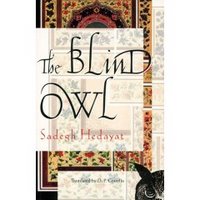 banned
The clampdown has been headed by the hardline culture minister, Mohammed Hossein Saffar Harandi, a former revolutionary guard and close ally of Mr Ahmadinejad. Opening Iran's national book week festival this week, he said a tougher line was needed to stop publishers from serving a "poisoned dish to the young generation". He said some books deliberately gave Iranians a sense of inferiority and encouraged them to be lackeys of the west. "We have complaints against those who see books as only a market and are acting as assistants for evil," he said. "Sometimes the humiliation of Iranian youth is implied or suggested in the books. Sometimes the media transmits the concept that we Muslims and easterners lack proper means and, therefore, we should stretch our hands towards others."
His comments followed the publication of a parliamentary report that attacked Mr Khatami's presidency for creating what it said was a climate encouraging immoral behaviour, sex before marriage, mockery of religious traditions and secularism. One of the report's authors, Javad Aryianmanesh, vice-chairman of the parliamentary culture committeea said: "Due to cultural indulgence necessary supervision over artistic and cultural works did not take place."
The rise in book censorship mirrors repression in other spheres. In September the reformist newspaper Shargh was closed after publishing a cartoon depicting President George Bush, disguised as a horse, debating with a donkey under a halo, widely seen as representing Mr Ahmadinejad. The publishers launched a replacement newspaper, Rouzegar, but it was ordered to close after five days.
Iran censorship
Newly banned books include Farsi translations of Tracy Chevalier's best-seller Girl With a Pearl Earring and Dan Brown's The Da Vinci Code, the latter for upsetting clerics within Iran's tiny Christian community. Chevalier's novel had completed six print runs in Iran and earned hefty profits for its local publisher, Cheshme.
 banned
The crackdown also covers classics, such as William Faulkner's As I Lay Dying, and scores of works by Iranian authors, including all works by Sadegh Hedayat, a pre-revolutionary novelist and commentator whose books are renowned in several European countries. His short novel, the Blind Owl is a masterpiece. Some Iranian writers have vowed to withhold future books for publication.
 banned
The clampdown has been headed by the hardline culture minister, Mohammed Hossein Saffar Harandi, a former revolutionary guard and close ally of Mr Ahmadinejad. Opening Iran's national book week festival this week, he said a tougher line was needed to stop publishers from serving a "poisoned dish to the young generation". He said some books deliberately gave Iranians a sense of inferiority and encouraged them to be lackeys of the west. "We have complaints against those who see books as only a market and are acting as assistants for evil," he said. "Sometimes the humiliation of Iranian youth is implied or suggested in the books. Sometimes the media transmits the concept that we Muslims and easterners lack proper means and, therefore, we should stretch our hands towards others."
His comments followed the publication of a parliamentary report that attacked Mr Khatami's presidency for creating what it said was a climate encouraging immoral behaviour, sex before marriage, mockery of religious traditions and secularism. One of the report's authors, Javad Aryianmanesh, vice-chairman of the parliamentary culture committeea said: "Due to cultural indulgence necessary supervision over artistic and cultural works did not take place."
The rise in book censorship mirrors repression in other spheres. In September the reformist newspaper Shargh was closed after publishing a cartoon depicting President George Bush, disguised as a horse, debating with a donkey under a halo, widely seen as representing Mr Ahmadinejad. The publishers launched a replacement newspaper, Rouzegar, but it was ordered to close after five days.
Iran censorship
Ferenc Puskas RIP
 Hungarian football legend Ferenc Puskas, has died aged 79 after a long battle against pneumonia. He had been in intensive care at a Budapest hospital for two months but had also been confined to hospital for six years with Alzheimer's disease.
He led his country's 'Golden Team' of the early 1950s, and was part of the first foreign side to beat England at Wembley, winning 6-3 on 25 November 1953 . Prolific both domestically and on the international scene, Puskas scored 83 times in 84 matches for Hungary between 1945 and 1956, including two goals in the Magical Magyars' famous match against England. He also starred in a subsequent 7-1 win in Budapest which saw Hungary made favourites for the 1954 World Cup, but an injury limited his impact in Switzerland and they lost in the final to Germany.
Puskas scored 512 goals in 528 matches for Real Madrid from 1958 and in 1962 he took out Spanish citizenship in time to play for his adopted country at the 1962 World Cup. Playing alongside Alfredo di Stefano, he was the cornerstone of a succession of domestic and European glories, scoring four goals in Real's 7-3 win over Eintracht Frankfurt in a remarkable final at Hampden Park in 1960, and winning the European Cup three times in all.
Real Madrid president Ramón Calderón added: "This is one of the saddest days for the Madrid fans, He had many friends and was a man liked by everyone, admired as a professional and a person. The Madrid fans in general, and those of my age in particular, will feel a great emptiness for the loss of one our childhood heroes."
Puskas was truly one of the greats of the game. Click here for a fuller biography.
Ferenc Puskas football
Channel 4 finally has the spine to broadcast Saddam’s Road to Hell
Back in July, I picked up on an Observer article by Nick Cohen regarding a film called
Saddam’s Road to Hell. Made by reporter Gwynne Roberts it focuses on massacre of 800 Barzani clan members as a collective punishment for the Kurdish revolt against Saddam.
The film follows Mohammed Ihsan, Kurdistan's Human Rights Minister, as he sets off to find the bodies of the dead. His journey takes him to backstreet shops where lawyers looking for evidence can buy documents looted from secret police archives, skeletons being dug out of mass graves in the desert and snuff videos of torturers blowing up prisoners or throwing them from rooftops. All the time the threat of assassination hangs over the investigation.
 a victim of the Barzani clan massacre
After sitting on it for months Channel 4 finally shows some backbone and will broadcast this film on Monday 20 November at 8pm. Why Channel 4 has not shown it before is incomprehensible but it is good to see that it has given it a prime time slot.
If you cannot get to see the Channel 4 showing The Road to Hell is to view here. I would highly recommend you watch it: its facts have been triple-checked, the producers present other points of view and the reporter shrinks into the background allowing Iraqis to speak for themselves.
Saddam Barzani massacre
Saddam’s Road to Hell. Made by reporter Gwynne Roberts it focuses on massacre of 800 Barzani clan members as a collective punishment for the Kurdish revolt against Saddam.
The film follows Mohammed Ihsan, Kurdistan's Human Rights Minister, as he sets off to find the bodies of the dead. His journey takes him to backstreet shops where lawyers looking for evidence can buy documents looted from secret police archives, skeletons being dug out of mass graves in the desert and snuff videos of torturers blowing up prisoners or throwing them from rooftops. All the time the threat of assassination hangs over the investigation.
 a victim of the Barzani clan massacre
After sitting on it for months Channel 4 finally shows some backbone and will broadcast this film on Monday 20 November at 8pm. Why Channel 4 has not shown it before is incomprehensible but it is good to see that it has given it a prime time slot.
If you cannot get to see the Channel 4 showing The Road to Hell is to view here. I would highly recommend you watch it: its facts have been triple-checked, the producers present other points of view and the reporter shrinks into the background allowing Iraqis to speak for themselves.
Saddam Barzani massacre

16 November 2006
I want one of these NOW!
I know this story is a couple of days old but this is very possibly the greatest scientific advance of all time.
Engineers in Australia have developed a new T-shirt which enables the wearer to play air guitar and create real noise in the process. Richard Helmer and a team of researchers at the Commonwealth Scientific and Industrial Research Organisation (CSIRO), Australia's national science agency, fashioned the "wearable instrument shirt" out of an ordinary T-shirt fitted with an array of sensors.
The built-in technologies measure the movements of the wearer, allowing them to "play" by moving one hand to mimic guitar chord patterns and using the other to pluck virtual strings. The shirt is hooked up to a computer that is able to read the signals and turn them into guitar sounds. The researchers say it allows anyone to thrash out their impressions of Led Zeppelin without ever picking up a real guitar.
"It's an easy-to-use virtual instrument that allows real-time music making, even by players without significant musical or computing skills. It allows you to jump around, and the sound generated is just like an original MP3," said Dr Helmer.
Anything that enhances the air guitar experience surely deserves the Nobel prize - the Nobel prize for RAWK N ROLL!
Engineers in Australia have developed a new T-shirt which enables the wearer to play air guitar and create real noise in the process. Richard Helmer and a team of researchers at the Commonwealth Scientific and Industrial Research Organisation (CSIRO), Australia's national science agency, fashioned the "wearable instrument shirt" out of an ordinary T-shirt fitted with an array of sensors.
The built-in technologies measure the movements of the wearer, allowing them to "play" by moving one hand to mimic guitar chord patterns and using the other to pluck virtual strings. The shirt is hooked up to a computer that is able to read the signals and turn them into guitar sounds. The researchers say it allows anyone to thrash out their impressions of Led Zeppelin without ever picking up a real guitar.
"It's an easy-to-use virtual instrument that allows real-time music making, even by players without significant musical or computing skills. It allows you to jump around, and the sound generated is just like an original MP3," said Dr Helmer.
Anything that enhances the air guitar experience surely deserves the Nobel prize - the Nobel prize for RAWK N ROLL!
Rosindell, evangelists and an Early Day Motion
Last week’s Romford Recorder carried an article titled “MP unmoved by ‘evil’ Islam row”. Unfortunately I missed last week’s Recorder and the online edition has only a small part of the article. Always willing to bash my poltroon of an MP I was curious to find out what this story was about. Apparently it is about an evangelical charity which may put evangelism above charity and whose head is not averse to making intemperate comments about Islam.
On 25 October Liberal Democrat MP Timothy Farron tabled an Early Day Motion (EDM) celebrating the work of Operation Christmas Child:
“That this House celebrates the Operation Christmas Child shoebox appeal run by Samaritan's Purse, which arranges for families in the UK to provide a sealed shoebox of Christmas gifts to be sent to children overseas who are less fortunate; congratulates the Westmorland Gazette for promoting this campaign in South Cumbria; and encourages hon. Members to take part in the scheme and to promote the appeal in their constituencies.”
Andrew Rosindell was one of a number of MPs that signed this motion presumably in the wish to be associated with a good cause. On the surface this seems to be a harmless enough motion even if the motivation of some of the signatories may have been self-serving.
Operation Christmas Child, an initiative of Samaritans Purse International(SPI) seems worthy in that it aims to distribute millions of shoe boxes filled by volunteers with sweets and gifts to underprivileged children in Eastern Europe and Africa. However, there have been allegations that the organisation’s motives are not quite as altruistic as it seems.
In 2002 the Guardian reported that its activities came with strings – the main objective being “…about more than Christmas presents. It is about introducing children and their families to God's greatest gift - His Son, Jesus Christ” according to the organisation’s head, Franklin Graham (son of Billy). The Rev David Applin, chief executive of Samaritan’s Purse, admits that a religious pamphlet - is distributed with the boxes but no box recipient is forced to accept religious literature and none is distributed in Muslim countries. However, in 2001, the charity was criticised in a New York Times article for holding prayer sessions in several villages in El Salvador before showing residents how to build emergency shelters following an earthquake.
Graham has condemned Islam on a number of occasions: In his 2002 book, The Name, he wrote: "The God of Islam is not the God of the Christian faith. The two are different as lightness and darkness."
When becoming aware of Graham’s views at least one MP withdrew his signature. Rosindell on the other hand apparently stated he supported the charity's work but that he could not be expected to check the bona fides of every group he endorsed in an EDM. (This is a person who put down one marking the return of Rupert Bear to British TV).
Leaving Rosindell aside I have a huge problem with any charity that would even consider using its work to proselytise, something that well respected charities such as Christian Aid or CAFOD would never do. If it is true that that SCI has ever attached any strings to its aid then it is ultimately self defeating unless you wish to create “Rice Christians”.
On 25 October Liberal Democrat MP Timothy Farron tabled an Early Day Motion (EDM) celebrating the work of Operation Christmas Child:
“That this House celebrates the Operation Christmas Child shoebox appeal run by Samaritan's Purse, which arranges for families in the UK to provide a sealed shoebox of Christmas gifts to be sent to children overseas who are less fortunate; congratulates the Westmorland Gazette for promoting this campaign in South Cumbria; and encourages hon. Members to take part in the scheme and to promote the appeal in their constituencies.”
Andrew Rosindell was one of a number of MPs that signed this motion presumably in the wish to be associated with a good cause. On the surface this seems to be a harmless enough motion even if the motivation of some of the signatories may have been self-serving.
Operation Christmas Child, an initiative of Samaritans Purse International(SPI) seems worthy in that it aims to distribute millions of shoe boxes filled by volunteers with sweets and gifts to underprivileged children in Eastern Europe and Africa. However, there have been allegations that the organisation’s motives are not quite as altruistic as it seems.
In 2002 the Guardian reported that its activities came with strings – the main objective being “…about more than Christmas presents. It is about introducing children and their families to God's greatest gift - His Son, Jesus Christ” according to the organisation’s head, Franklin Graham (son of Billy). The Rev David Applin, chief executive of Samaritan’s Purse, admits that a religious pamphlet - is distributed with the boxes but no box recipient is forced to accept religious literature and none is distributed in Muslim countries. However, in 2001, the charity was criticised in a New York Times article for holding prayer sessions in several villages in El Salvador before showing residents how to build emergency shelters following an earthquake.
Graham has condemned Islam on a number of occasions: In his 2002 book, The Name, he wrote: "The God of Islam is not the God of the Christian faith. The two are different as lightness and darkness."
When becoming aware of Graham’s views at least one MP withdrew his signature. Rosindell on the other hand apparently stated he supported the charity's work but that he could not be expected to check the bona fides of every group he endorsed in an EDM. (This is a person who put down one marking the return of Rupert Bear to British TV).
Leaving Rosindell aside I have a huge problem with any charity that would even consider using its work to proselytise, something that well respected charities such as Christian Aid or CAFOD would never do. If it is true that that SCI has ever attached any strings to its aid then it is ultimately self defeating unless you wish to create “Rice Christians”.
Subscribe to:
Posts (Atom)